



The Jewish Traveler


Milan’s Jewish Past, Present—and Olympic Future
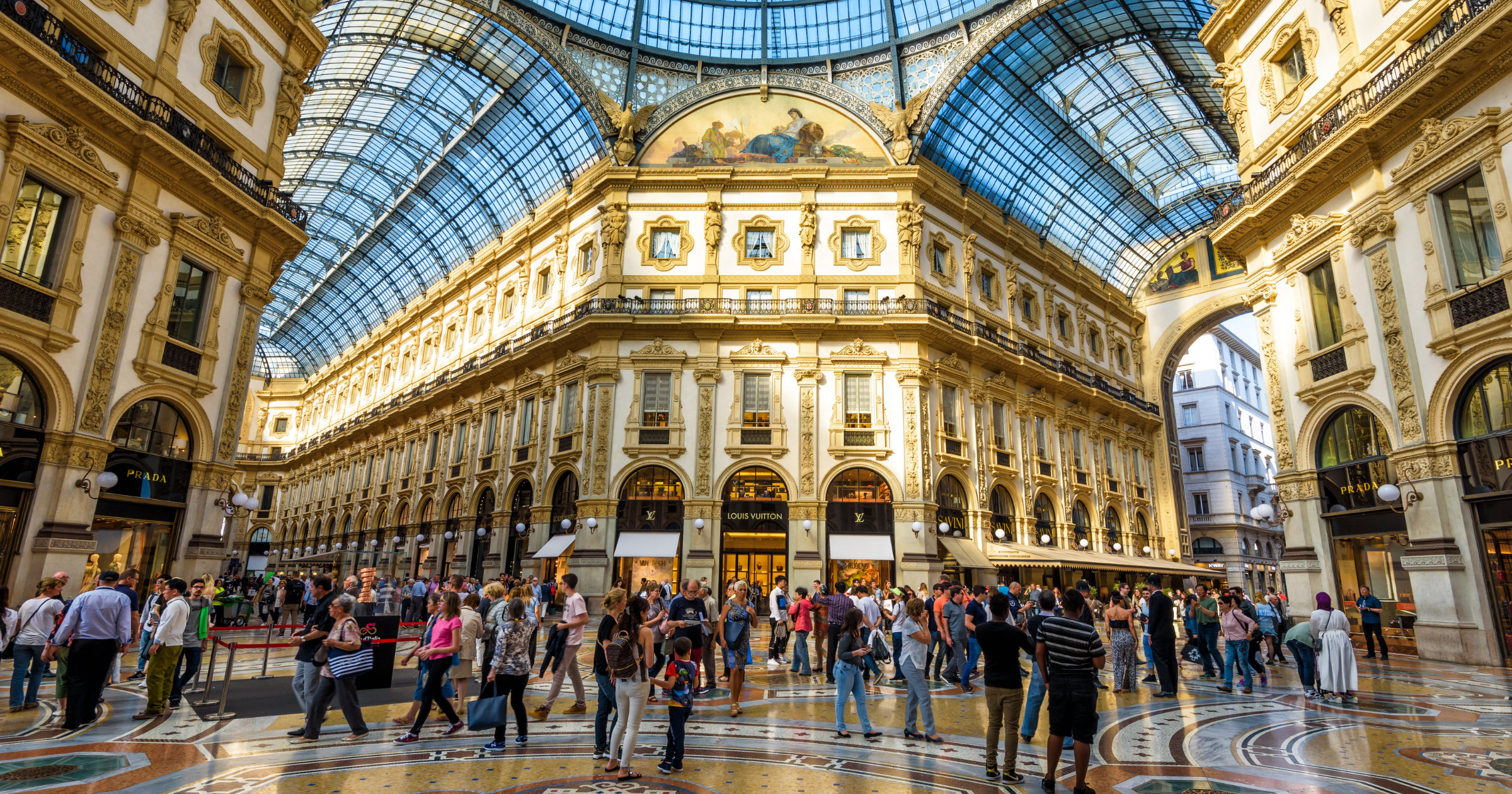
They call Rome the Eternal City, but Italy’s second-largest city, Milan, makes a strong case for the title as well. That was my thought last August when I found myself in front of the massive, ornate Milan Duomo. The monumental scale of both the cathedral and the surrounding city struck me as I stepped out of the Sinagoga Centrale, with its quirky turquoise façade, and strolled to the Duomo across the luxurious lawns and lily ponds of the Giardini della Guastalla.
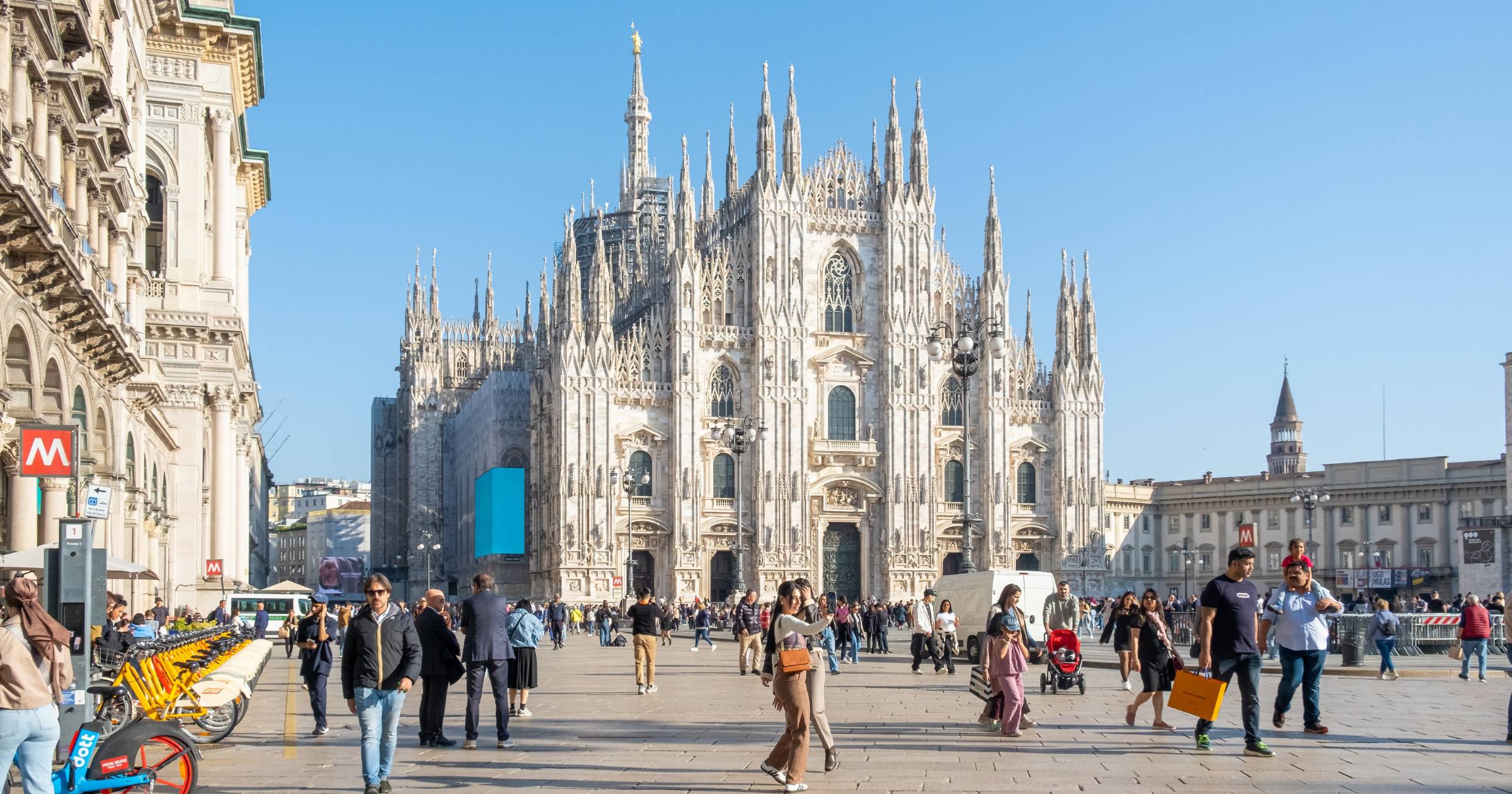
Around the corner in the Piazza del Duomo—Milan’s central square—the triumphal arch of the Galleria Vittorio Emanuele has welcomed well-heeled shoppers for 150 years. Just north, music lovers can visit the internationally renowned La Scala opera house and, a bit west, art enthusiasts can try to score tickets to see Leonardo da Vinci’s famous painting, The Last Supper, at the Basilica di Santa Maria delle Grazie.
And then there is the Cimitero Monumentale north of the Duomo. The mausoleum-filled cemetery has a Jewish section—established in the 1870s to replace several existing Jewish burial grounds—that is still in use and features statuary and tombs honoring nearly 2,000 souls. These include memorials to victims of the Holocaust as well as the Lombardian Jews murdered by the Nazis in what are known as the Lake Maggiore massacres of 1943. In September and October 1943, after Italy’s surrender to the Allies and the ousting of Fascist dictator and Axis leader Benito Mussolini, a division of the SS defied orders not to harm citizens and murdered 56 Jews, many of whose bodies were disposed of in Lake Maggiore.
Architectural grandeur is what you’d expect to see in the capital of Italy’s wealthy Lombardy region, with its more than six million inhabitants. Yet amid all the stunning sights, what also struck me was that, outside of the touristy area where I was staying—Naviglio, a picturesque but mosquito-infested canal district—Milan in August is just as depopulated and quiet as most Italian cities during the summer.
Let Miami become a year-round destination, let the shops of Barcelona open on Sundays, let Mexico City’s dining spots offer English-language menus—all signs of our changing times and our globalized world. The Milanese want no part of that.
Indeed, local inhabitants have sacred traditions, and a lot of them revolve around the calendar: the fiscal year (Milan is Italy’s banking capital), the spring and fall fashion weeks, and the August vacanze flight to somewhere less humid.
This year, the calendar has expanded to include the Winter Olympics. Milan is the host city for the 2026 games, which begin February 6. Sporting events will be held throughout Lombardy as well as in neighboring Veneto, where the Cortina D’Ampezzo ski resort in the Italian Alps will showcase the slopes’ events. A highlight for those watching for Jewish athletes will be Israel’s bobsled and skeleton team, whose members include Boston-born captain AJ Edelman as well as other Jewish and Arab athletes.
One thing Milan doesn’t have is a historic Jewish neighborhood. The synagogues, community centers and youth programs serving the metro area’s roughly 5,000 Jewish residents—down from a high of 12,000 before the Holocaust—are distributed throughout the city (and the region, including the nearby urban centers of Bergamo and Brescia).
Yet Jewry is an ancient and integral part of Milan. Hebrew inscriptions unearthed by archaeologists reveal a Jewish presence that dates to Roman times, including evidence of a fourth-century synagogue—and its mandated destruction by local authorities.
The first well-documented Jewish community coalesced in the 13th century, when a series of ruling dukes granted rights that elevated Jews to positions of power, including, in the 1400s, Elia di Sabato da Fermo, the personal court physician to Duke Filippo Maria Visconti.
But later dukes reversed course. With the Inquisition in full swing across Catholic Southern Europe, officials expelled the Jews from Milan in the 1490s and restricted Jewish residency and freedoms in the surrounding territory. A century later, Holy Roman Emperor Charles V expelled Jews from the region entirely.
The upheavals of 19th-century Europe—revolutions, national consolidations and urbanization—gave a new opening to Jews, who resettled the Milanese community and established a congregation in 1840. In 1870, the newly formed Kingdom of Italy granted full rights to Jews, who by then numbered 700 in Milan.
Fifty years later, that number had risen to 4,500, fortified by immigration from across Southern Europe, and by the time World War II began, had more than doubled with the arrival of those from Eastern Europe. All that came to a halt during the Holocaust when, under Mussolini, Milan’s central railway station became a major transit point to deport Italian Jews to death camps.
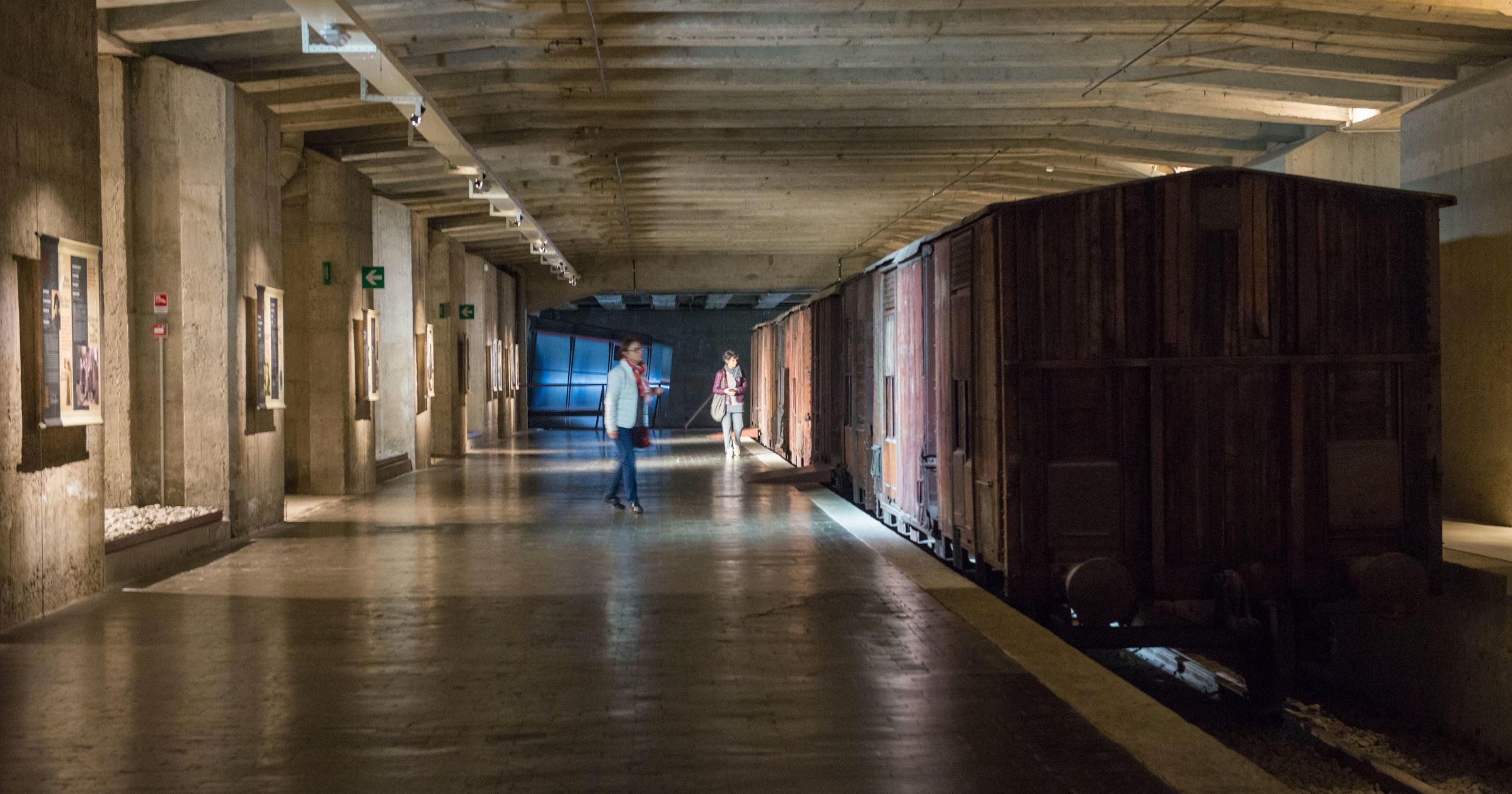
Today, the subterranean track used for those purposes, known as Binario (“track”) 21, forms the centerpiece of Milan’s main Holocaust memorial. Built around a hub of the railway network that transported approximately 1,200 Jews to death camps, the memorial features an eerie descent from the columned entrance—branded with the word “Indifferenza” (“indifference”) in 6-foot-high letters—historical exhibits and an underground labyrinth of passages.
After the war, the community began to rebound, resettled first by displaced Jews from across Europe, then by waves of Middle Eastern Jewish refugees and émigrés from North Africa. Milan also regularly hosts prominent foreign Jews, many in banking and fashion. Over the years, its fashion week has helped boost the careers of myriad foreign designers, such as Daizy Shely, an Israeli-born protégé of the late Giorgio Armani who is now based here.
Milan, in other words, is a city of and for newcomers and innovators.
And this winter, if the Israeli bobsled team is any indication, Milan may become the literal launchpad for a new generation of Jewish trailblazers.
IF YOU GO
The Duomo is Milan’s central monument to Catholicism. Among the numerous marble statues and reliefs adoring its exterior, however, are scenes from the Hebrew Bible, such as Daniel with the lions, Joseph and Potiphar’s wife, Judith beheading Holofernes, Esther with King Ahasuerus and many others. Meanwhile, some of the cathedral’s most spectacular stained-glass windows were designed by an artist with Jewish ancestry. Aldo Carpi, who passed away in 1973, is best known today for his memoirs of his imprisonment at the Mauthausen concentration camp, where he survived by painting portraits of Nazi officers. His “Stories of David” panel of windows at the Duomo, begun in 1934, was completed and installed after his liberation.
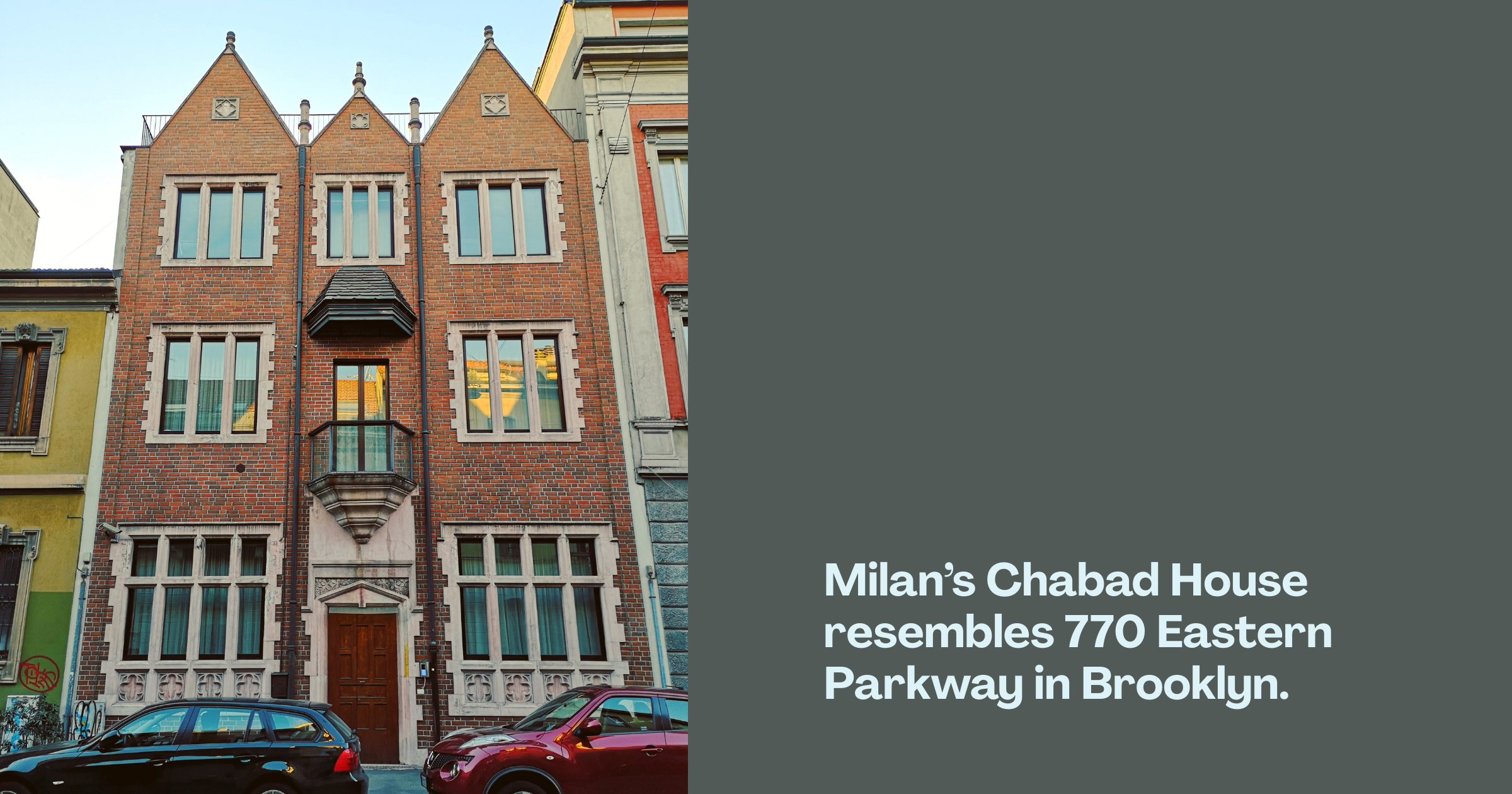
Milan is home to more than a half-dozen synagogues and minyanim, ranging from traditional Orthodox congregations to the liberal Lev Chadash and Congregation Beth Shalom. Beth Shalom, which was established in 2002 by a group of American, British and Italian residents, has traditionally hired American Reform clergy and hosted Italy’s first-recorded interfaith wedding under a chuppah. The city also hosts one of the many international Chabad Houses whose architecture replicates the design of 770 Eastern Parkway in Crown Heights, Brooklyn, which was the headquarters and home of the late Rebbe Menachem Mendel Schneerson.
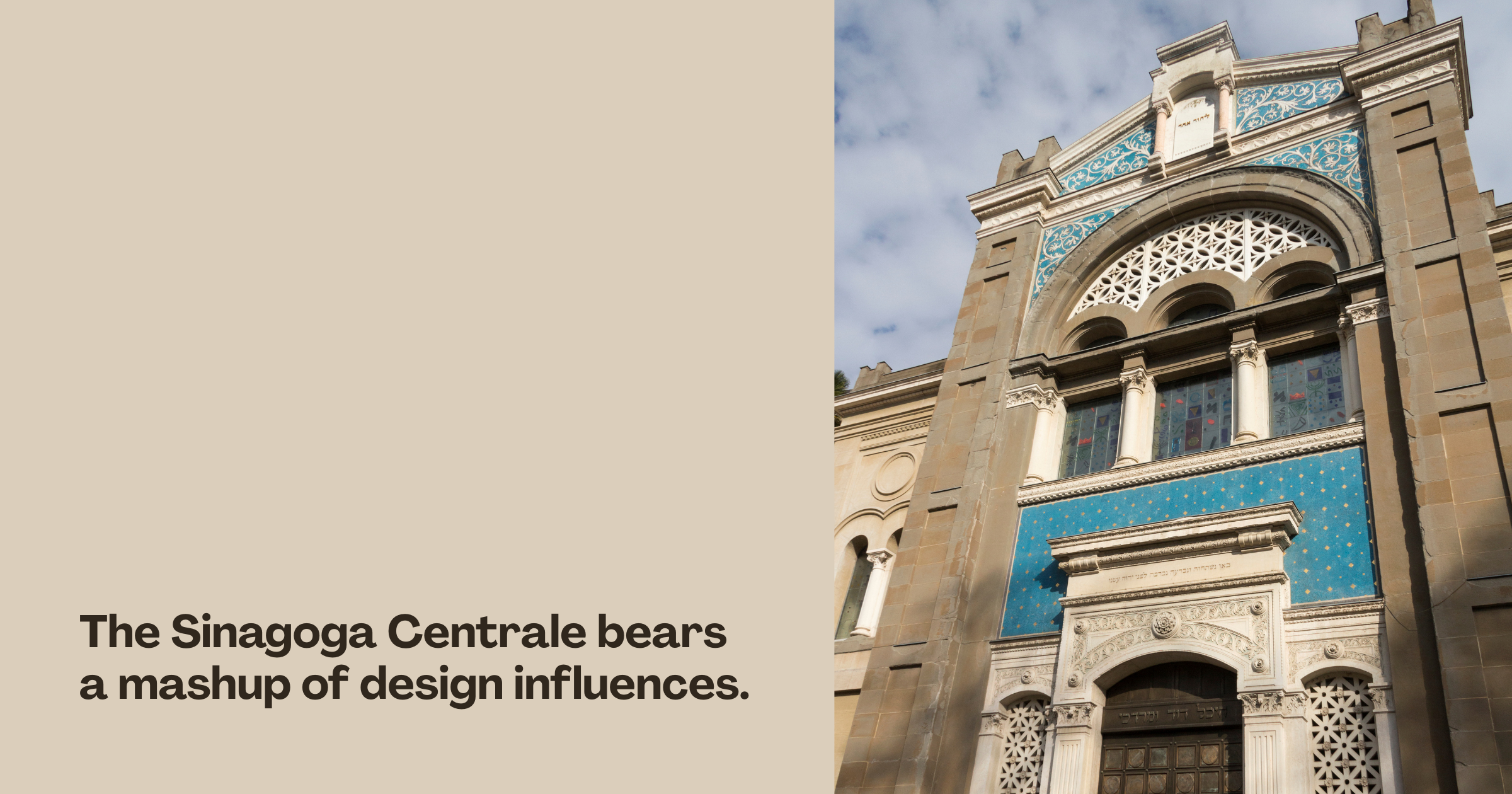
The august Sinagoga Centrale, which offers distinct Orthodox services that follow Sephardi and Italian rites, also has an American connection: Its quirky stained-glass windows—handmade in Murano for the building’s 1997 renovation—were designed by New York artist Roger Selden and feature simple images of menorahs, shofars and lulavs. The Orthodox congregation was built in the 1890s to accommodate Milan’s growing Jewish population, and along with those windows, its façade is an arresting mashup of influences: Moorish-style arches, geometric patterns and blue-and-white floral motifs.
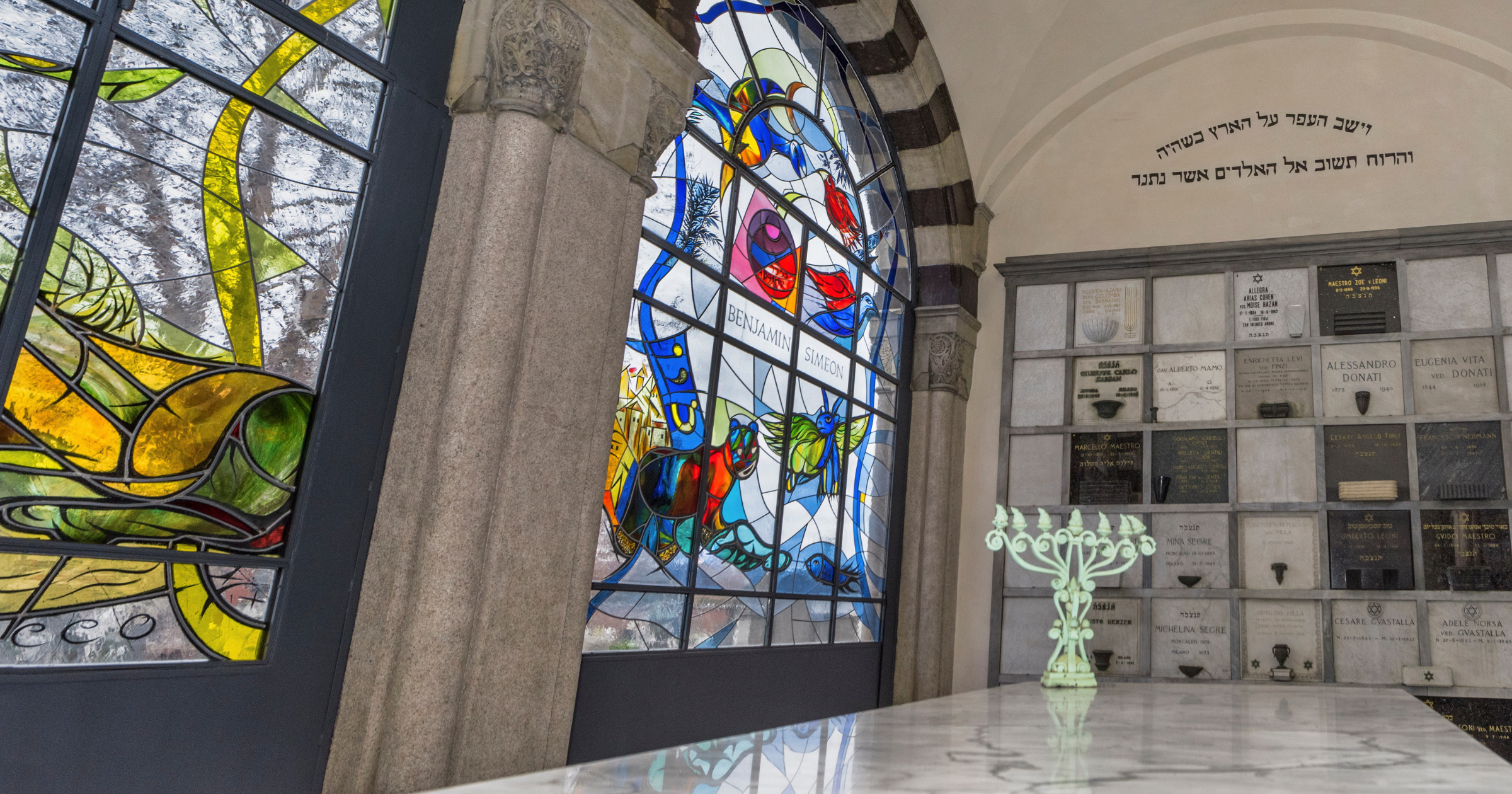
The Cimitero Monumentale’s prominent Jewish section (closed on Shabbat) illuminates the growth of Milan’s Jewish community from the turn-of-the-last-century through the Shoah and beyond. Among the monuments are miniature temples, statues of lions and marble tree trunks in the children’s area. The central building’s colorful stained-glass windows were added in 2014 by artist Diego Penacchio Ardemagni as an homage to Marc Chagall’s windows of the Twelve Tribes of Israel installed in the Abbell Synagogue at Hadassah Hospital Ein Kerem in Jerusalem.
Don’t miss the Pinacoteca di Brera, Milan’s top art museum. In the galleries, look for paintings by Antonietta Raphaël, a Lithuanian-born rabbi’s daughter who settled in Rome in the 1920s, and her Roman Jewish husband, Mario Mafai. Together they founded the interwar Scuola Romana movement of dramatic Expressionist painting. When you finish your art crawl, the boutiques and cafés of the museum’s surrounding cobblestoned Brera neighborhood, where gelato is served with whipped cream on top, are a delight to explore.
Lombardy is the birthplace of risotto. Kosher diners will find the saffron-scented risotto milanese on the menu at Ba’Ghetto, whose Milan outpost is part of an Italian kosher meat chain that also hosts Italian Jewish cooking classes in English. At Denzel, kosher diners can sample the quintessentially Lombardian tagliata steak, grilled and sliced and usually drizzled with olive oil. And notable Milan dishes arancini di riso (fried risotto balls) and spaghetti with saffron are the highlights at Carmel, an upscale kosher dairy eatery.
Hilary Danailova writes about travel, culture, politics and lifestyle for numerous publications.
 Facebook
 Instagram
 Twitter

Sher Rosenthal says
member #1252697
Can your suggest any Jewish tour guides for Milan – preferably a group to join or if necessary a contact for a private reasonably priced guide.
Thanks,
We will be there May 4-6