



Arts
Film


New Doc Celebrates Israeli Olympian Swimmer’s Comeback
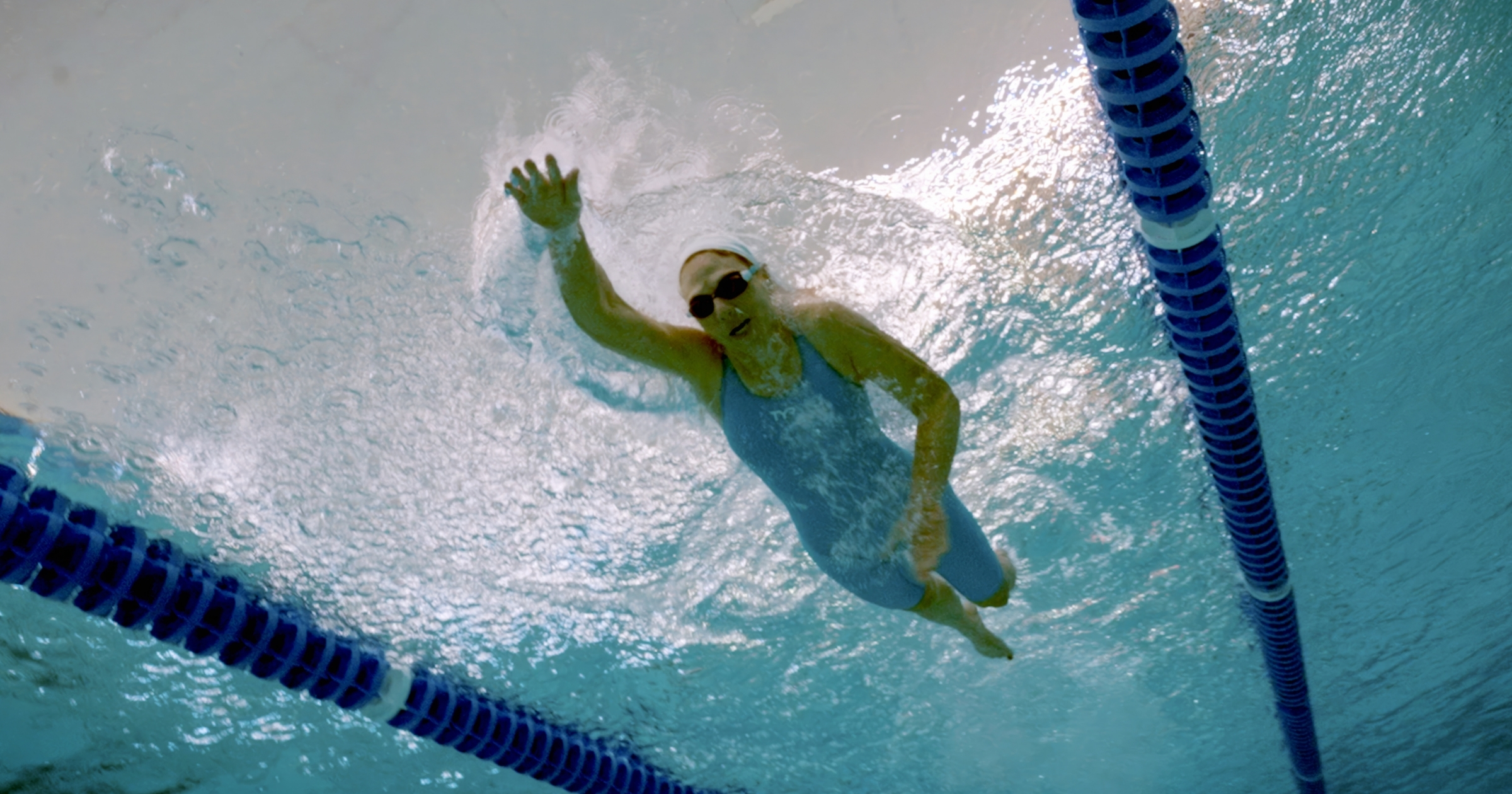
When former competitive swimmer and documentary filmmaker Michele Kuvin Kupfer set out to make a sports film several years ago, she initially planned to focus on the Maccabiah Games, the “Jewish Olympics” for athletes around the world held in Israel every four years. Instead, she narrowed her focus when making Parting the Waters, a film that chronicles her efforts, at age 59, to return to competitive swimming at the 2022 Maccabiah Games after a 40-year absence.
This is not your typical sports movie. The film offers a window not only into competitive swimming but also into Kupfer’s life and Jewish identity. Through archival footage, home movies, interviews and her own narration, Kupfer confronts personal challenges, including her now adult son’s health battles and the death of her best friend and former teammate from cancer. Ultimately, Parting the Waters is about finding “bubbles of possibility,” the director said in a Zoom interview from her home in Washington, D.C.
In the film, those bubbles serve as metaphors for hope and motivation. “They represent the idea that it’s never too late to try and reinvent yourself,” she said.
Still on the film festival circuit in the United States, Parting the Waters will be screened in Israel this summer.
“I’ve been working with Michele for years,” said Austin Kase, a co-producer of the film, along with Marc Levy and Marc Salomon, “but Parting the Waters feels like a true culmination for her as both a filmmaker and a human being. I’m in awe of her bravery—her willingness to open old wounds and lay her heart bare.”
Kupfer grew up in Palm Beach, Fla., at a time when the sundrenched barrier island was rife with antisemitism. In the film, she recounts how her father, the area’s only physician, treated wealthy residents in their homes and at country clubs that barred Jews.
Her father’s successful medical practice allowed the family to split their time between Israel and the United States. In 1976, her father opened the Kuvin Center for the Study of Infectious and Tropical Diseases at Hebrew University. Around the same time, her mother—and later Kupfer and her sisters—became lifetime members of Hadassah.
“Hadassah is integral to my life,” she said. “Growing up, Henrietta Szold sat in my head alongside Golda Meir—two strong women with purpose.”
At 14, Kupfer joined the swim team at the Jerusalem YMCA and began the training that elevated her to elite athlete. Her ascent culminated in a spot on the 1980 Israeli Olympic swim team, to be held in Moscow. But after the Soviet Union invaded Afghanistan, Israel joined the boycott of the summer games.
“My identity was ripped away from me, I wanted to quit swimming forever,” she says in the film. Instead, she refocused and earned medals in the 200-, 400- and 800-meter races at the 1981 Maccabiah Games in Jerusalem.
The film traces Kupfer’s life after she left competitive swimming, including her work as a behavioral therapist as well as her marriage and three children. When her youngest son, Zev, was diagnosed with a brain tumor at 5, her focus narrowed to keeping him alive.
During the Covid pandemic, Kupfer said, she experienced an epiphany: She felt her most genuine self in the water. She decided to compete at the 2022 Maccabiah Games and won eight medals at the games—seven gold and one silver—and set a new Israeli record in the 400-meter freestyle.
In the film’s closing shots, Kupfer slices through the water once more. “I’m a swimmer,” she says in the voiceover. “I will always be.”
Cathryn J. Prince is a freelance journalist and the author of For the Love of Labor: The Life of Pauline Newman.
 Facebook
 Instagram
 Twitter
Leave a Reply