




Books
Hadassah


New Yiddish Books and Memoirs From Hadassah Members
We Will Not Be Hijacked: A Life Story of Survival
By Uri Bar-Lev. Translated by Anastasia Torres-Gil (Braughler Books)

September 6, 1970, was a pivotal day in international civil aviation. That year had been marked by a record number of plane hijackings, and on that single day there were four coordinated attacks on planes bound for the United States by the Palestinian terror group PFLP (Popular Front for the Liberation of Palestine). Only one of those attempts was unsuccessful: El Al Flight 219, en route from Amsterdam to New York City.
Captain Uri Bar-Lev and his crew thwarted the hijacking midair. It is believed to be the only instance in which a pilot defeated an attempted hijacking at 30,000 feet.
In his memoir, We Will Not Be Hijacked, Bar-Lev recounts the split-second decisions and harrowing moments aboard the flight. He describes how two terrorists armed with guns and grenades tried to take over. One of them was Leila Khaled, a Palestinian terrorist whose image has been used in anti-Israel protests since October 7, 2023.
Acting quickly, Bar-Lev threw the plane into a steep dive. The sudden drop in altitude and air pressure made a potential explosion from a grenade less dangerous and sent the hijackers crashing to the floor. An Israeli air marshal killed one of the hijackers, and Khaled lost consciousness due to the dramatic shift in air pressure. She was arrested after the plane landed in London. (She was later released as part of the demands tied to a successful hijacking.)
We Will Not Be Hijacked begins with descriptions of Bar-Lev’s life in pre-state Israel on the fledgling agricultural moshav of Avihayil, founded by his parents. He joined the Palmach, the elite military strike force of pre-state Israel, and flew missions as a 16-year-old during the 1948 War of Independence and later during the 1956 Sinai war, before becoming one of the first pilots for El Al, Israel’s national carrier.
“While I am grateful that I lived during these turbulent times, I do not delude myself,” Bar-Lev writes. “I know full well that the Israel of today is not the same as the Israel in which I grew up. ‘Man is a landscape of his homeland,’ wrote the Israeli poet Shaul Tchernichovsky. And my life has followed the dynamic pattern of my homeland.”
Now in his mid-90s, he still lives in Avihayil in central Israel and gives talks about his life and experiences. This fascinating memoir, filled with details of the early days of Israel, its struggles and triumphs, is beautifully translated into English by Anastasia Torres-Gil, a former member of the Hadassah National Board and a current board member of the Hadassah Foundation.
Bar-Lev’s memoir has another Hadassah connection, according to Torres-Gil: Faye Schenk, Hadassah national president from 1968 to 1972, was a passenger on El Al Flight 219. In a Hadassah Magazine President’s Column from October 1970, Schenk shared her experience, urging then-President Richard Nixon to find ways to release the hostages taken on other flights; the column also notes that Schenk had been seated next to one of the terrorists.
Kvell: A Word You Should Know
By Barbara Edelston Peterson (Post Hill Press)
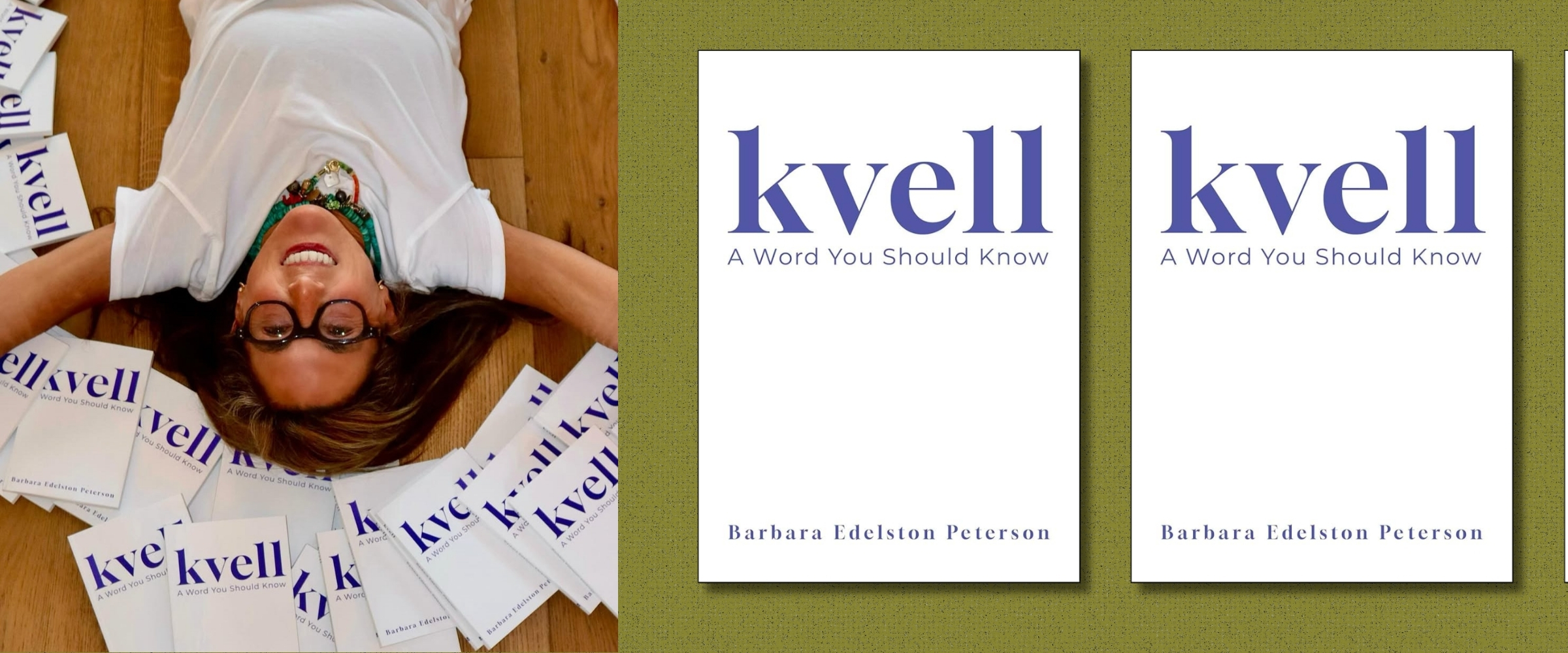
You don’t have to be a linguist or even Jewish to understand the Yiddish word kvell, meaning to express happiness or burst with pride over someone’s accomplishments. In Kvell: A Word You Should Know, Barbara Edelston Peterson presents kvelling as “a love language” for everyone, from child to adult.
“It’s such a simple way to communicate with a beautiful effect,” she writes. “It’s spontaneous, genuine, and freeing—all through a touch on the shoulder, a wink of the eye, a smile bubbling into a cheer, or a compliment.”
“Kvelling,” she continues, “encourages self-belief, leads to initiative, and brings out human capability, from one person to another.”
Which is why Peterson, an author, sports psychologist and motivational speaker as well as a Hadassah member in California, wants the term to become part of the lingua franca of American speech. She bemoans that negative Yiddish terms, like oy vey and kvetch, are more commonly used by both Jews and non-Jews. Kvell, she writes, is the opposite of kvetch, and inspires a surge of positive emotion.
To buttress her claims, the author cites a study published in the journal Social Cognitive and Affective Neuroscience, which used MRI scans to show that receiving affirmation—even self-affirmation—activates the brain’s reward centers. The act of kvelling releases endorphins, boosts immune function and reduces stress.
So, shouldn’t we all kvell now?
As this short, breezy book makes clear, kvelling can be beneficial in many circumstances, but it does not override human nature. Some people are depressed and require other solutions; others simply don’t want unsolicited advice or praise; and some people are, frankly, sourpusses.
If your aim is to instill pride and inspire success, however, then kvelling may indeed help.
Mamaleh: A Legacy of Loss and Love
By Elaine Culbertson (Tursulowe Press)

The Yiddish word mamaleh, meaning little mother, is often used affectionately toward children or grandchildren. In this poignant two-part memoir, author Elaine Culbertson recounts both her own life growing up in Brooklyn and, later, in Philadelphia as the daughter of two survivors, and that of her Polish-born mother, Dore Freilich. As a form of catharsis and a way of processing the two years she spent in Auschwitz, Freilich wrote down her experiences on scraps of paper, both during the war and in the years that followed, as she started a new life in the United States.
The book opens with an image of one of those scraps, bearing a poem written by Frielich in Yiddish: “And how shall I mourn for you on this memorial day/ There are too few candles and not enough prayers/ Perhaps from the sky I will gather the stars/ And they will become your memorial candles/ For you and for your burned communities/ For what remains after war but candles and prayers.”
Throughout the book, Culbertson—a Hadassah member active in the Dona Gracia chapter in Philadelphia—includes quotes from these scraps, set in italics. In them, Freilich recalls the loss of her entire family, grandparents, aunts, uncles and cousins—all murdered by the Nazis.
“I mourned for them although I never knew them,” Culbertson writes. “I was the replacement mother, the replacement sister. Stories of hunger and deprivation substituted for fairy tales in my childhood.”
Culbertson describes how, as a child, she would hide under the table as the older generation sat eating potatoes and herring and sharing accounts from the old country alongside their stories of survival. She would often fall asleep there, staring at the different shoes belonging to different family members—her father’s oxfords, the various heels of the women.
“We are a shoe family,” she writes.
Indeed, her paternal grandfather owned a shoe factory in Poland, and her father crafted specialty shoes for polio sufferers and eventually opened his own shoe store.
He did well enough to take the family to a bungalow colony in the Catskills to escape the summer heat.
Until she was in her 20s, Culbertson continued to speak Yiddish with her mother. She considered it a kind of inheritance her friends did not have.
“I can still hear her voice in my head as she complimented someone’s baby,” she writes, “and then said, ‘Pooh, pooh, pooh,’ to ward off the evil eye.”
Stewart Kampel was a longtime editor at The New York Times.
 Facebook
 Instagram
 Twitter
Leave a Reply