



Arts


The Curious History of Jewish Magic and Mysticism

When construction workers removed the floorboards of a room in 97 Orchard Street on the Lower East Side of New York City in 1993, they discovered a yellowing advertisement for “Prof.” Dora Meltzer—“World Famous Palmist and Mind Reader.”
Little is known about Meltzer, other than that in the late 19th and early 20th centuries she dabbled in the dark arts from the Manhattan building that is now the Tenement Museum. Her ad promised that she could advise on lawsuits, love and your “past, present or future.”
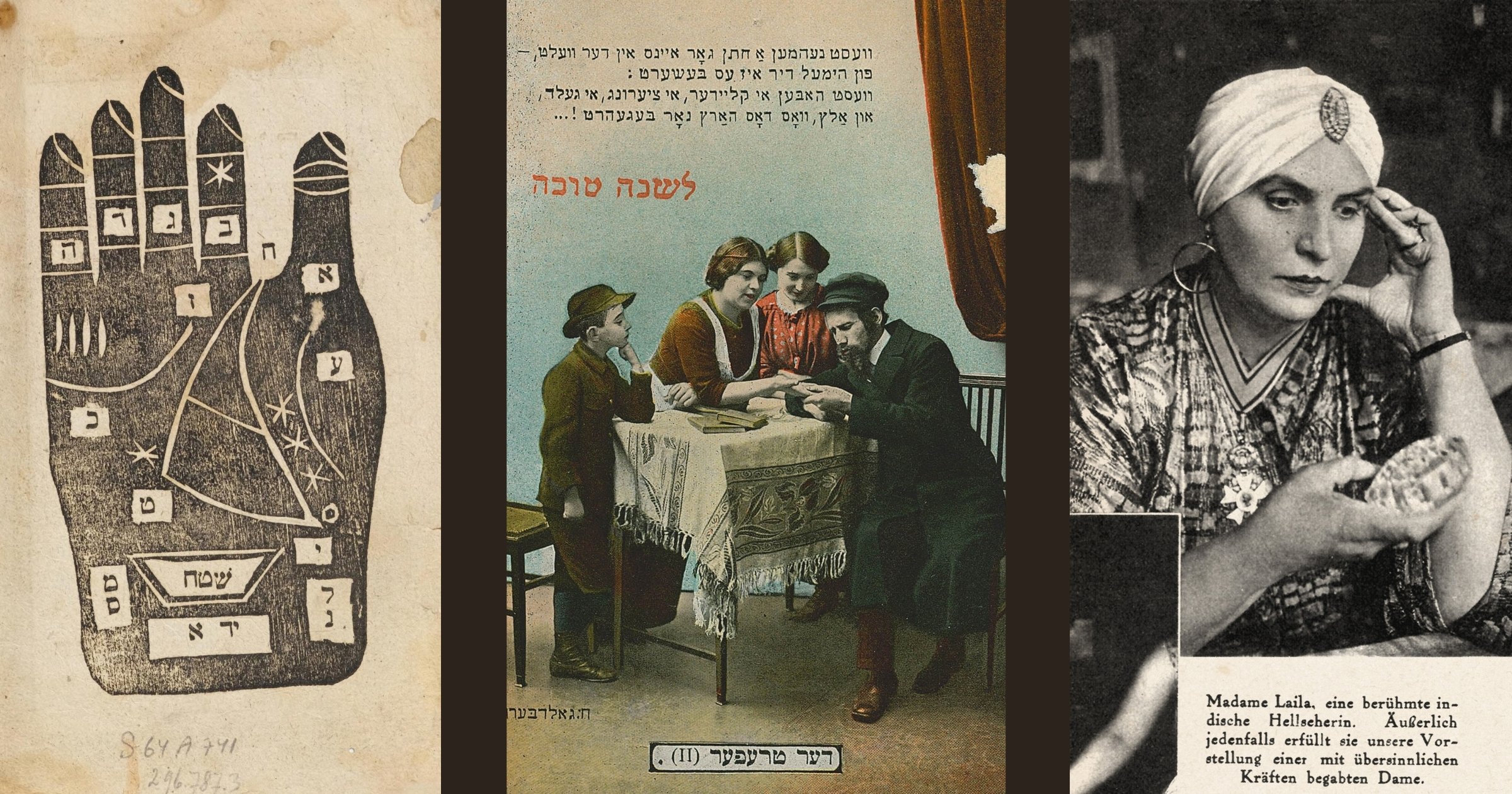
Displayed at YIVO’s “Jews Are Magic: Occult Practices from Palmistry to Professional Psychics,” the ad hints at how the occult and magic were woven into Jewish life, even though they were forbidden.
“You’re not allowed to be an enchanter, a witch, a wizard or a necromancer,” Eddy Portnoy, senior researcher and exhibition curator at YIVO, said, referring to a verse in Deuteronomy. “But if an authority bans something, people are going to do it.”
The exhibition, which runs through the end of December at Manhattan’s Center for Jewish History, which houses YIVO, features kabbalistic amulets, palmistry manuals and other occult manuscripts taken from YIVO’s archive of 24 million items.
Also on display are 19th-century petitions, called kvitlekh in Yiddish, addressed to the Polish mystic Rabbi Eliyahu Guttmacher. Jews around the world sent petitions to Guttmacher, asking for divine intercessions and magical services for problems such as restoring sight to someone who became blind, casting out a demon and ensuring the safe return of a child conscripted into the army as well as for help with poverty, illness and infertility.
The kvitlekh, Portnoy said, “reveal problems of Jews of this period.”
The exhibit highlights 10 Jewish psychics from the 19th century. Terfren Laila, born Else Terese Frenkel, donned a white turban adorned with a gleaming ruby pin and traveled the world. She counted Georges Clemenceau, the prime minister of France, and Lord Balfour, British foreign secretary, among her clients.
Naftali Herz Imber, best known for his poem that was later adapted as “Hatikvah,” Israel’s national anthem, also worked as a traveling clairvoyant. Under the stage names “Mahatma” and “the Apostle of the Kabbalah,” his psychic act located missing husbands and predicted the future. A number of his predictions have come true, including that the sun’s energy could be harnessed to heat homes.
Although some artifacts may seem like tawdry relics, the beliefs underpinning them—seen today in the fear of the evil eye, or keynahora, or the wearing of a red string to protect from bad luck—endure.
Cathryn J. Prince is a freelance journalist and author of For the Love of Labor: The Life of Pauline Newman.
 Facebook
 Instagram
 Twitter

Leave a Reply