




Books


Jewish Kids’ Books Are Tackling a Tougher World
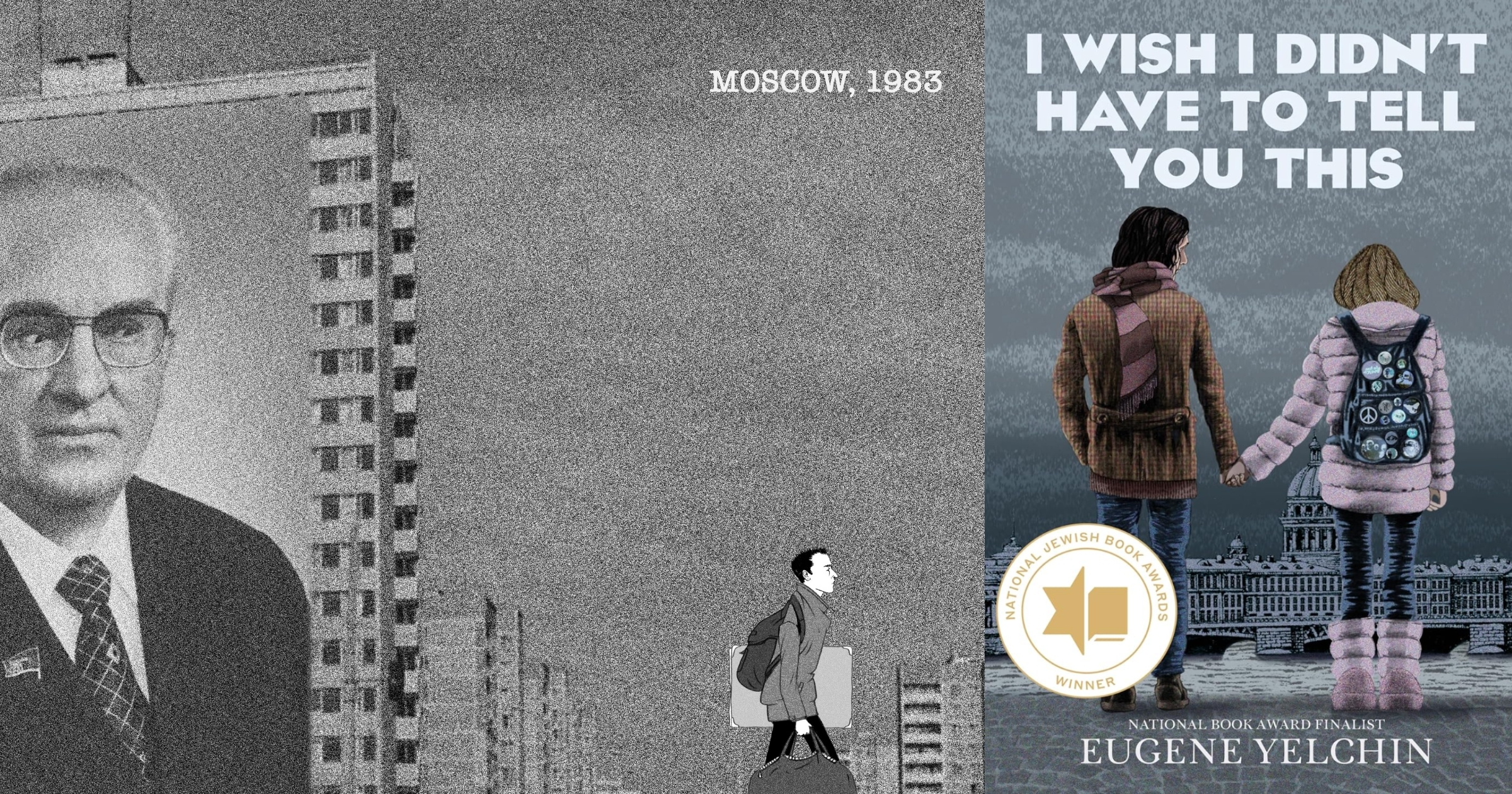
In his graphic memoir, I Wish I Didn’t Have to Tell You This (Candlewick), award-winning author Eugene Yelchin recounts his early 20s living in the Brezhnev-era Soviet Union, a repressive and antisemitic regime.
Every panel, each dot of ink, palpably conveys a depth of emotion and the author’s urgency to share events that happened 40 years ago with readers for whom the Soviet Union might seem like ancient history.
The memoir, this year’s National Jewish Book Award winner for young adult literature, tells the story of a young Jew who just wanted to paint, design theater sets and, maybe, fall in love. Yet a life of meaning and creativity was almost impossible.
“Surviving in the world that considered Jews less than human…had its price—the internalization of the flawed sense of identity,” Yelchin, now living in California, said in an interview.
His memoir crystallizes a dilemma not unique to a specific time and place: Do we change or even hide ourselves to adjust to the world around us? Or do we demand that the world change and accept who we are?
I Wish I Didn’t Have to Tell You This is one of several books published in recent years depicting difficult questions faced by young Jews. Some tackle antisemitism that hews closer to our own time and place. Works like Don’t Feed the Lion, Right Back at You and Linked reflect American manifestations of antisemitism, while also exploring mundane school drama. In all these works, anti-Jewish bias is one facet of a three-dimensional coming-of-age story.
The best in middle grade and young adult titles have long explored mature subjects with deep respect for readers. Think Judy Blume’s Are You There God? It’s Me, Margaret with its focus on puberty, interfaith marriage and existential questions.
Yet close observers say that something has shifted for young Jews in the years following the Tree of Life shooting in 2018 and the Hamas attacks of October 7, 2023. “Middle grade books are leaning into more difficult topics than they used to,” explained Alisa Koyrakh, director of books at PJ Library, which every month sends free Jewish books to more than 650,000 subscribers worldwide.
At this age, she said, kids are examining “how to confront issues that are coming up in their lives. Unfortunately, antisemitism is coming up in their lives.”
Come January, PJ Library will be offering families the illustrated A Time to Talk: A PJ Library Guide for Talking with Your Children About Antisemitism and Building Jewish Resilience, geared to help parents and caregivers navigate conversations about antisemitism with children through age 12.
The global surge in anti-Jewish and anti-Israel sentiment is not the only issue that Jewish tweens and teens are confronting. Covid, climate change, social media, mass shootings and political polarization have combined to make American childhood more fraught than in generations past.
Naomi Firestone-Teeter, CEO of the Jewish Book Council, noted that young adult and middle grade books have “a unique ability to meet readers at a formative stage in their lives.”
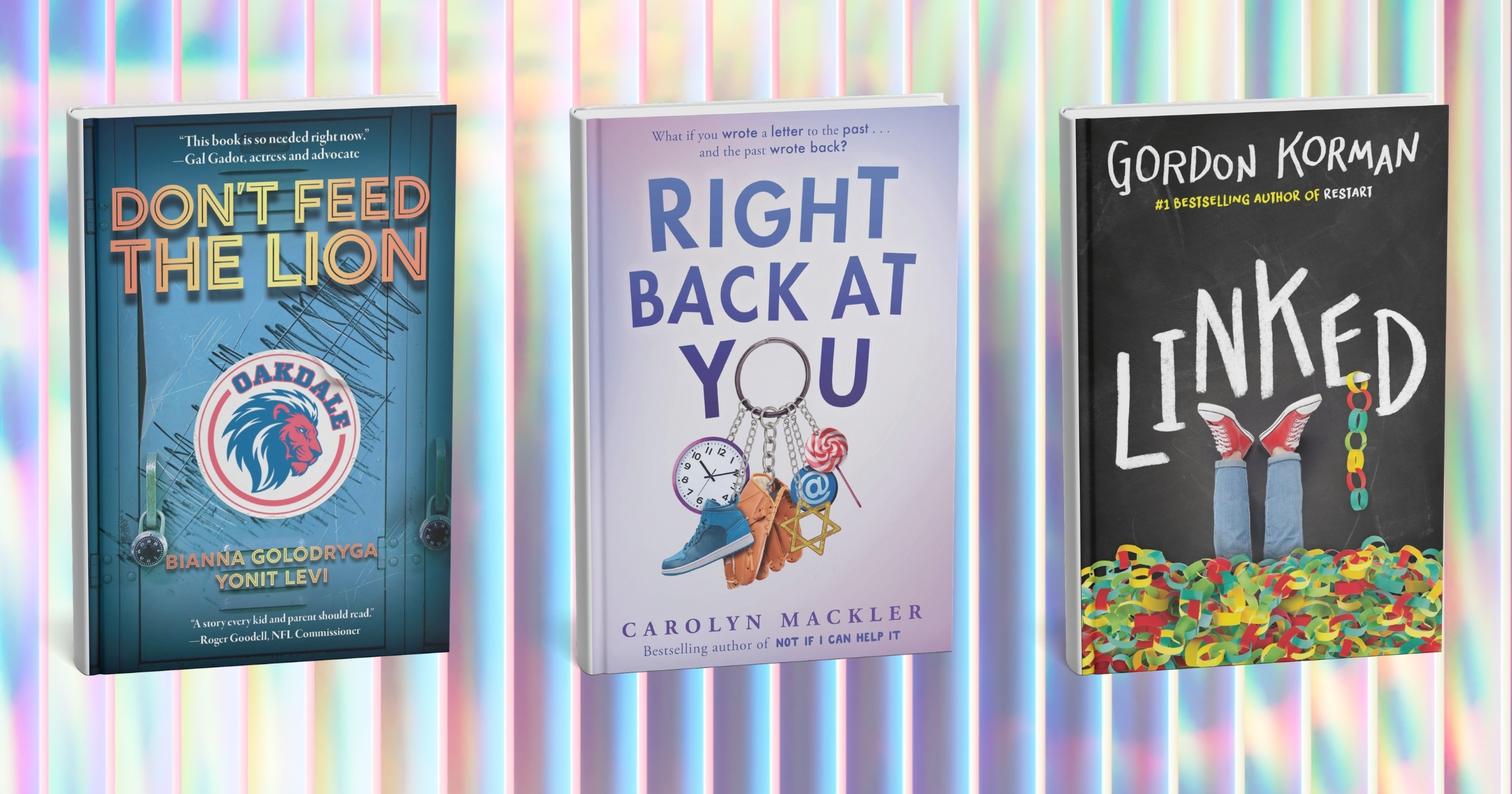
Books such as Don’t Feed the Lion, published in 2025, “create space for young readers to see themselves reflected in stories of friendship, family, tradition and resilience,” she said.
Don’t Feed the Lion has received considerable attention and reportedly is exceeding sales expectations. That’s in part because of the prominence of its authors: Emmy Award-winning CNN anchor Bianna Golodryga and Israel’s Channel 12 anchor Yonit Levin. It also helped that the two wrote an engaging story that captures something essential about what it means to be a middle-schooler today.
In the book, conflict begins when a famous British soccer player makes an antisemitic comment on social media. Soon after, Theo, a Jewish middle school soccer star, finds his locker vandalized with a swastika. Theo’s voice is particularly authentic as a kid who simply wants to play soccer, fit in and avoid becoming the center of controversy.
“It was too early for this lecture,” Theo reports from a Friday night dinner with his grandparents, when they want him to speak out about the locker incident. “Besides, why was it up to me to speak out about this stuff and save the world? I just wanted to be a thirteen-year-old who fought for the right to eat Doritos in my room.”
In contrast, his younger sister, Annie, called a “self-centered Yid” on social media, is determined to battle antisemitism online. The novel’s portrayal of antisemitism feels immediate and believable, unfolding in school hallways, around the family dinner table and across social media feeds.
Although the story is set before the Hamas attacks, the authors have shared in interviews that it was a response to a post-October 7 climate.
That sense of writing for the future while responding to the present shapes Yelchin’s broader body of work. “My job is to make children’s books, but I often catch myself making books not so much for children as for future adults,” said Yelchin, a National Book Award finalist and Newbery Medal honoree, who has written and/or illustrated nearly 30 books.
In I Wish I Didn’t Have to Tell You This, a sequel to his award-winning middle grade book, The Genius Under the Table, Yelchin describes how his closest friend, Mark, defied Soviet authorities by studying Hebrew and Bible. A young married father, Mark applied for an exit visa so he and his family could make aliyah. When permission was denied, he staged a protest outside a government building.
In a certain kind of book for young people, Mark would be rewarded for standing up to tyranny. Instead, Yelchin tells a harsher truth: Mark is killed, his death euphemistically described as “an accident.” Everyone knows what really happened, but no one says it out loud: Mark was murdered by the KGB.
Such bleakness could turn readers away. Fortunately, some books balance difficult subject matter with humor and page-turning storytelling. Yelchin, for instance, lightens I Wish I Didn’t Have to Tell You This with comic relief from the protagonist’s overbearing grandmother and his awkward attempts to woo an American student named Libby.
Carolyn Mackler likewise leavens serious themes with wit and warmth in her 2025 book Right Back at You. The wildly imaginative story follows Talia, a 12-year-old Jewish girl in 1987 who confronts antisemitic jokes and ostracism, and Mason, a non-Jewish boy of the same age from 2023 who is being bullied. The two correspond through a kind of space-time wormhole theorized by Einstein that somehow shows up in their bedroom closets, discussing heavy subjects, including antisemitism, bullying and alcoholism.
Mackler has said in interviews that the novel was inspired by her own painful middle school experience in Brockport, a small village in western New York, where she was bullied because her father was Jewish.
Despite those themes, the novel is a delight to read. Its epistolary format allows the protagonists to build a gradually deepening friendship. The book also delivers plenty of laughs, particularly as a kid from the 2020s tries to explain his life to someone who lives decades earlier. (What do you mean, Talia writes, that “you have your own computer?” Or, in another letter, “How can you check the weather on your telephone?”)
Among the best-known recent middle grade works to tackle antisemitism is Gordon Korman’s 2021 novel Linked (Scholastic). It has sold hundreds of thousands of copies and become a staple in school libraries.
The story revolves around a Colorado town rocked by a series of swastika vandalisms and a buried past as a center of Ku Klux Klan activities. Fast-paced and suspenseful, the novel follows the mystery of who spray-painted a swastika on a school wall.
According to its New York Times best-selling Jewish author, the story was inspired by his fascination with Paper Clips, the 2004 documentary about a middle school project in Whitwell, Tenn. In order to understand the magnitude of the loss in the Holocaust, students collected six million paper clips. In Linked, a non-Jewish student comes up with the idea of making six million paper chains, an effort that ultimately involves the whole town and takes some surprising turns.
The book is dedicated to Jonathan Greenblatt, CEO of the Anti-Defamation League. Korman and the Jewish communal leader became acquainted through their sons, and the author peppered him with questions about how antisemitic vandalism might play out in school settings. The book, he said in an interview, is as much about racism and the impact of vandalism as it is about antisemitism.
“It’s a story about a bunch of kids, set in a middle school, told from different perspectives,” said Korman, the author of more than 100 novels. “It explores the nature of how individual middle-schoolers are different and how they can look at the same events in a completely different way.”
Books, he noted, take on a life of their own. And he believes the novel now lands differently than it did when it was first published.
“I almost wonder if October 7 and the aftermath has made the book more fraught than it might have felt before that,” Korman said.
For his part, Yelchin said he wishes that stories depicting antisemitism in the Soviet Union didn’t feel so relevant.
“Even though my personal experience occurred long ago and far away from my young Jewish readers, sadly, they are now facing a similar dilemma,” he said. “Whether my Jewish readers decide to adjust to the rapidly emerging authoritarian and antisemitic world around them or risk challenging it, I have no power to control.
“But with books like I Wish I Didn’t Have to Tell You This,” he concludes, “I can try to point their moral compasses in the right direction.”
Bryan Schwartzman is a writer living outside Philadelphia. Follow his work at bryanschwartzman.com.
 Facebook
 Instagram
 Twitter
Leave a Reply