




Books
Non-fiction


REVIEW: ‘Once a Paratrooper’
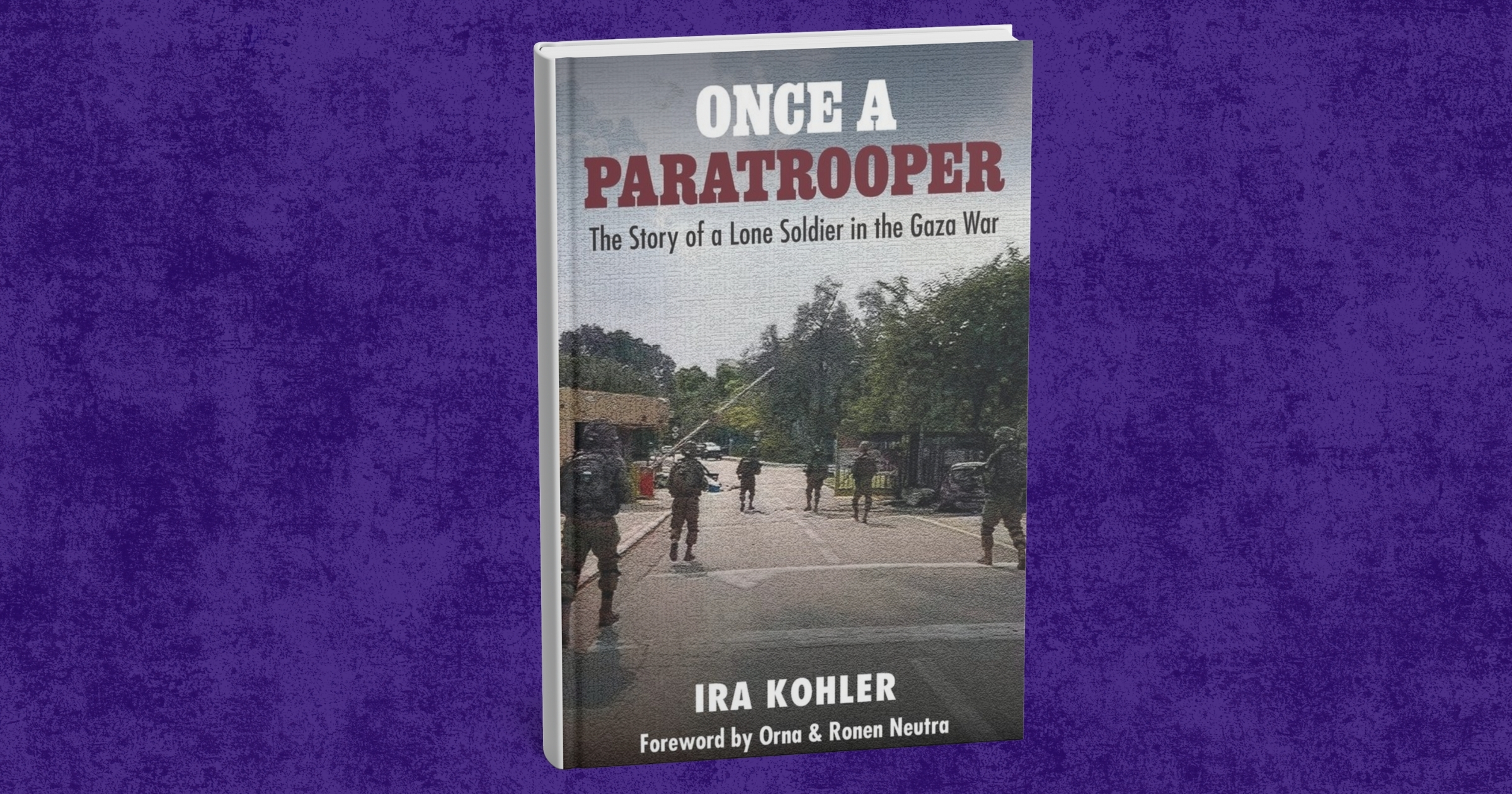
“This is a story of what it’s like to be a soldier, especially during the toughest moments. It’s also a story that aims to offer some clarity—some understanding—of what life was truly like for a soldier in the war, particularly while fighting in Gaza.”
Ira Kohler shares these straightforward words near the start of his memoir, Once a Paratrooper(Paratrooper Press, Inc.).
The powerful account chronicles the journey of a young American who honored his Jewish and Zionist identity by volunteering for the Israel Defense Forces and the courage he displayed after Hamas’s surprise invasion of Israel.
For Jews and Israelis, that day will forever be among the darkest in history. For Kohler, then a lone soldier in the IDF with less than three months remaining in his service, the attacks were a call to extend his service in a paratrooper brigade and become a reservist in the unit. “Once a paratrooper, always a paratrooper,” he writes.
Kohler, who grew up in Plainview, N.Y., traces his childhood and how a developing connection to Judaism, Israel and the Jewish community led to his army service. He and his brother and sister attended the Schechter School of Long Island, a Conservative Jewish day school, and were sent to Young Judaea sleepaway camps. “These camps,” he writes, “became a home away from home.”
After graduating from the University of Delaware, Kohler moved to Israel in August 2021. Enlisting the following January, he was placed in the 890th Battalion of the Paratrooper Brigade. After October 7, 2023, he fought in the effort to retake Kibbutz Be’eri along the southern border as well as in some of Israel’s toughest battles during his more than 100 days inside the Gaza Strip.
“Every time I entered Gaza,” Kohler writes, “I’d hear one phrase repeatedly: Tachzeru B’Shalom. May every soldier currently serving, return in peace to their loved ones.”
Life as a soldier in Gaza, he writes, “was unique and normal at the same time.” He describes adapting to primitive living conditions and accepting that basic comforts—bathrooms, kitchens and showers—would have to wait.
Kohler does not shy away from describing the physical and mental stress of being a soldier. He also shares the difficult transition back to civilian life.
The book is dedicated to three friends he lost in the war: Amir Naim, Omer Neutra and Yair Avitan.
Kohler and Neutra had been friends since their Long Island childhood. A fellow lone soldier and the commander of one of the 12 tanks stationed along the Gaza border on October 7, Neutra was initially believed to have been taken hostage.
His parents, Orna and Ronen Neutra, launched an international campaign to learn his fate. They were eventually informed that he had been killed during the attacks and that Hamas was holding his body.
His remains were later returned to Israel for burial. Today, a street near the Midway Jewish Center in Plainview, his family’s synagogue, bears his name.
Kohler met Naim and Avitan through his military service. Naim, formerly a counselor for the lone soldier program, was killed defending Kibbutz Erez, while Avitan, also a paratrooper, died fighting in Gaza.
Today, Kohler has returned to the United States after what he describes as “several lifetimes” in Israel. Adjusting to civilian life has proven difficult.
“What might seem ironic to many of you reading this,” he writes, is that “life after the war has felt harder than the war itself. During the war, the structure, routine and deep sense of purpose gave my life a meaning I had never experienced before.”
Stewart Kampel was a longtime editor at The New York Times.
 Facebook
 Instagram
 Twitter

Leave a Reply