



Israeli Scene
Books
Non-fiction


Simon Sebag Montefiore on the Modern Middle East
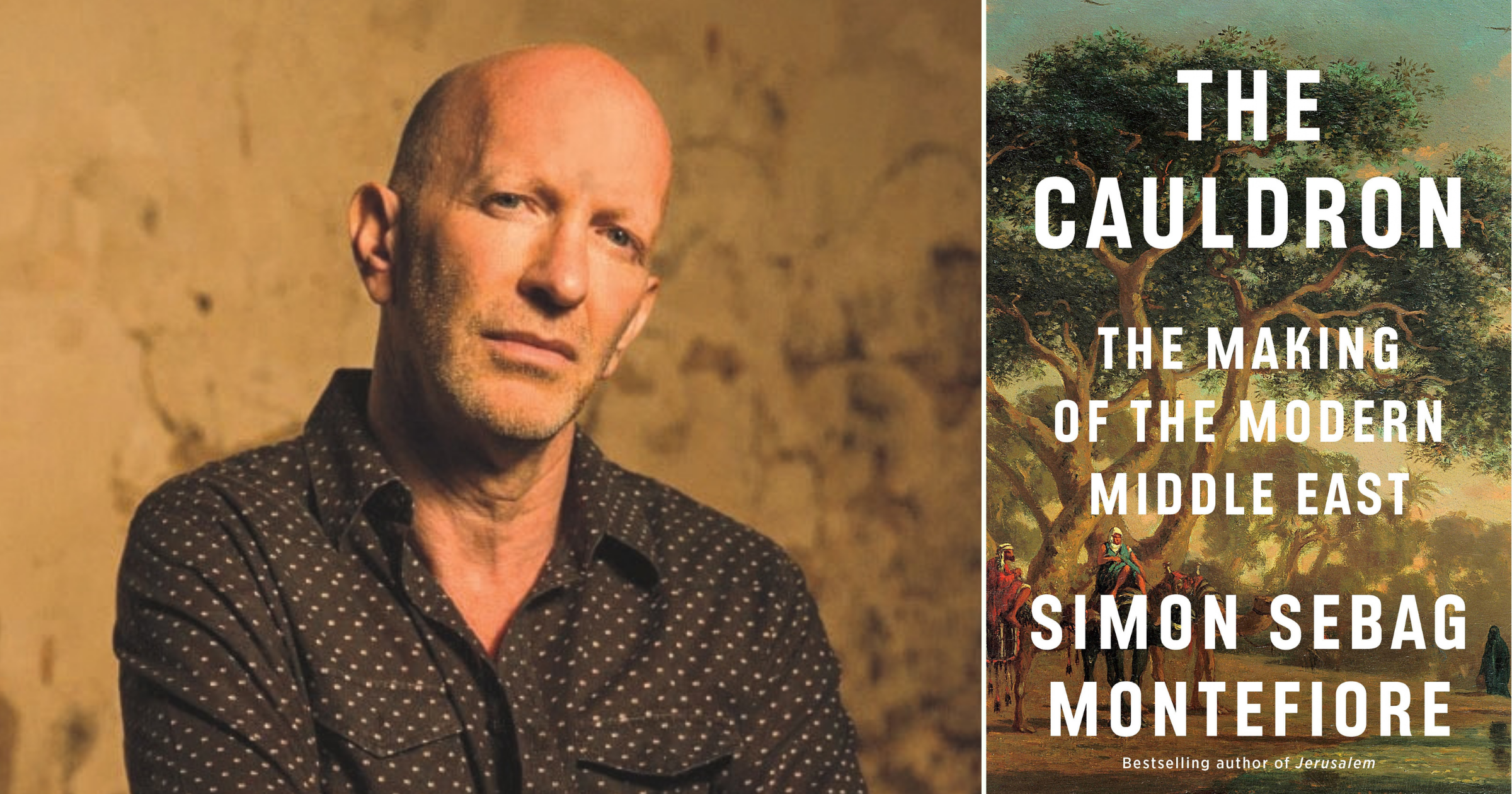
Simon Sebag Montefiore is among Britain’s best-known popular historians. The author of bestsellers about Jerusalem, Russia and a history of the entire world, Montefiore just published a new book, The Cauldron: The Making of the Modern Middle East, 1900-2026, that unpacks the historical context for the multiple wars currently unfolding across that region.
The scion of two illustrious Jewish families who themselves play minor roles in this history, Montefiore, 61, writes of the fall of the Ottoman Empire and its impact on Arab-Israeli relations throughout the 20th century, how the 1979 Iranian Revolution was a world-altering event with implications that still reverberate and why the Middle East has become a battleground for the world’s great powers. This interview has been edited for brevity and clarity.
What made you decide to write a single-volume history of the modern Middle East?
It seemed necessary to write about a history that has been increasingly befuddled, blurred and distorted. This book is meant to be a guide to the whole Middle East that combines everything: from Morocco to Iran, Turkey to Yemen, and Sudan, Syria, Egypt, Israel. When I looked for this book, I couldn’t find it. And as my great hero, Benjamin Disraeli, always said, “When I want to read a book, and I can’t find it, I write it myself.”
Why do you think there’s so much focus on Israel in the West?
Israel certainly is one of the great powers of the Middle East, and the Israel-Palestine conflict is highly significant, but it’s actually a relatively small part of this wider picture. You can see that now with the American war with Iran, the rivalry between rising powers in the Middle East, including Turkey and Iran, and the roles of the United States, China and Russia in the region.
There’s an obsession in the West about the Palestinian question and the Holy Land and Israel that reflects a weird, fetishistic, historic-cultural, religious obsession that goes right through Western history. Often, it has manifested as armed intervention in the Middle East. If you look at the de-colonialist, anti-Zionist, anti-imperialist ideologues who are now protesting in Western cities and universities, they constantly attack the Crusades and Western imperialism. Yet they are increasingly asking for Western intervention in the Holy Land.
We’re meant to be living in this 21st-century era of reason and secularity—a post-religious, post imperialist epoch. But we’re not. These people and their moral attitude toward the Holy Land is so proprietorial it’s nearly imperialistic. It’s religious in nature. If you listen to their language, their religious passion and the simplicity of their approach, it’s the direct heir to the Crusades, the Puritans of the Cromwellian era, the evangelicals of the Victorian era and their white missionaries. I use the word weird, or fetish, because these progressives would be very shocked and outraged to have that comparison made.
In The Cauldron, you write about the Iranian Revolution of 1979 as a mega-historical event that ought to be ranked with the French Revolution and the Russian Revolution as a global rupture. Why?
We are still seeing its consequences. America is at war with Iran at this very moment. The Strait of Hormuz is a potential stranglehold not just on oil but also on all the goods we expect to be delivered to our houses by Amazon delivery people. Access to the Red Sea and Suez Canal, which is a link to the entire world, is in jeopardy by the advance of Yemen’s Houthis, who are linked to Iran. This is totally a global conflict with global consequences. It always has been, because Iran is such a major power. That’s why in a book about the Middle East, Iran is the main story.
The 1979 revolution is so significant because it created, solidified, promoted and projected a new and really dynamic concept of Islamism, which is radical anti-Western resistance based on violence. Even though the Iranians are Shiites, the greatest success of the Iranian Revolution was in promoting a new Sunni radical resistance across the region. Even though Iran’s proxy vassals are slightly in retreat after Israel’s defeat of Hezbollah and Hamas and the fall of the Assad regime, the jury’s still out about the destiny of this incredibly powerful alliance across the whole region.
You write that Israel won the October 7 war militarily but lost the war over narrative. Can you expand on that?
Israel has conducted the information war catastrophically. It’s been very parochial and needs to become more sophisticated and more aware of how Israeli politics looks to the world. In the Gaza war, for example, Israel made no attempt to answer the incredibly sophisticated, instant narratives that Hamas put out about each Israeli strike in the world press. Meanwhile, Israeli ministers were conducting themselves in a really unacceptable manner—as if their words would not be seen by the outside world. That arrogance had a really disastrous effect. Some of this can never be reversed. It’s extremely unfortunate, because the information front is almost as important as the military one. Politics is all about theater and understanding how you’ll be seen.
You write that Yahya Sinwar wanted to provoke an Israeli response so overwhelming it would expose Israel’s “diabolical nature” to the world. In hindsight, did that strategy work?
It did. The slaughter and rapine attack unleashed by Sinwar was one of the most repellent moments in modern world history. It failed militarily, ultimately, but it succeeded politically. You see that in the comments of the Hamas leaders who I cite in the book. They say, “We’ve lost 50,000 or 70,000 people, but that doesn’t matter, because look what we’ve achieved in American universities. People aren’t calling for a two-state solution; they’re calling for a Palestinian state and the destruction of Israel.” Who’d have thought we’d hear that from American students in Columbia and Harvard?
Can you find any optimism in this conflict, and in the Middle East in general?
I think there is hope for optimism, but not in the next month, or maybe the next few years. In the wider sense, this conflict is a battle for the soul and future of Islam, between the side that is open-minded, exchanges ideas with the West and tries to deliver a good life for its people, and the narrow-minded, radical Islam personified by groups like Hamas and Hezbollah and Iran.
On Israel-Palestine, there must be a process, a negotiation. We have to find some generosity in our approach, and that means recognizing the other side’s narrative, their national story. That’s part of the mission of this book—to recognize the many identities and narratives that exist.
Uriel Heilman is a journalist living in Israel
 Facebook
 Instagram
 Twitter

Leave a Reply