



Books
Feature


Jewish Librarians Past, Present and Into the Future
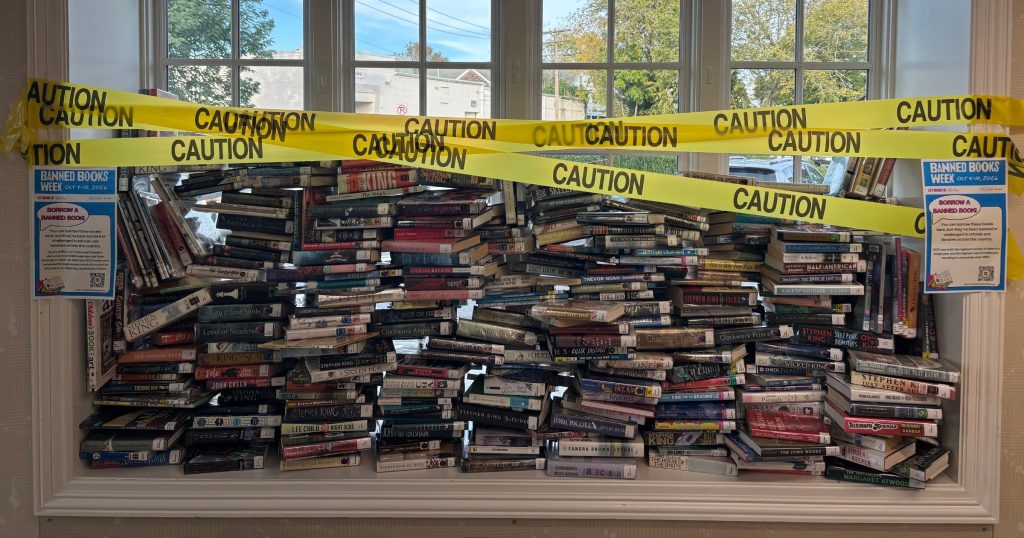
In advance of banned books Week in October, Mara Zonderman walked the stacks of the Westhampton Free Library in New York, pulling volumes from the shelves. One by one, she piled them onto a folding metal table. The growing collection, which again this year included Judy Blume’s teenage classic Are You There God? It’s Me, Margaret and Maia Kobabe’s Gender Queer, shared little except that someone in a position of authority, be it a school board member or elected official, got the book banned, removed, restricted or challenged in at least one jurisdiction in the country over the last 12 months.
Because Zonderman could only pull books in her library’s collection, she also displayed a list of every title challenged or banned in the United States this year.
“My list is already over 2,000 books, and I’m nowhere near the end,” said Zonderman, the library’s head of reference and adult services. “It’s very disheartening but should make for a powerful display.”
The visual confrontation forced the library’s 6,200 cardholders to wrestle with the fragility of intellectual freedom and remember the foundational duty of a librarian: putting information directly into people’s hands.
This core mission endures despite sweeping transformations across the profession. Today, America’s nearly 125,000 libraries—public, academic, religious and specialty—have evolved beyond card catalogs and silent reading rooms. They are now dynamic community hubs with recording studios and crafting spaces. Modern librarians curate digital resources, design programming and oversee eclectic lending collections that include everything from sewing machines to ghost-hunting gear.
Fanny Goldstein became the first Jewish woman to direct a public library in Massachusetts when she was named director of the West End Branch of the Boston Public Library, the largest branch in the city, in 1922. Among her many achievements was founding Jewish Book Week—later developed into Jewish Book Month—which, under the auspices of the Jewish Book Council, is still celebrated annually in the month leading up to Hanukkah.
Sophie A. Udin began her career in 1914 at the New York Public Library, where she concentrated on foreign collections. Beginning in 1925, Udin spent two years at the National Library in Jerusalem, the precursor to today’s National Library of Israel, helping to implement the Dewey Decimal System and training staff. She made aliyah in 1949 after Prime Minister David Ben-Gurion appointed her the first director of the Israel State Archives. Later, she served as the Knesset librarian.
Thanks to Goldstein, Udin and other Jewish women—Golda Meir worked part-time in the Milwaukee Public Library in 1917—the glass ceiling was shattered and women entered the field in droves. Today, women account for about 82.5 percent of all professional librarians in the United States, according to the Bureau of Labor Statistics.
The career became officially professionalized in 1951, when the American Library Association (ALA), the largest membership organization for librarians in the country, changed its accreditation standards and required librarians to earn a Master of Library Science. The degree evolved to become a Master of Library and Information Science, or MLIS, between 1990 and 2000.
While a precise number of Jewish librarians in the United States isn’t available, the Association of Jewish Libraries (AJL), the primary group representing Jewish librarians in the country, counts almost 400 members. By comparison, the ALA has 59,000.
Beyond the numbers, most of the Jewish librarians interviewed for this article agree that they have a distinct connection to the field.
“We need professional librarians to ensure accessible and accurate knowledge. We are the people of the book after all!” said Jackie Ben-Efraim, AJL president and special collections librarian at American Jewish University, who entered the field 47 years ago.
Zonderman took a more winding path into the stacks. Before earning her MLIS 20 years ago, she worked as a lawyer and lobbyist, including a stint at the Anti-Defamation League.
“I probably should always have been a librarian,” she said. “As a kid, I was always going to the library, and we always had books in our home. The library was absolutely an integral part of our life.”
Heidi Rabinowitz, who said she “quite literally played librarian as a kid,” was inspired to become a librarian while earning an English degree at Oberlin College. After obtaining her MLIS, she worked in Florida’s Broward County public library system. For the last 28 years, she has headed the Feldman Children’s Library at Congregation B’nai Israel in Boca Raton.
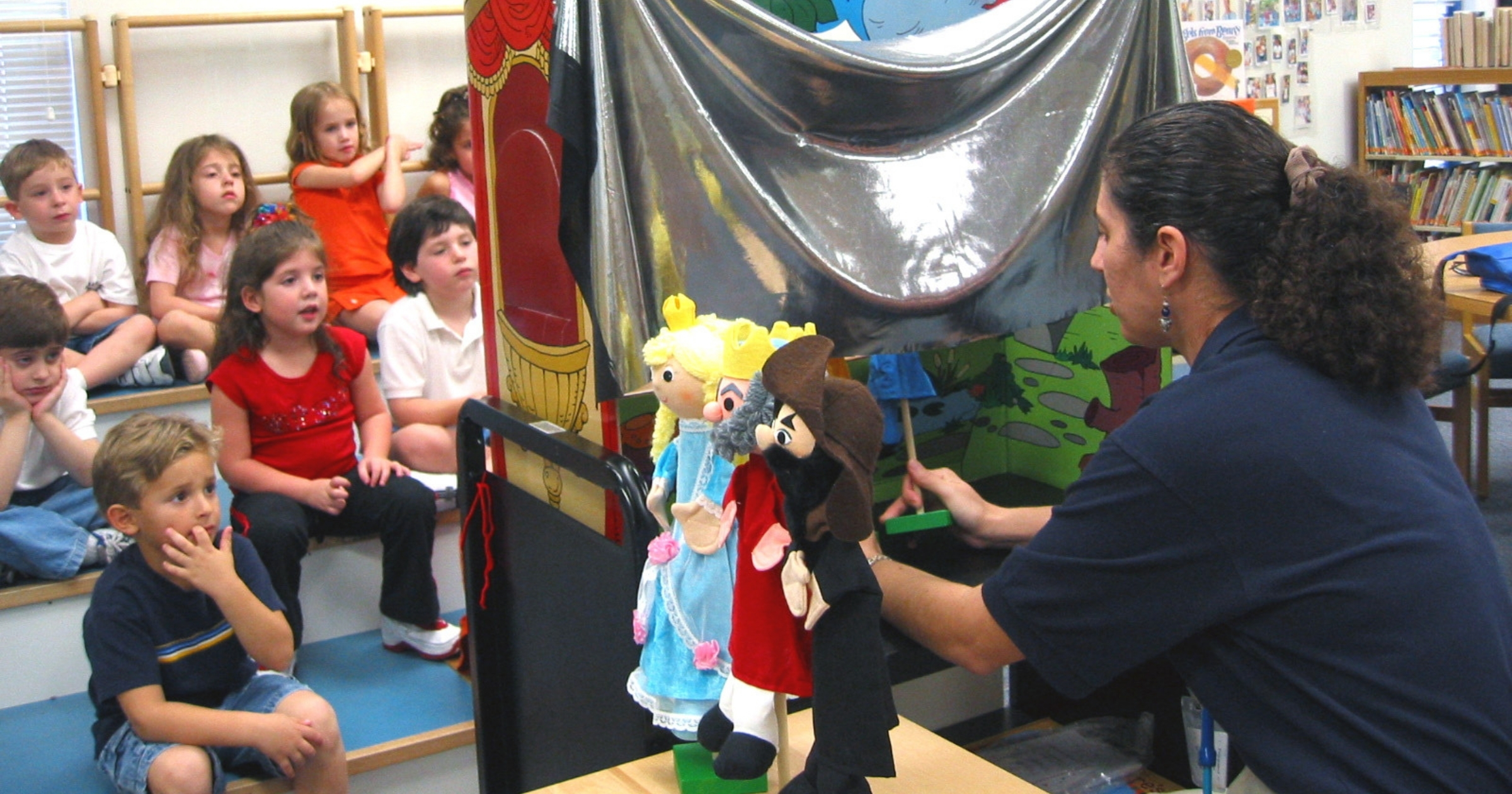
Rabinowitz leads 20 story hours a week during which she settles into a chair and holds a book—a favorite Hanukkah title is Herschel and the Hanukkah Goblins—high enough for the kids sitting on a rug to see.
“They are indeed wiggly and distractible, so I get as interactive as I can,” she said.
The children identify objects in illustrations, answer questions and sing. When they need to burn off energy, Rabinowitz calls for a game or dance break.
Synagogue libraries operate differently from public ones. Because they are private, their librarians may have more latitude in deciding which books belong on their shelves. Public libraries must adhere to federal, state and local laws as well as their own written guidelines when deciding which books and digital items to add, keep or remove from their shelves.
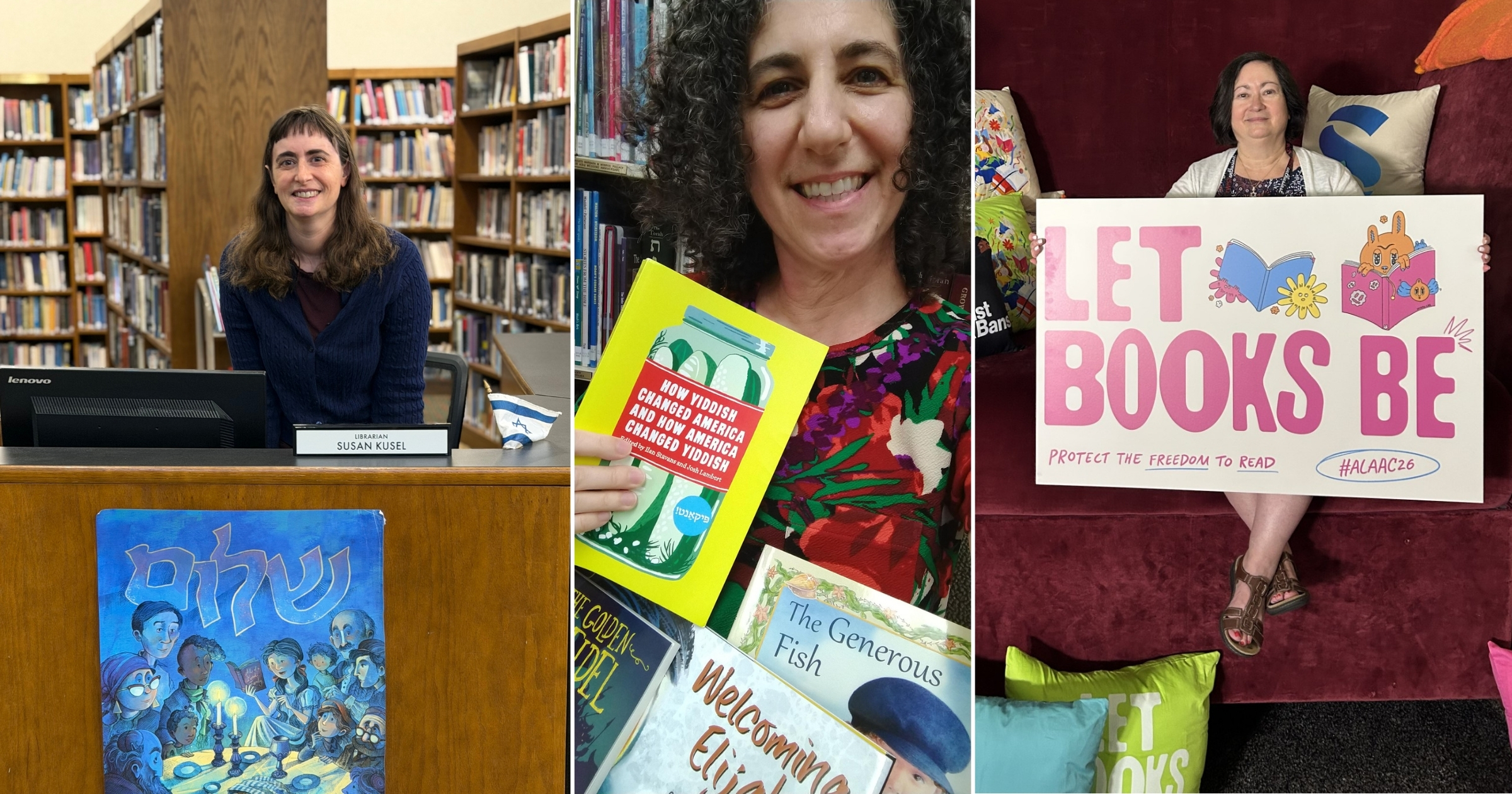
Susan Kusel, a librarian at the Blumberg-Zalis Family Library at B’nai Israel Congregation in Rockville, Md., has embraced the freedom that comes with being a synagogue librarian. She has served on the Caldecott Medal selection committee, which awards one of the top prizes in children’s book illustration, and sits on the AJL’s Sydney Taylor Book Award Committee, which honors outstanding Jewish children’s books.
As the author of her own Sydney Taylor Book Award-winning title, The Passover Guest, Kusel is naturally committed to expanding her synagogue’s collection for children and teens. Where Holocaust-related books once dominated Jewish children’s literature, she said, there is now greater demand for books that portray the breadth of Jewish life, for instance, stories about Sephardic and Mizrahi Jews, Jews of Color and LGBTQ Jews. Among them is the picture book Joyful Song by Lesléa Newman, about a two-mom interracial Jewish family bringing their newborn daughter to synagogue for her baby naming.
“Over the years,” Kusel said, “we are getting requests for somewhat fewer Holocaust books and more books that celebrate Jewish joy.”
Kusel and Rabinowitz collaborate on a number of initiatives, among them, The Jewish Book Garden on Substack; The Book of Life podcast; Jewish Kidlit Mavens, a Facebook community; and a twice-yearly list of new children’s books about Jewish holidays for the AJL. Their latest project is co-authoring The Jewish Library Handbook, which will serve as a comprehensive guide for establishing, managing and maintaining synagogue, school and Jewish community center libraries.
Most librarians share the belief that they do more than simply share knowledge: They protect the fundamental right to read. According to the ALA’s Office for Intellectual Freedom, 4,235 unique titles were challenged in 2025, just five books short of the all-time high set in 2023, and 920 books were subject to access restrictions, including relocation or requirements for parental permission.
The ALA doesn’t break down book ban figures by specific religious, national or cultural groups. However, recent challenges have targeted Jewish titles, including Art Spiegelman’s Pulitzer Prize-winning graphic novel Maus, banned by a Tennessee school board; and Anne Frank’s Diary: The Graphic Adaptation, challenged in Florida and Texas over what was described as “sexual content.”
“The pace has really picked up, and it’s very distressing,” Ben-Efraim said. “They’re banning Maus because the mouse is naked? Holocaust denial is what that is.”
Sometimes censorship starts with a librarian’s decision not to buy a book in the first place. That is the chilling effect Zonderman, in Westhampton, worries about.
“The thing to me that is of the most concern is that librarians are going to self-censor and say, ‘We just won’t order that book,’ ” she said. “You’re doing a major disservice to your community if you do that.”
Zonderman said she uses the same standard when choosing books, regardless of the politics or subject, including books about Israel and Gaza. For example, she has bought copies of Eli Sharabi’s Hostage, which recounts the former hostage’s ordeal on October 7, 2023, and captivity in Gaza, and Being Jewish After the Destruction of Gaza: A Reckoning by Peter Beinart, a far-left Jewish critic of Israel. She consults professional reviews in Library Journal along with those in mainstream publications like The New York Times Book Review and Kirkus Reviews.
“What I order will have nothing to do with whether I agree with it or not,” Zonderman said. “I have to ask if it meets the standards and will my community want it.”
That’s a familiar predicament for Rebecca Levitan, a librarian at the Pikesville branch of the Baltimore County Public Library. Pikesville has a large Jewish population.
“Someone noticed P Is for Palestine on the shelf,” Levitan said of the children’s alphabet book. “A few tried checking it out and not returning it, and we had to explain that a public library serves all people.”
“Personally,” she added, “I would like it not to be on the shelf. It has ‘I is for Intifada,’ and for me the intifada is blowing up pizzerias and buses. But, as a public librarian, it’s my job that it goes on the shelf, even if it makes me uncomfortable.”
But this commitment to access raises another question. Are there limits to what belongs in a library?
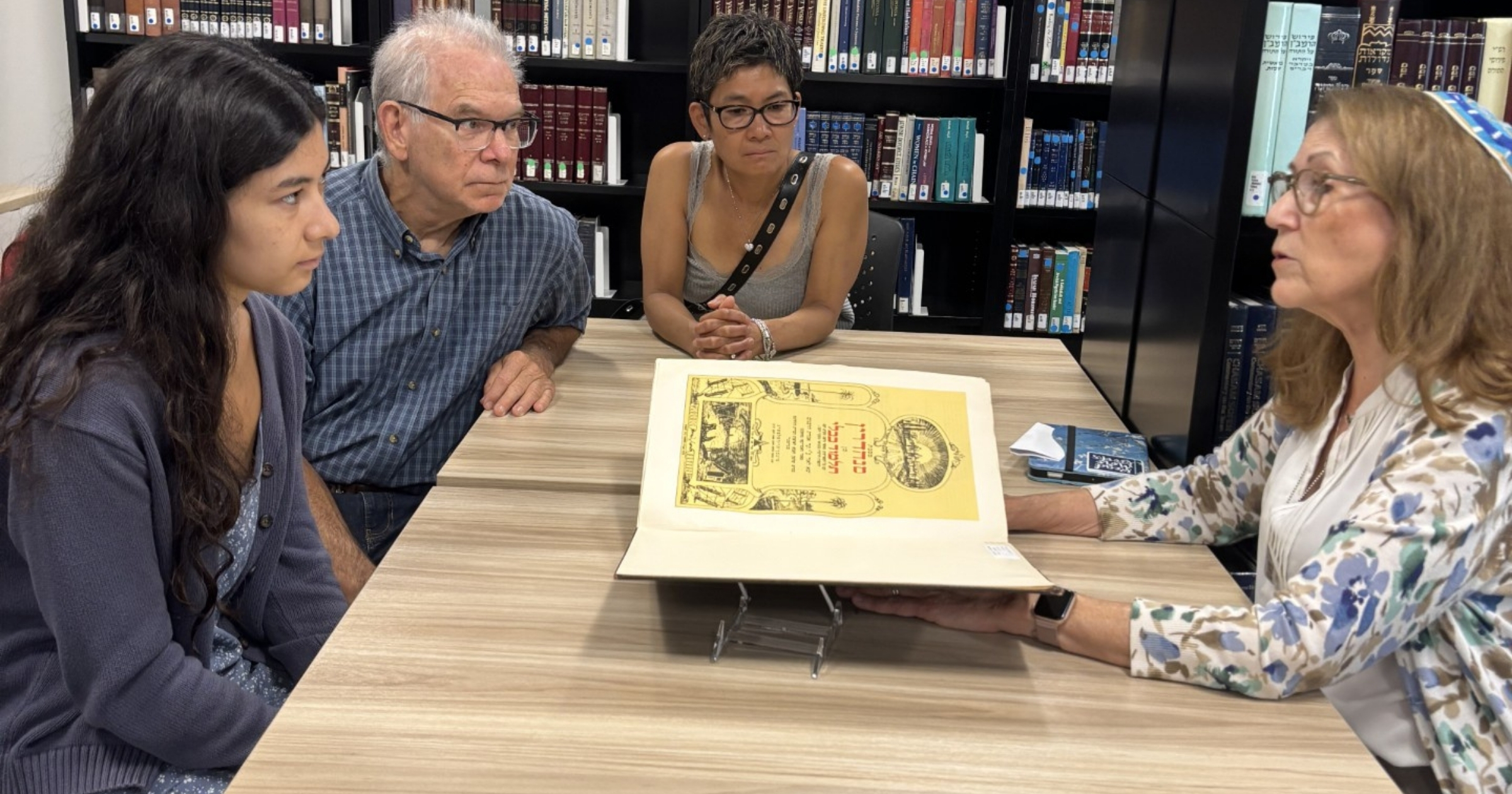
The AJL champions broad access to differing viewpoints in public and private libraries. At the same time, it draws a line at deliberate misinformation and antisemitic propaganda, citing works such as The Protocols of the Elders of Zion and Mein Kampf. Such books, according to the AJL, belong in specialized collections, for example, the YIVO Institute for Jewish Research in New York, rather than in general circulation.
The distinction becomes more complicated as Jewish and Israeli authors, and books dealing with Israel, face increasing scrutiny. For librarians navigating that landscape, silence isn’t necessarily neutral, whether they’re advocating for their patrons—or themselves.
“First and foremost, pay attention and speak up,” said Sally Stieglitz, communications and outreach coordinator for the Long Island Library Resources Council (LILRC) in New York. Stieglitz has spent her tenure at LILRC, which serves 200 member institutions and three million residents, watching what she describes as a steady stream of anti-Jewish microaggressions.
Last year, the Public Library Association, a division of the ALA, scheduled its annual meeting during Passover. When Stieglitz and others raised the time conflict, organizers dismissed the concern. “ ‘Oh well, we’ll have kosher food,’ ” Stieglitz, who also serves as editor-in-chief of AJL’s News and Reviews, recalled being told. The association later apologized for the oversight.
She has responded to the tense climate for Jews by working with Artists Against Antisemitism, a group that unites creatives in the fight against anti-Jewish bias, on guides for public libraries to help ensure that diversity displays include Jewish books.
While book lending remains central to a library’s mission, nearly 2,000 to 3,000 collections around the country now extend to so-called Libraries of Things. The growing movement allows patrons to borrow everything from rakes and birdwatching kits to specialty baking pans, 3-D printers and sewing machines.
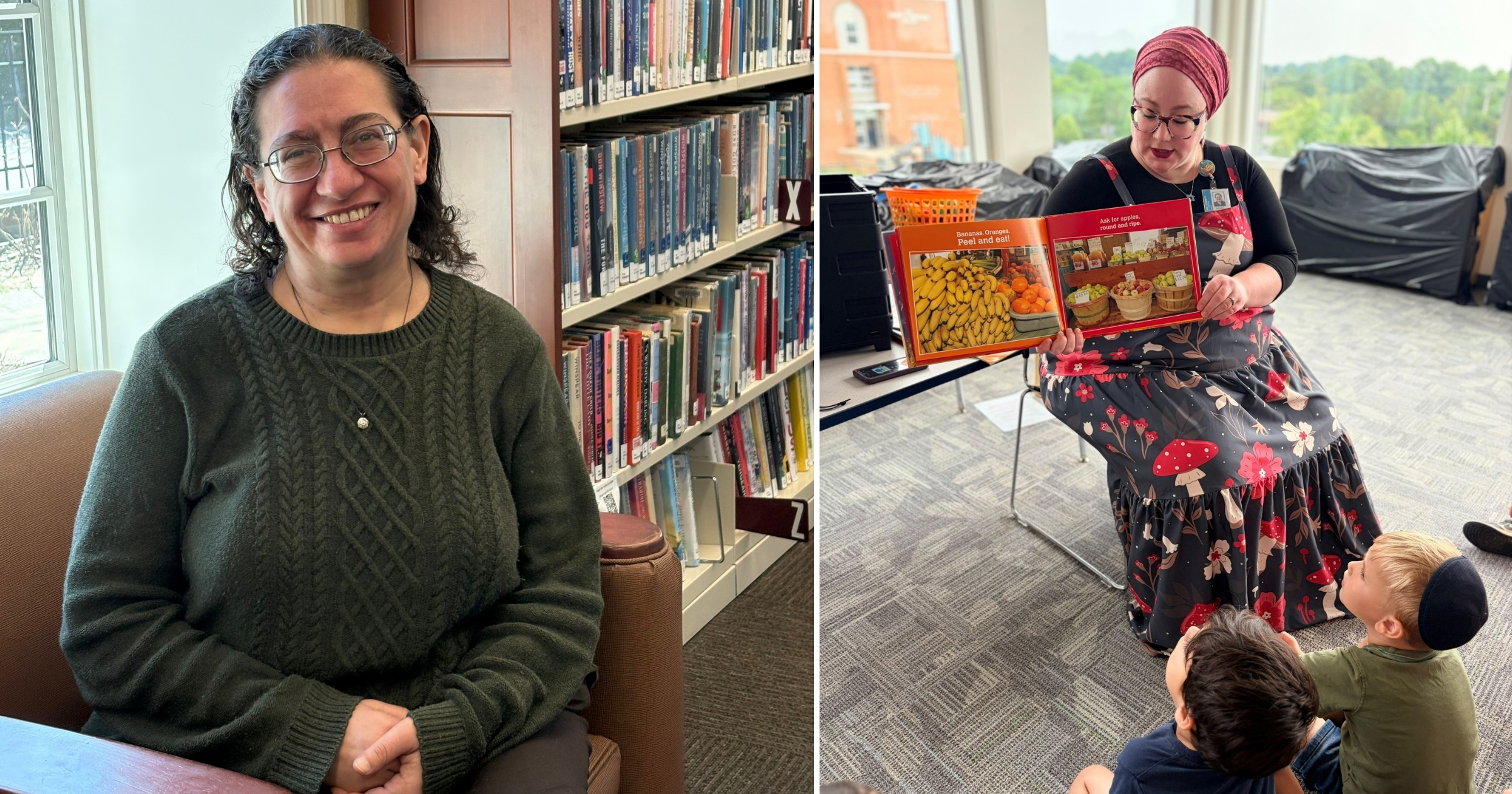
“One of my favorite conversations to have is, ‘I didn’t know you could do this at the library,’ ” Zonderman said.
She also described how libraries have become important community centers. In Westhampton, patrons gather for weekly lunches, games, bus trips to Manhattan to see Broadway plays and tutoring sessions.
“Today, I had a patron who came in to play mah jongg, but she also needed to get a document notarized, and of course, she needed to print the document first,” Zonderman said, all of which the woman could do at the library. “She got a book today, too.”
Stieglitz represents just how far librarianship has moved beyond the traditional image of someone sitting behind a desk, shushing patrons and stamping books. In her role at LILRC, she collaborates with outside institutions, including with NASA as a Solar System Ambassador, organizing continuing-education programs with astronauts.
While technology has undoubtedly impacted libraries, they remain a central address where people come looking for information, and where librarians help them find it.
“It’s a little like being on a game show sometimes. A customer comes in and asks, ‘What’s that book I read 27 years ago about a forest?’ ‘What’s that book with the pink cover?’ ‘I need a good book to read,’ ” Kusel, the Rockville librarian, said. “We are professional researchers, and we know how to answer questions.”
Cathryn J. Prince is a freelance journalist and author of For the Love of Labor: The Life of Pauline Newman.
 Facebook
 Instagram
 Twitter
Leave a Reply