



Books


REVIEW: ‘Playmakers’
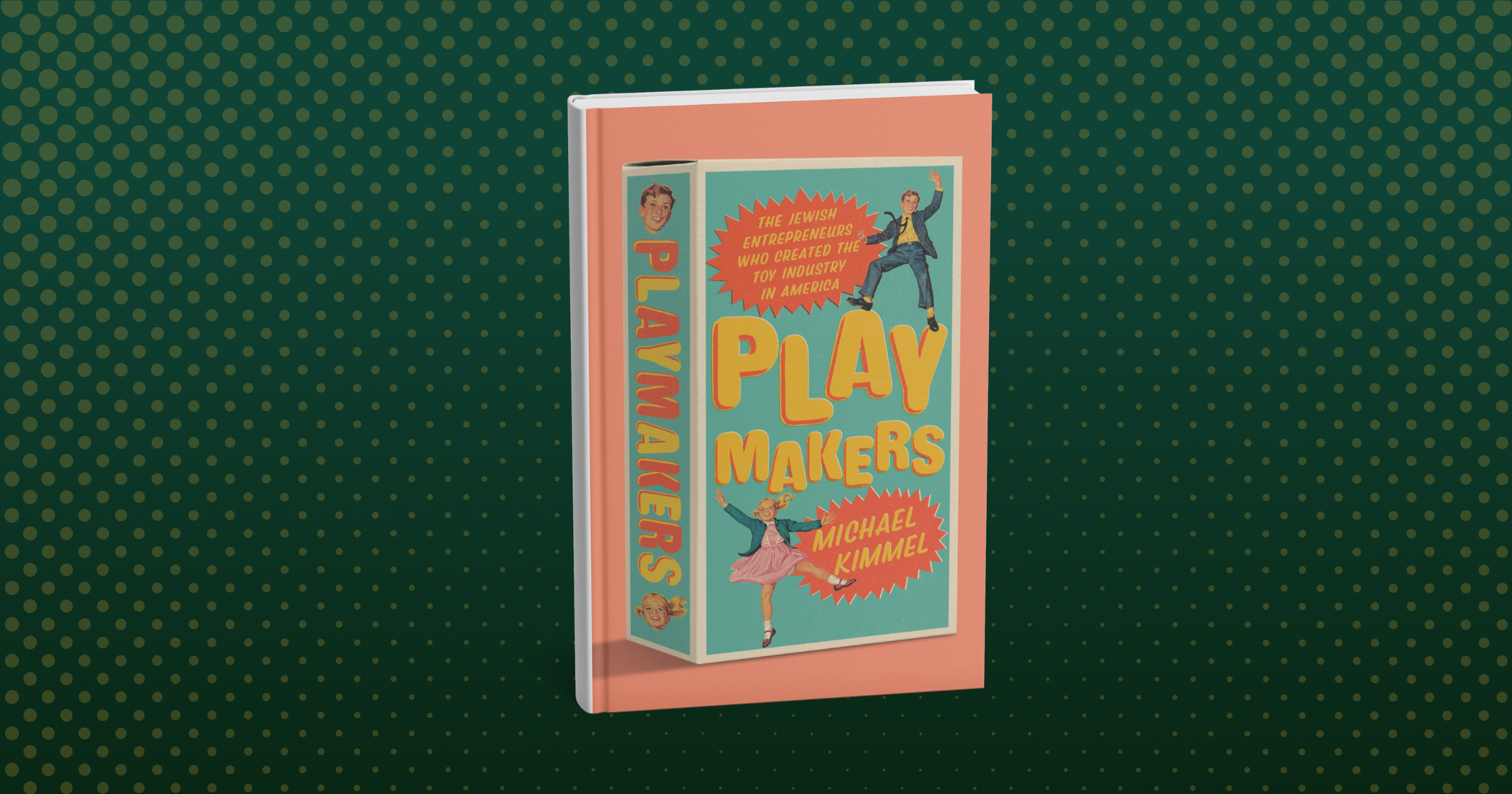
Playmakers: The Jewish Entrepreneurs Who Created the Toy Industry in America
By Michael Kimmel (W.W. Norton)
“My aim in this book has not been to recount some triumphalist parade of extraordinary Jews, nor to celebrate Jewish creativity and entrepreneurialism,” Michael Kimmel writes in his new book, Playmakers.
But he doesn’t acknowledge that until Chapter 12—and by then, it’s too late. He has already spent more than 300 pages exceeding any reader’s kvelling quota with his profiles of the Jewish men and women who created Mr. Potato Head, Lionel model trains, G.I. Joe, Marvel and DC Comics as well as many other toys and stories that long shaped American childhood.
A few years ago, the Barbie movie reminded audiences that the doll was created by a Jewish woman, Ruth Handler. But Kimmel’s biggest revelation is that much of the early 20th-century American toy industry was dominated by Jews. Beyond Mattel’s Ruth and Elliot Handler in Los Angeles, there were the Hassenfeld brothers in Providence, founders of Hasbro, as well as Lewis Marx and Joshua Lionel Cowan in New York, creators of Marx and Lionel trains.
Kimmel, a SUNY distinguished professor emeritus of sociology and gender studies at Stony Brook University, places the success of these Jewish toymakers in historical context. Part of their rise, he writes, was timing. The early toy industry emerged alongside profound economic and social changes. Until the early 20th century, childhood looked nothing like it does today. Boys worked from a young age, girls managed household chores, and few children attended school.
But lower birth rates, urbanization and education and labor reforms reshaped ideas about raising children. This shift corresponded roughly to the arrival of the second wave of Jewish immigrants from Eastern Europe—whom Kimmel calls “Yiddishkeit Jews”—determined to make it in America.
Take Morris and Rose Michtom, who together created the original Teddy bear in the back room of their Brooklyn, N.Y., candy store. The stuffed animal was inspired by a story about President Theodore Roosevelt, an avid hunter. When on a hunting trip, he refused to shoot a bear that had been cornered and tied to a tree for him, considering it bad sportsmanship. Rose Michtom then crafted the first “Teddy’s Bear” out of scraps and sawdust.
Kimmel is in fact distantly related to Morris Michtom on his mother’s side—the side, he notes, that was eventually pushed out of the company. He began researching the book “thinking I was writing a family memoir,” before realizing that he had uncovered a “rich tapestry.”
That tapestry extends beyond toys. Jews also dominated the early comic book industry, creating Li’l Abner, Popeye and MAD Magazine.
“The world of comic strips, the entire world of superheroes was a virtual Jewish ghetto—a ghetto created in large part because a slew of young Jewish artists had been frozen out of the highest source of artistic endeavors, architecture and advertising,” Kimmel writes.
From that ghetto emerged Superman, Batman, Captain America and the battalion of Marvel characters envisioned by Stan Lee and his cohort.
Many nonfiction writers feel compelled to include every fact uncovered in their research, whether illuminating or not. Kimmel, by contrast, is more discerning, offering both substance and delight, weaving rich lore with irresistible anecdotes.
For example, I knew fans debated whether Superman was Jewish, but I did not know that his birth name, Kal-El, means voice of God in Hebrew. Or that author Michael Bond modeled Paddington Bear on the Jewish refugee children from the Kindertransport.
Playmakers is a near perfect blend of fact and fun.
Curt Schleier, a freelance writer, teaches business writing to corporate executives.
 Facebook
 Instagram
 Twitter
J Kaufmann says
This information is great. I did not know many of the facts Mr. Kimmel presented.
I think it would make a great documentary and shown at the Jewish Film Festivals around the country.