



Hadassah
President's Column


Life Making Sense
Through the ages, there is a clear pattern in Jewish history: the proximity of sorrow and joy. Purim, beginning this year on March 2, recalls a near massacre followed by the celebration of survival. Passover—the first seder this year falls on April 1—reminds us of slavery followed by a liberation so sudden that bread didn’t have time to rise.
More recent additions to the Jewish calendar only reinforce this phenomenon: Yom Hashoah (Holocaust Remembrance Day), beginning this year on April 13, is followed a week later by Israel’s Memorial and Independence Days (Yom Hazikaron and Yom Ha’atzmaut).
This is not only history, ritual and memory. If we look at the news, or even our own lives, we see the routine scrambling of struggle and relief, of sorrow and jubilation.
I recently saw a photo of two young girls, together on a trip to Poland, that brought a smile to my face. Maria from Mariupol and Yevgenya from Kharkiv first met at a Jewish summer camp in their native Ukraine when they were 11; they became friends and kept in touch, even as the world shifted beneath their feet.
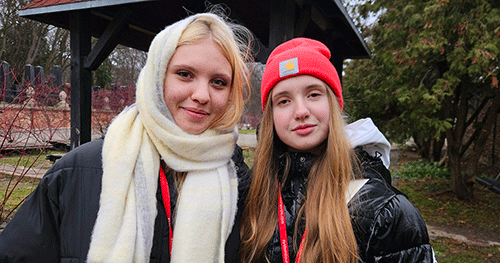
In 2023, after Russia invaded Ukraine, both made aliyah with family members, and both eventually wound up in our Youth Aliyah villages, Maria at Hadassah Neurim and Yevgenya at Meir Shfeyah. Now in 12th grade, they recently reunited at Ben Gurion Airport, where students from four youth villages met on their way to the annual Hadassah-sponsored trip to visit Jewish heritage and Holocaust memorial sites in Poland.
The annual Youth Aliyah Poland trip, by the way, is not just for youngsters who have roots in Eastern Europe. As usual, this year’s tour included Jewish teens with family backgrounds in Ethiopia and the Middle East as well as Arab students. The diversity in our student population reflects Israel’s cultural mosaic.
Part of the magic that happens at Hadassah hospitals each day is the opportunity to create joy in the wake of injury and illness—and our goal, of course, is healing. Ever since the Gandel Rehabilitation Center opened on the Hadassah Hospital Mount Scopus campus in the early days of the Gaza war, we have seen the fruit of our efforts. The Gandel Center has treated more than 2,000 patients, many of them wounded soldiers who came for rehabilitation after surgery. We rejoice every time someone who had to be carried in walks out our door under their own power.
But for all the expertise of our superb staff, there are still some outcomes that come as a surprise.
In January 2025, Yehuda, a 22-year-old staff sergeant, came to Hadassah Hospital Ein Kerem with severe burns over his body after he was injured in an explosion in Gaza. After treatment in the burn unit, he was transferred to the Gandel Center to continue his healing. The final stage of his recovery took him to the occupational therapy unit, and it was there that Yehuda first crossed paths with Avital Schmeltz, a 21-year-old immigrant from the United States who, after a year in a woman’s seminary, was doing volunteer national service at the center.
Avital and Yehuda connected first through short conversations, then longer ones. When Yehuda, having recovered full function, was finally released, he asked if she’d like to stay in touch. She hesitated at first; a few days later, she texted him. They dated for five months, became engaged and ultimately married.
“It’s true, I was injured, and the rehabilitation was long,” Yehuda observed recently. “But sometimes what seems like a setback is actually for the best.”
As we strive to make sense of life, sometimes—amid the disorder—it’s life that makes sense of us. May we all have a joyous holiday season.
 Facebook
 Instagram
 Twitter
Leave a Reply