



Arts
Exhibit


Lisa Edelstein Paints Our Jewish Family
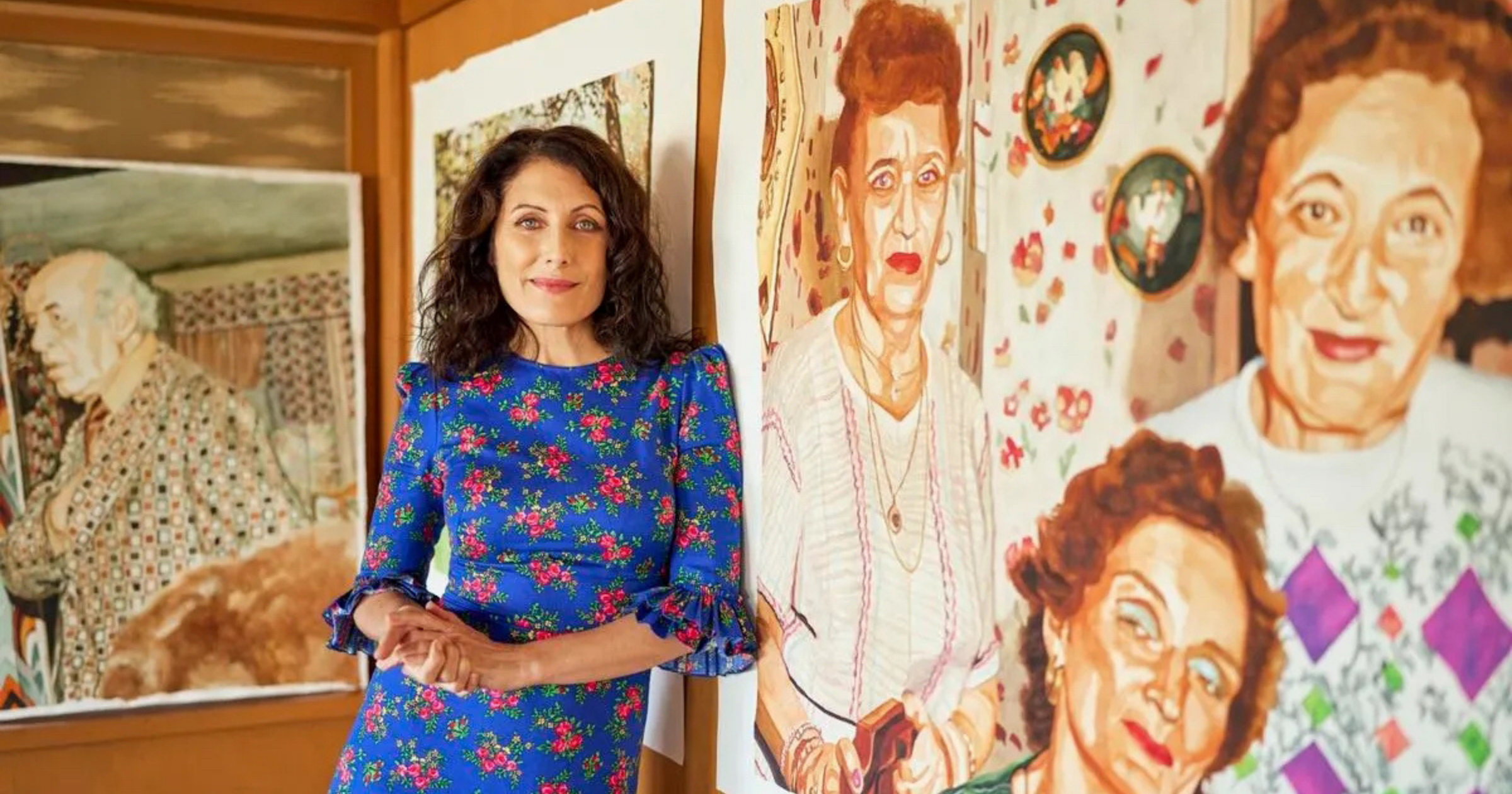
When television actor Lisa Edelstein isn’t providing the voice of Naomi Schwartz—the loving yet overbearing Jewish mom in Long Story Short, Netflix’s animated series about a multigenerational American Jewish family—she is working on her visual art.
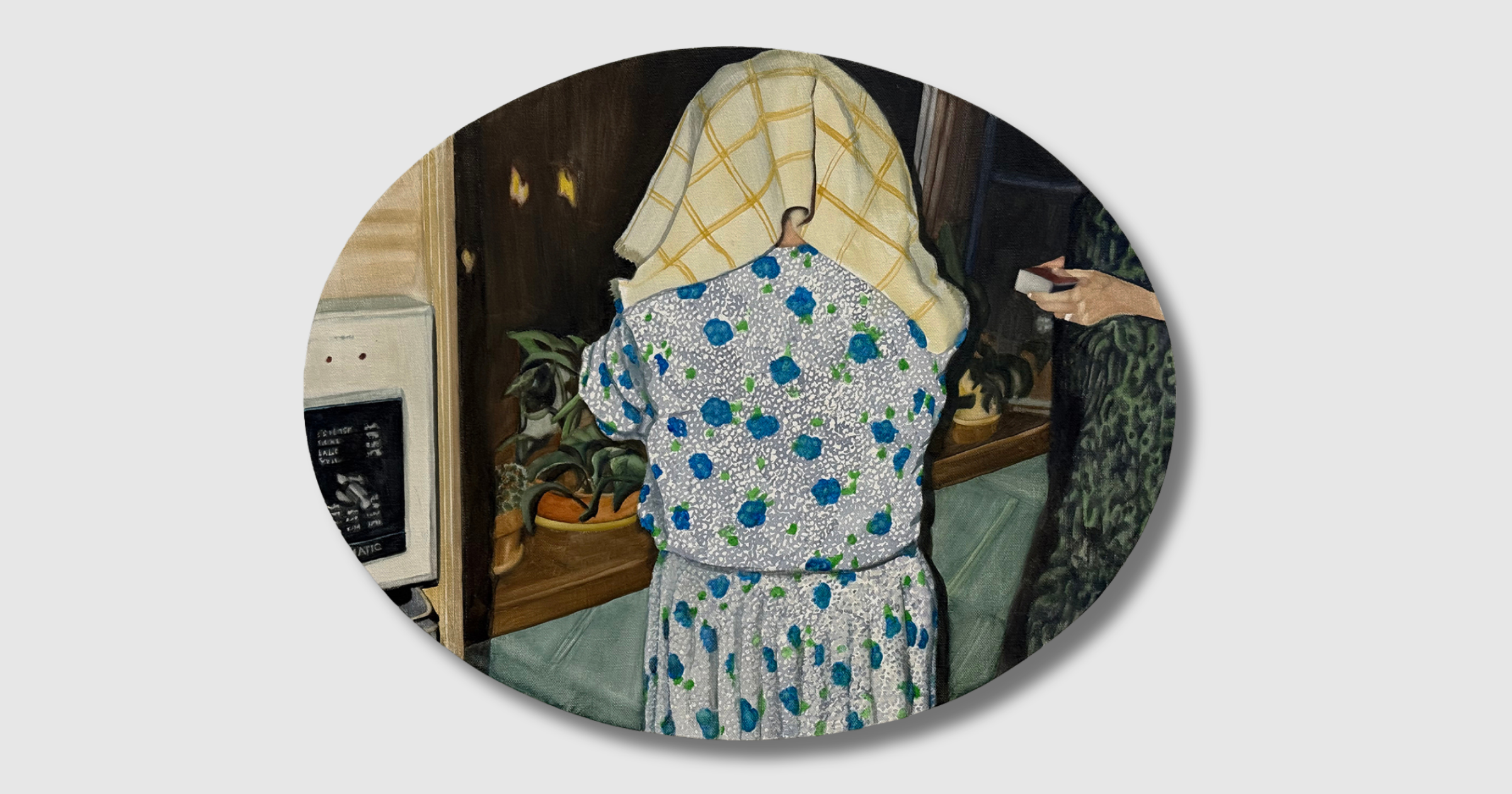
For the past five years, Edelstein, 60, who lives in Los Angeles and may be best known for her portrayal of Dr. Lisa Cuddy on the Emmy Award-winning series House, has been mining her own family photos in watercolor-on-canvas paintings. Edelstein’s nostalgic, often off-kilter images of Jewish slices of life—bar and bat mitzvahs, weddings, women chatting on the phone, children laughing and playing, Shabbat candle lighting—reflect both her childhood memories and 20th-century American Jewish domestic life more broadly.
Her new exhibition, a collaboration with her husband, Robert Russell, is on view at the Skirball Cultural Center in Los Angeles through September.
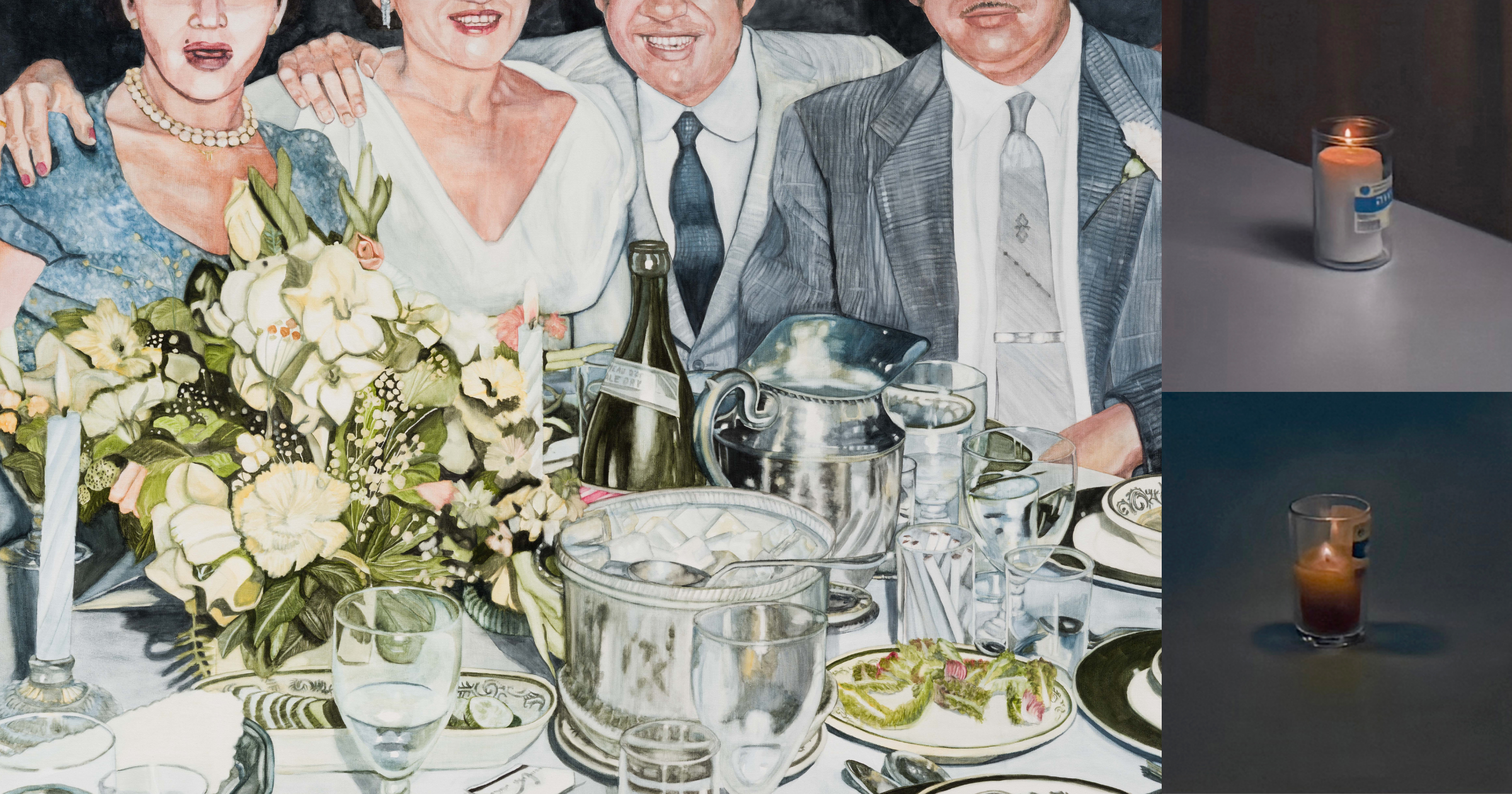
“Robert Russell and Lisa Edelstein: A Palace in Time” pairs Russell’s oil paintings, many depicting Jewish ritual objects, with Edelstein’s intimate watercolors of family. The exhibition subtitle comes from civil rights activist and leading 20th century scholar Rabbi Abraham Joshua Heschel, who described Shabbat as a “palace in time.”
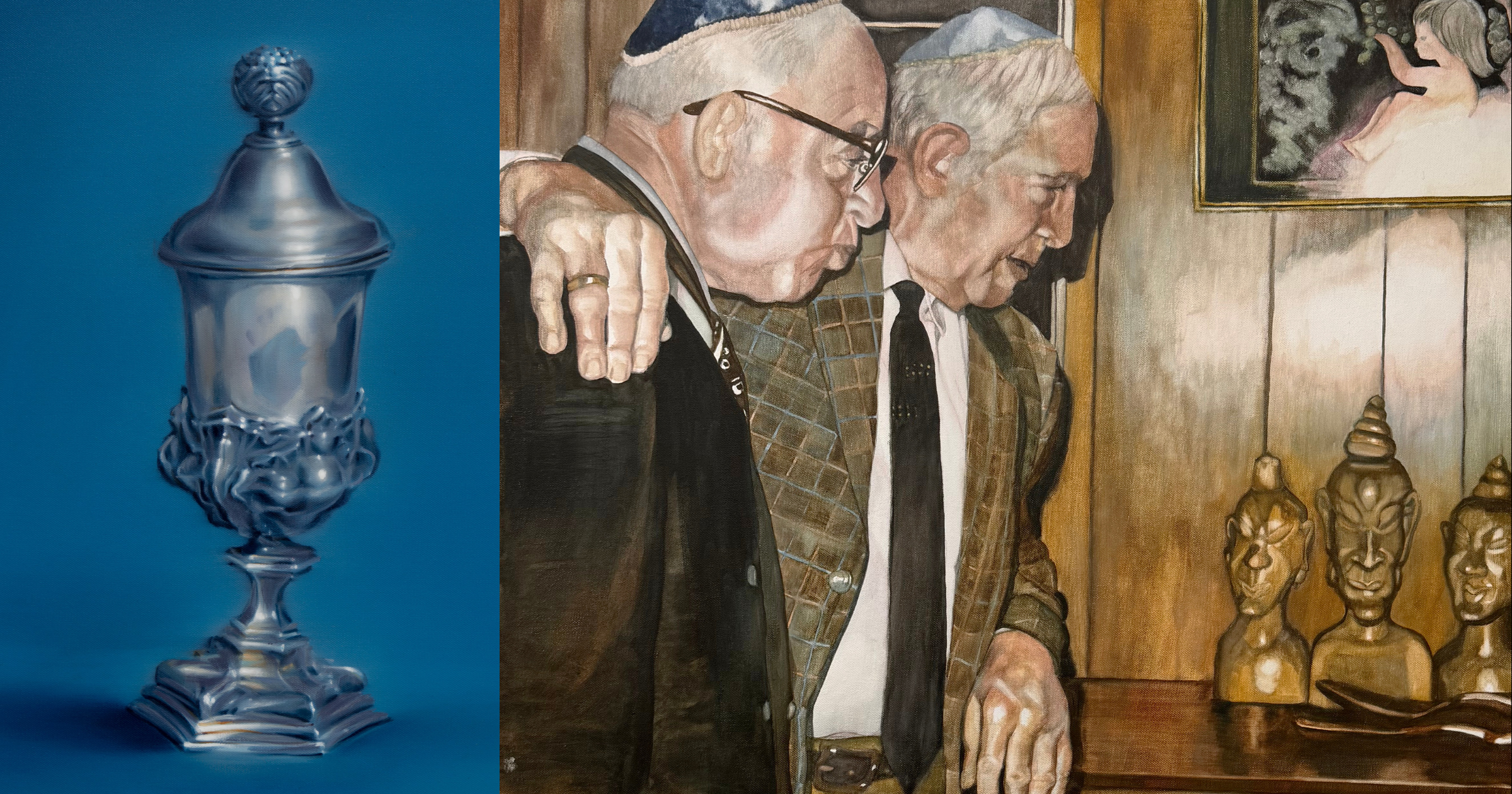
Drawn from shared Jewish traditions, the works explore how moments of celebration and loss shape our existence. In one example, a painting of a wedding scene is paired with one of a yahrzeit candle; in another, an older man reading a newspaper hangs beside a painting of a silver Kiddush cup.
Both in her artwork and in public appearances, Edelstein has been outspoken in her support of Israel. One of her older pieces, The Jerusalem Windows—not on display at the Skirball—shows a group of people having fun at a family gathering. On a wall in the background is a poster of artist Marc Chagall’s stained glass windows from the Abbell Synagogue at Hadassah Hospital Ein Kerem.
“So many Jewish families had this image hanging in their houses,” Edelstein said of the windows. “Jerusalem, as a concept and a country, was ever present in our lives. Despite the comedy that’s taking place between the people pictured, to me, the whole point of that image was the way Israel and Jewishness were part of our everyday experience and the way we built our homes.”
Edelstein spoke with Hadassah Magazine about working with her husband, her experiences with antisemitism and the Jewish themes reflected in her art. This interview has been edited for brevity and clarity.
What is it like working with your husband?
Our life is a collaboration! I met my husband just seven weeks after he’d split with his ex. He had two very young boys, and they were all in chaos. It was probably the worst time in someone’s life to start anything, but we just knew immediately that we belonged together. I met the kids soon after and we’ve all been together ever since. Sixteen years!
On our second date, Robert gave me a beautiful painting of a dove. He asked me for a drawing in return. I had always made things, but as a coping skill. If I was depressed or lonely or not working enough, I’d make things. So in a funny way, it was a reductive use of a really important tool I had to express myself.
What was the initial inspiration for you to start painting your family?
Being with Robert, living with a painter and being around so many amazing artists, slowly changed the way I viewed the things I made. Until finally, during Covid, when there was nothing but time and nowhere to be, I dug in. I had just inherited boxes of photos from my parents who were downsizing. Using these images as a resource, I began to make myself a coloring book of my childhood.
Starting with markers, then with marker refill ink, it soon became apparent that I wanted to make larger pieces, so I learned how to use watercolor. It’s become a huge part of my life, an incredible joy.
Tell me about your Jewish life growing up.
I grew up in a pretty Jewish household. My grandparents were Orthodox. My parents, first-generation Americans, raised us Conservative: I was bat-mitzvahed, we kept kosher, we built sukkahs, we had Shabbat dinners and went to shul on Saturdays. And we had a battalion of different sets of plates and silverware: meat, dairy, Shabbat meat, Shabbat dairy, Passover meat, Passover dairy, Passover Shabbat meat, Passover Shabbat dairy. I don’t know how my mother managed all that!
How does your background connect to your art?
Because my resource began as my own family photos, there was always the presence of yarmulkes and bar and bat mitzvahs and Shabbos candles and Seder plates. When I had my very first show several years ago, it occurred to me that I had put together an extremely Jewish show. What looked just like family photos to me became a portrait, not just of my life but of a version of Jewish life, too.
It feels even more important to me to represent, in every way I can, Jewish life in the Diaspora. And I especially love the feeling of immortalizing old Jewish faces. We don’t find them in classical paintings, so in my small way, I wanted to insert my ancestors into the world of historical representation.
Given the very Jewish nature of your paintings and outspoken support of Israel, have you received any pushback in the art world?
The art world is a complicated and expansive place. So the answer is, ‘Yes, of course,’ mostly from the artists but less from the world of galleries and collectors. I am outwardly Jewish. My name is Edelstein. It’s not confusing. Since October 7, I’ve worn my Star of David, and until the last living hostage came home, dog tags. There were a number of artists who found that offensive, who whispered about it behind my back, who were shocked that I was one of them, those people who believe Israel should exist.
I was naively shocked by how long people had been soaking in anti-Israel, anti-Zionist and antisemitic learnings. This long pre-dated October 7. I remember going to the original Women’s March in D.C., when Trump was elected the first time. I stood in front, by the stage, in an area set aside for celebrities and speakers and VIPs, so I could hear all the speeches. One after another, people were yelling “Free Palestine,” which would have been fine if it hadn’t been almost every single speaker, for three hours, at a march for women’s rights in America. They talked of every kind of bigotry and -ism except antisemitism. Over and over. So I should have known then. But I didn’t really get it.
Did you experience antisemitism growing up?
I grew up in Wayne, N.J., which The New York Times dubbed “The Home of Anti-Semitism” the year my family moved there, in 1967. The head of the school board, in his re-election campaign, published an op-ed in a local paper, that you shouldn’t vote for the Jews running against him because they were going to take Christmas away. That was also the year they’d legally been forced to take down the “No Blacks, No Jews” signs. Anyway, he won the election. Then became mayor. For 12 years. I asked my parents why they’d moved there and they shrugged. It was like that everywhere.
The kind of antisemitism back then was less overt. Being Jewish was somehow unattractive; it meant you had a big nose and bad hair and were spoiled. It took me a long time to have a healthy relationship with that part of myself. That said, I never changed my name, even though as an actress it was limiting. I didn’t want to leave my roots behind, whatever the price.
What’s it like for you to play Jewish characters on television?
It’s very rare that I play a character who isn’t Jewish, or who doesn’t become Jewish once I’ve been playing them for a short while. I don’t do this on purpose, but I’m happy to represent. Sometimes it’s challenging if I feel the stereotyping gets heavy handed, but it at least gives me the opportunity to humanize even the worst of that kind of writing.
Long Story Short, recently received two nominations for Hollywood Creative Alliances’ Astra TV Awards. How did your mother react to your character in the series?
One of the nice things about doing a cartoon is that my mother can’t judge my hair, my outfit, or my shoes, because, well, they’re drawn on. As for the character herself, as far as I know, my parents had a great time watching it and in no way saw a reflection of themselves in any of it, despite that I am 100 percent imitating my mother throughout the entire season!
Have you ever experienced antisemitism in Hollywood?
I once didn’t get a job because “two Jews were one Jew too many” on a show. That one hurt. It’s always sort of been there. It’s less about antisemitism in Hollywood than it is about antisemitism in the audience Hollywood is selling to.
This is a numbers game, like any other business. If having a Jew will make you more money, hire a Jew. If it gets in the way, it’s not going to happen. Hollywood is just a reflection of the culture at large.
You’ve spoken publicly about your support for Israel. How have the events since October 7 influenced your Jewish identity and your connection to Israel?
My husband and I had been reading books about Israel pre-October 7. Our synagogue is very progressive, and there had been a lot of talk about what was happening in the West Bank, so we wanted to get a better understanding of it ourselves.
That’s why we were so shocked by the deep ignorance in how most people talked about the region. We are soaking in news and studies of the Middle East now, so much so that it’s possible I know more about what’s happening there than here. It certainly forced me to recognize how important my Jewish identity is to me and how important Israel is. Half my family lives there, some for many generations. It’s personal.
One final question about the new exhibition: How has your family responded to your art?
The first thing my mom does is name everyone in the painting and tell me some gossip about them. If she happens to be in it, she decides whether she likes the outfit she was wearing or if she was at an approved weight (never.) At some point, she gets to the fact that it’s a painting and it’s good. They love Robert’s work so much, and my parents are both genuinely excited about seeing our marriage express itself in the form of a collaborative show.
Susan L. Hornik is a veteran entertainment and lifestyle journalist living in California.
 Facebook
 Instagram
 Twitter
Larry Snider says
Glad beyond your talent as an actress that you represent a vital part of the Jewish experience in large watercolours well enough to be featured at Skirball. It is important you remember that the anti-Semitic, pro-Palestinian marketing was fully evident at the Womens March long before the Hamas attack in the Negev on October 7, 2023. Its a blessing for me to see even tiny images of your paintings portraying Jewish life itself as normal and beautiful and a fundamental part of America.
Many ThanX
Gail Margolis says
Would love for her to have a showing in south Fla! I always admired her and hope her works are a huge success! Mazel Tov on her marriage!
Joan Edelstein says
Off-topic but taking a chance. Please give your parents my warmest regards. Your father and I, who were in a Yiddish shmues-krayz together, try to figure out if we were possibly related, but the geography of our ancestors was a bit too far apart. When I was growing up in Brooklyn there were nine pages of Edelsteins in the phone book. When I lived in Oakland, it was only my mother and me
I understand that fiddler on the roof in Yiddish will be coming to LA and I hope to visit with your parents the next time I’m down. I also hope you will be having an exhibit as I would love to see your paintings up close. Your parents schep so much naches from you!
Wedding aaha says
Jewish family celebration through art! Different traditions enriching wedding culture. Cultural traditions expressed through modern art! This article showing heritage integration beautifully. Celebrations reflecting couple’s identity and heritage!