



Books
Non-fiction


New Books Explore the Southern Jewish Experience
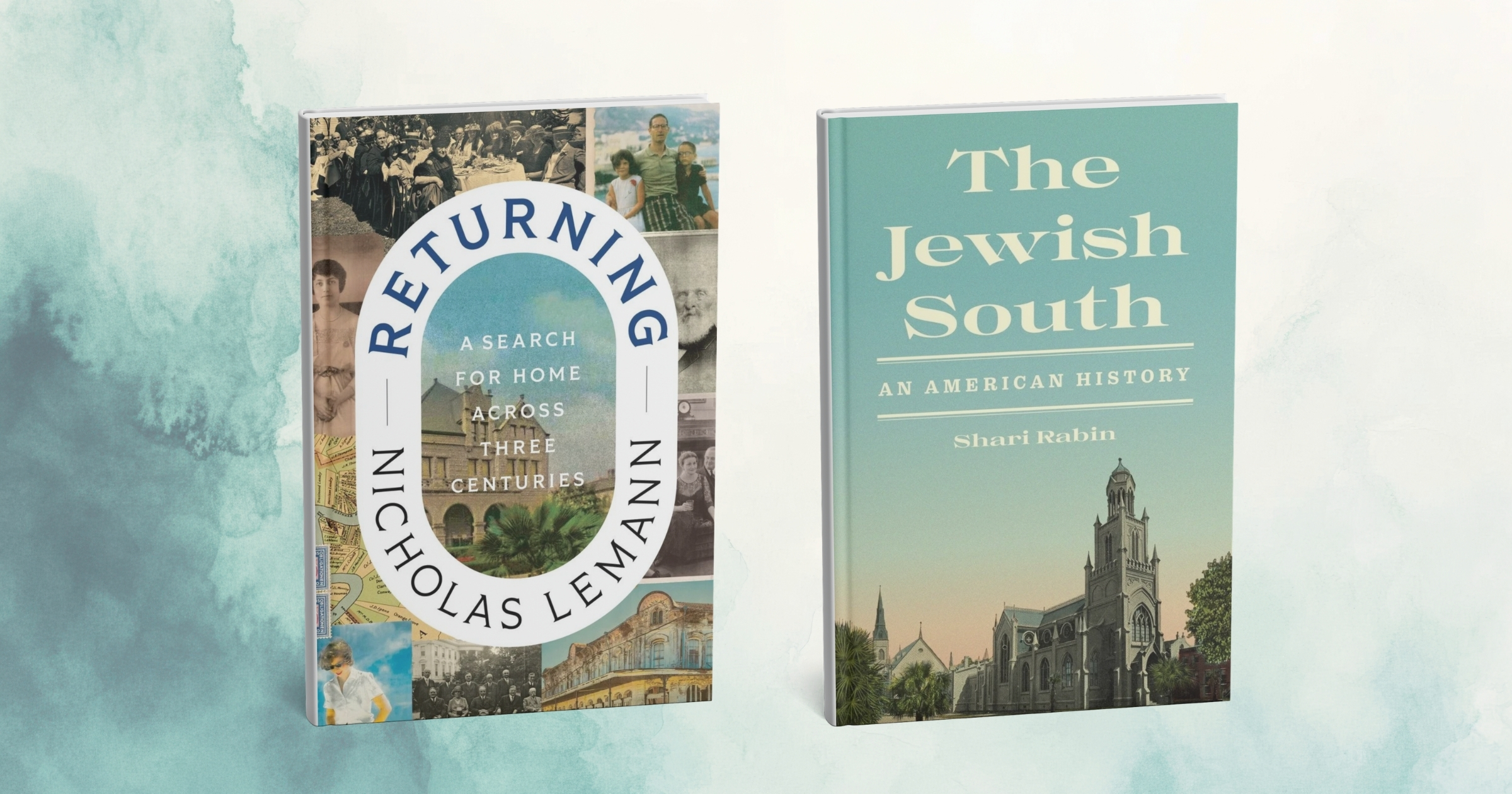
Despite the blossoming of scholarship on southern Jewish history in the past several decades, the southern Jewish experience can still feel a bit foreign. It’s not only because the bustling streets of the Lower East Side are what largely fuel most images of American Jewish history. It’s also because it’s difficult for many today to imagine how Jews navigated life during slavery and, later, in the Jim Crow South.
Two books published within the last year—one a memoir, one a general round-up—help our understanding of this experience by exploring the tightrope that southern Jews walked in a racially divided society.
Nicholas Lemann’s Returning (Liveright Publishing Corporation) follows in the path of Eli Evans’ groundbreaking The Provincials, which was published in 1973 and first ignited an interest in southern Jewry. Like Evans, Lemann intersperses his fascinating family history—his grandfather was a Harvard Law School classmate and lifelong friend of Supreme Court justice Felix Frankfurter—and his own personal narrative with a general recounting of the region.
Lemann, a former dean of Columbia University’s journalism school and the author of the best seller The Promised Land: The Great Black Migration and How It Changed America, (Vintage) chronicles his family’s rise to New Orleans’ southern Jewish aristocracy.
Lemann’s great-great-grandfather immigrated to New Orleans from Germany in 1836. Looking through records and extensive family financial reports, Lemann discovered that his ancestor not only had slaves in his household, he also occasionally accepted them as collateral in business loans. The family moved back to Germany at the onset of the Civil War but later returned and made a fortune as postwar plantation owners.
By the mid-20th century, the South was a world, Lemann writes, in which his family remained Jewish and were identified as such by mainstream New Orleans society. But, as he puts it, “we were southerners first, Jews a distinct second.” He was even the first Jewish person invited to the junior version of the city’s Mardi Gras ball, although he didn’t attend.
His family belonged to a local Reform temple and went to services once a year, on Thanksgiving, not Yom Kippur. They celebrated Christmas at home, but not Hanukkah. In fact, he “can’t remember our doing anything explicitly Jewish for years.” That’s something he’s changed in the second half of his life. Lemann and his second wife sent his two children to a Jewish day school through eighth grade, joined a synagogue and keep kosher at home. He writes that he is now in the “major leagues of living a Jewish life.”
Although his family was liberal by southern standards, the civil rights era was not discussed in Lemann’s house. Indeed, a rabbi at their temple refused to provide support for a sit-in at a local lunch counter, explaining that the New Orleans Jewish community “was in far too insecure a position to feel it could safely support public acts of civil disobedience.”
While Lemann’s family was part of a larger German Jewish immigration to the Unted States in the 1830s and 1840s, the first southern Jews moved north from the Caribbean to what would become the southeastern United States by the mid-1600s, as Shari Rabin details in The Jewish South.
Early on, Jews lived in a limbo status, with more rights than Blacks or indigenous people, but fewer than white Christians, particularly Anglicans. There were laws passed in Colonial America to prevent Jews from holding political office, but they were rarely enforced.
As Rabin, a professor at Oberlin College, writes, Jews neither created nor dominated the slave trade. However, many southern Jews owned slaves. In Richmond in 1820, the average Jewish household included three enslaved people.
The Jewish reaction to the Civil War ran the gamut from active support—2,000 Jews served in the Confederate Army—to vocal opposition.
In the late-19th and early-20th centuries, Russian Jewish immigrants arrived, albeit in smaller numbers than in the Northeast and Midwest. The newcomers’ backgrounds and religion—they were less likely to identify as Reform, the predominant denomination at that point in the South—created conflict with their mainly German Jewish counterparts. This was in part because southern Jews feared a loss of status among their white Christian neighbors.
Rabin makes clear that antisemitism was always present to some extent. She explores the 1915 lynching of Leo Frank and the temple bombings of the 1950s as well as other instances of bias. But by the mid-20th century, southern Jews had moved up the economic ladder. Many were shop owners, of general stores as well as large department store chains.
As the civil rights movement unfolded, only a few southern Jews took the lead in the fight for desegregation, fearing the loss of white business and resenting the confrontational tactics of Black activists.
“As Black citizens intensified their demands for equality, most southern Jews would prove neither heroes nor villains,” Rabin writes.
Taken together, Lemann’s memoir and Rabin’s history go a long way toward fleshing out the uniqueness of the southern Jewish experience.
Peter Ephross, the editor of Jewish Major Leaguers in Their Own Words: Oral Histories of 23 Players, is a longtime writer about the Jewish world
 Facebook
 Instagram
 Twitter

Leave a Reply