




Being Jewish
Hadassah


Remembering Writer Rochelle Furstenberg
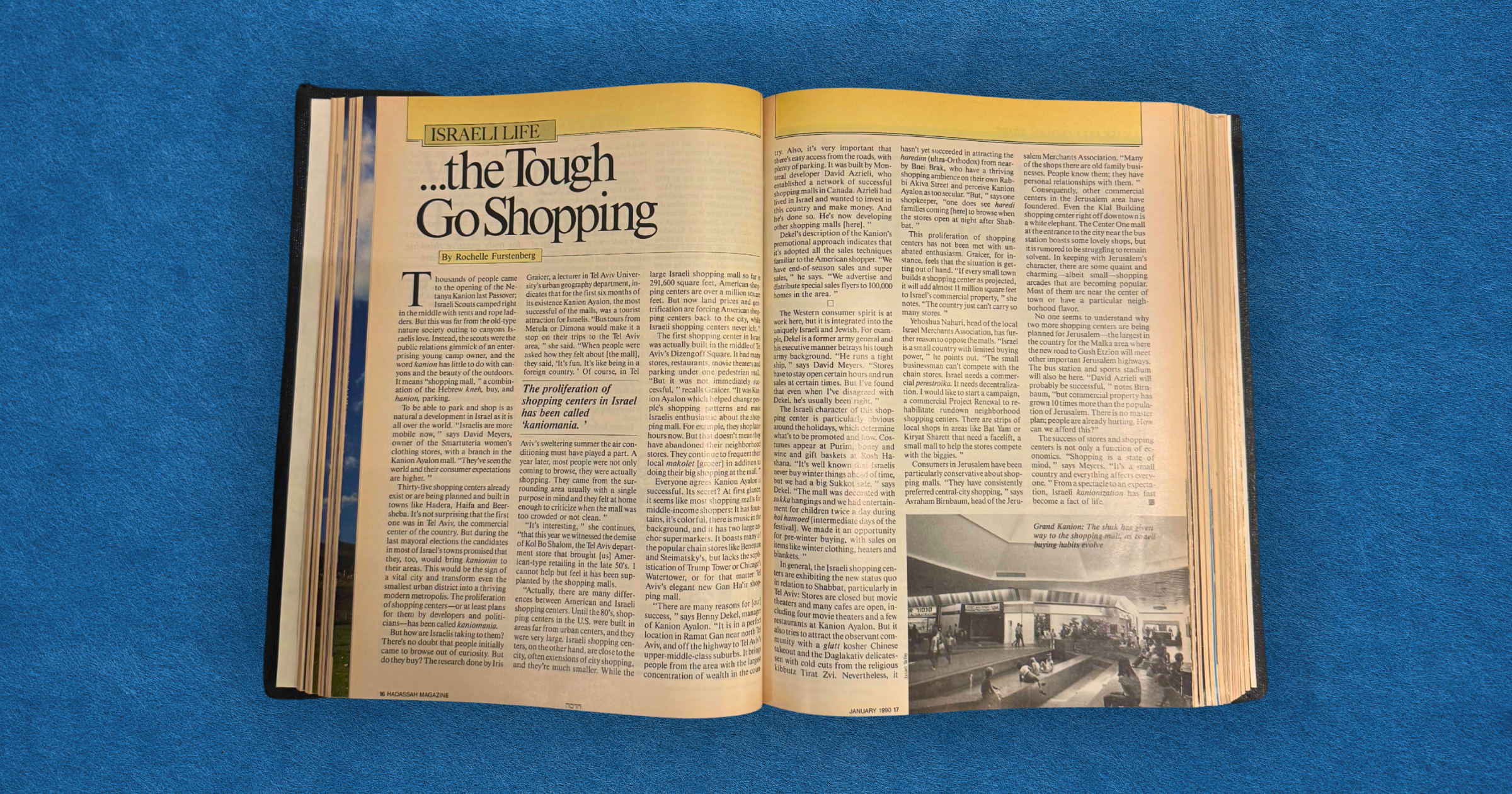
When I interviewed for the position of Hadassah Magazine’s executive editor in 1979, I was asked to write a detailed critique of the publication, with recommendations for changes. In that report, I observed that some of the regular columns had outlived their relevance and, conversely, that some occasional contributors should be offered more space.
One of the writers who fell into the latter category was American-born Israeli journalist and editor Rochelle Furstenberg. Among the qualities I saw in her work was an eye for small details that helped illuminate larger stories, a skill no doubt honed by her experience as a literary critic. In 1980, making my first trip to Israel in my new position, I met Rochelle in person and invited her to write a monthly column for the magazine. She continued for the next 35 years—under the rubric of “Israeli Life,” covering the country with passion and abiding curiosity.
Rochelle passed away on September 11 at the age of 90, leaving a loving family and generations of appreciative readers—not only of Hadassah Magazine but also a long list of publications she served as a writer or editor.
Over the years she wrote for this magazine, she covered an Israeli culture bursting at the seams and a society striving to knit itself together. A tiny sample of the issues she examined includes the integration of immigrants from the former Soviet Union and Ethiopia, the evolution of Israel’s public transportation, Jerusalem’s pricy real estate, and the persistence of beggars—not just those who frequent the Western Wall plaza but also the one who climbed the three flights of stairs to the door of her Jerusalem apartment. She explored the formative nature of army duty, the often-controversial system of exemptions and the role of Israeli Arabs in national service. She chronicled the evolution of Israeli feminism, employment for Orthodox women and the emergence of Orthodox single mothers.
In her columns she also indulged—and allowed readers to savor—a passion for how Israel’s development played out in its literature and culture. Some of the columns that stand out in memory involved the Shalev family—Israel’s writing dynasty and answer to the Brontë and Dumas clans—the biblical vein running through Israeli rock and popular music, and the Jerusalem and Tel Aviv cafés where the country’s journalistic and literary elites gathered.
I was privileged not only to be Rochelle’s editor but also her friend. She was wise, kind and unpretentious. Beyond our regular story conferences there were the dinners she hosted, usually with 15 to 20 people, most in journalism and the arts, crowded into her living room—evenings that evoked the literary cafés she wrote about and an echo of the artists’ salons that once flourished in Paris and Vienna.
Rochelle Furstenberg is survived by her husband, Professor Hillel Furstenberg, a world-renowned mathematician (recipient of the Israel, Wolf and Abel Prizes), with whom she had five children and 16 grandchildren.
May her memory be for a blessing.
Alan M. Tigay is editor emeritus of Hadassah Magazine. He writes about music from around the globe at worldlisteningpost.com.
 Facebook
 Instagram
 Twitter


Leave a Reply