




Books


A Jewish Showbiz Empire in Ireland
Several months ago, I returned to Dublin. It was where my father had been born, though he moved to England as a young man, and where I, as a youngster, spent many happy times visiting family.
Over the past three-plus years, Ireland has become highly critical of Israel, with that sentiment sometimes extending to treatment of Jews in the country. Ireland’s Jewish Representative Council has noted a sharp rise in antisemitic incidents, and relations between Israel and Ireland have deteriorated, with Israel shuttering its embassy in Ireland in 2024 over the Irish government’s attitude to the conflict in Gaza.
I traveled in Ireland with my three daughters and sons-in-law. Although my girls and I have dual Israeli and British citizenship, we decided, in an Israeli dafka kind of way, to enter Ireland on our Israeli passports, despite possible hostility.
As it turned out, the gesture was unnecessary.
From the moment we arrived, we were met with warmth and kindness. The taxi driver who drove us from the airport spoke enthusiastically of his plans to visit Israel. At the City Library, the archivist lauded the Jewish contribution to Ireland. An Irish radio personality, whose uncle had known my uncle, was more pro-Israel than we were. Everywhere we went, people we met expressed dismay at their government’s harsh stance toward Israel.
I was in Dublin for the launch of my recently published book about my family’s Irish roots. The event took place at the Walworth Road Synagogue, co-founded by my grandfather in 1911 and now part of the Irish Jewish Museum. The synagogue is in Portobello, the central Dublin neighborhood once known as Little Jerusalem because it was home to so many Jewish immigrants around the turn of the last century.
Portobello is no longer a Jewish area, but on the afternoon of the book launch, the historic synagogue was full, its 300-year-old wooden floor creaking beneath the feet of those gathered to hear about the show business dynasty founded by my paternal grandfather, Maurice Elliman.
His story is, in many ways, little different from that of the three million other Jews who fled the pogroms of Eastern Europe in the late 19th and early 20th centuries. Maurice started life in a Lithuanian shtetl, where, in 1892, a bottle of vodka was all it took for the border guard to look the other way as my grandfather, then 20, crossed the border. From there, he walked 700-plus miles to Hamburg, boarded a ship and ended up in Dublin, where officials changed his name from Moishe Helman to Maurice Elliman.
A traveling cantor in Lithuania, he became a door-to-door peddler and then a grocer. He learned English and saved enough money to marry and bring his mother and brothers to Ireland.
Where my family’s story takes an unusual turn is in the business they entered. For the first 60 years of the 20th century, the Elliman name was synonymous with entertainment in Ireland. The family owned 31 cinemas and three theaters: the Queen’s, the Gaiety and the Theatre Royal. They brought American stars, including Bob Hope, Danny Kaye, Jimmy Durante and the Three Stooges to Irish audiences. Judy Garland performed a two-week residency at the Theatre Royal, Ireland’s largest theater and the second largest in Europe, with 14 sold-out performances. The Queen’s drew packed crowds for its Sunday night wrestling spectacles throughout the 1940s.
The family business began around 1910, when Maurice acquired a bioscope, or magic lantern, a then-new technology that projected moving pictures onto a screen. He began by presenting magic lantern shows at traveling fairgrounds and moved on to building cinemas throughout Ireland. By the time he died in 1952, he was hailed by Irish newspapers as “the father of the Dublin film trade.” His funeral procession brought such crowds that the police stopped traffic throughout Dublin.
His charismatic son Louis, the third of his 12 children, took over for him, becoming Ireland’s greatest impresario of the early 20th century. Louis expanded the business his father had begun into a national entertainment empire, launched many a career and founded the country’s first film studios at Ardmore. Known as Ireland’s Mr. Show Business, Louis brought to Dublin worldclass performers in international theater, opera, dance and music.
When World War II closed the seaways to international stars, Louis nurtured homegrown talent, among them singer Josef Locke, actor Mai Devitt, entertainer and performer Dickie Forbes, actor Maureen O’Hara and radio and television presenter Eamonn Andrews. When the war ended, Louis made two high-profile visits to Hollywood, where he was feted by the major film studios, partied with glittering stars (and one party thrown just for him by gossip columnist Louella Parsons) and met with legends from Louis B. Mayer to Walt Disney.
Interwoven with this story of entrepreneurial success is that of a family finding its feet in a new world. They were part of the wave of Jewish refugees from Eastern Europe, many of them observant, who joined and quickly reshaped Ireland’s 600-year-old, largely Sephardic and more secular Jewish community.
The newcomers became the dominant force in Irish Jewish life, remaking it around their own synagogues, traditions and communal structures.
Like many Jewish immigrants in these years, my grandfather worked hard, educated his nine sons and three daughters, and when he achieved success, moved his family to better housing in better neighbourhoods. He also endured loss, burying his wife and three of his children as well as sitting shiva for a fourth, his son Bennie, who converted to Catholicism; his other children refused to sit with him.
I grew up hearing stories of my grandfather, who passed away a few years after I was born, and began writing them down to preserve them for Maurice’s descendants, not least among them, my own daughters and four (and counting) grandchildren. As I dug through family memoirs, journals, documents and anecdotes, I came to understand how foundational a role my grandfather and uncles—primarily Louis—had played in establishing Dublin as a vibrant cultural hub.
My father, Hymie, was the only one of Maurice’s sons who never entered the family business. Instead, he earned a medical degree and moved to London, where he met and married my mother. That was where I was born and lived, until moving to Israel in 1974.
As a child, our visits to Dublin were regular family highlights, from the warmth of the community to the free seats for the latest plays and movies. Although most of my family has since left Ireland, a core remains, and through them my own children have come to know that same sense of belonging.
The book is both a tribute to my Uncle Louis, who never had children, and a portrait of Irish Jewish life from the 1890s to the 1960s. It is also a reminder that Ireland’s Jewish community—never more than 5,500 people at its peak in the 1930s and now less than half that size—made an outsized contribution to the country’s cultural life.
Graciously received, for the most part, by this staunchly Catholic country, Irish Jews became part of the fabric of the nation while quietly keeping their faith and traditions. In today’s changed landscape, the antisemitism that once remained largely beneath the surface seems increasingly strident and acceptable in public discourse.
Yet the welcome my daughters and I received was a reminder that Ireland’s hostility is not the entire story. While much reduced, a Jewish community remains in Ireland—members of my family among them—living there with a strong sense of loyalty and belonging.
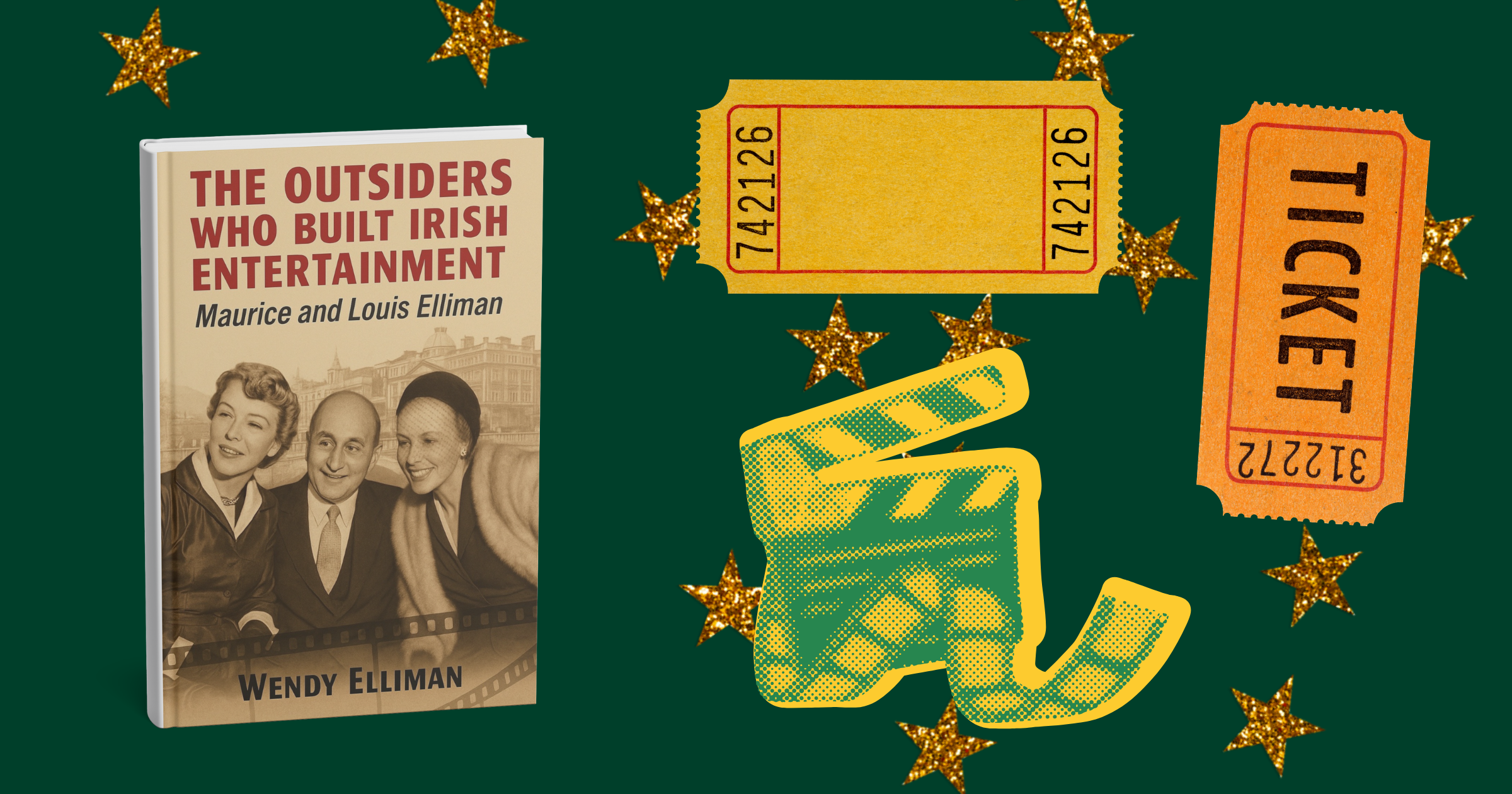
Wendy Elliman, a long-time correspondent for Hadassah Magazine, is a British-born science writer who has lived in Israel for more than five decades. This essay is adapted from her book, The Outsiders Who Built Irish Entertainment: Maurice and Louis Elliman (Vallentine Mitchell).
 Facebook
 Instagram
 Twitter


Leave a Reply