



Books
Non-fiction


REVIEW: ‘A Call at 4 AM’
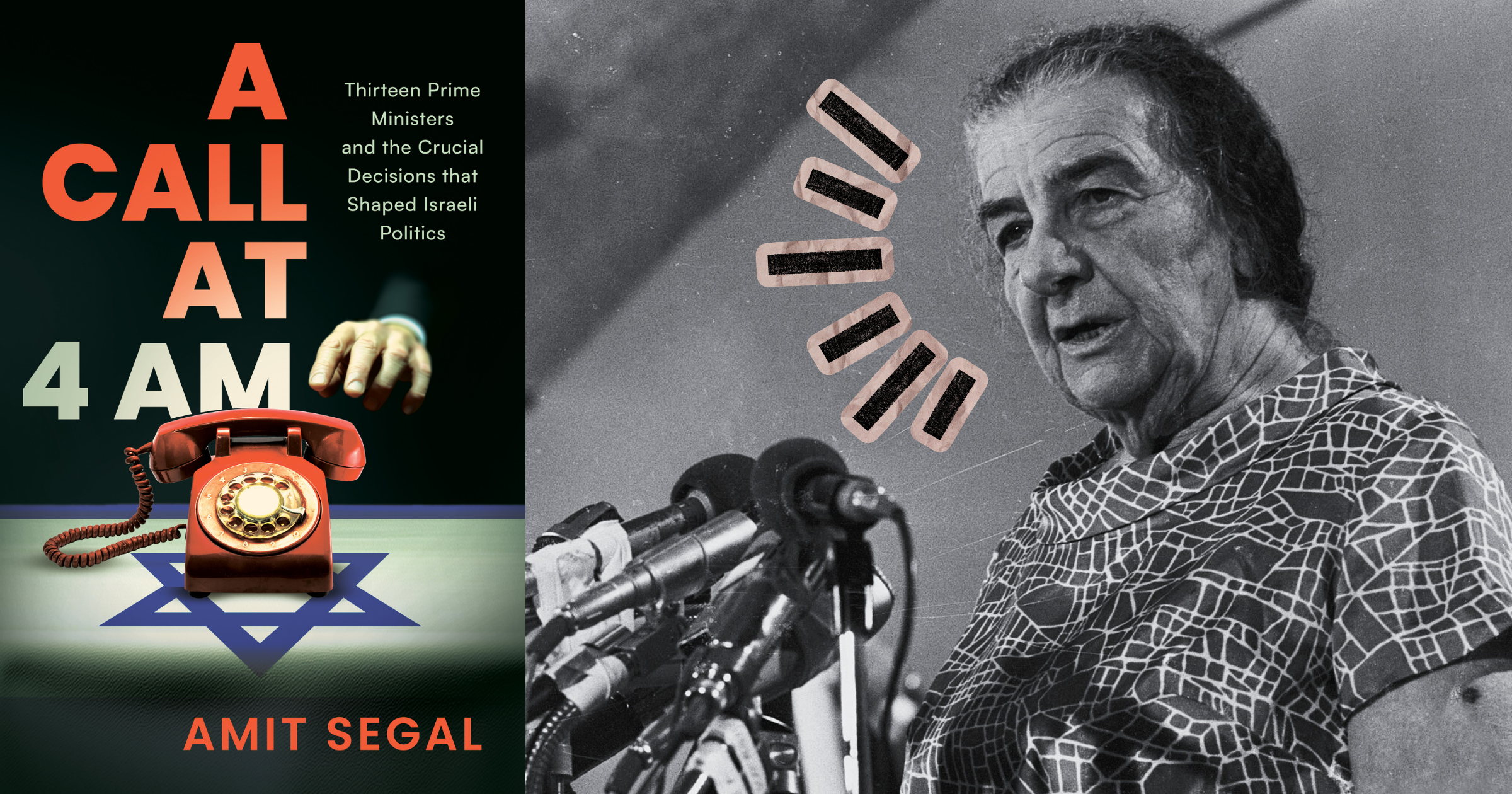
A Call at 4 AM: Thirteen Prime Ministers and the Crucial Decisions that Shaped Israel
By Amit Segal (Post Hill Press)
Amit Segal, a highly respected Israeli journalist with great insider access and a prodigious grasp of his country’s history, has done a yeoman’s job of demystifying the Jewish state’s unique and complex politics. He accomplishes this feat by taking us behind the scenes of critical decisions made by most of Israel’s prime ministers.
Among them is Golda Meir’s tragic decision in 1973 not to order a pre-emptive strike on Egyptian and Syrian forces when intelligence sources clearly pointed toward the countries gearing up for an attack. After suffering recurring nightmares during the summer of that year, she received a phone call at 4:00 a.m. on Yom Kippur morning and heard a voice on the line chillingly say, “There will be a war today.”
This 4:00 a.m. call is the book’s central metaphor and basis of its title. When Americans go to the polls, the dominant issue often is the economy. In Israel, Segal stresses, it is security. “Inside the voting booth, hidden from view, most Israelis, most of the time, vote on the basis of a single question: When the red telephone rings at 4:00 AM, who should answer? Who should pick up the receiver and make the fateful decisions that will keep the State of Israel alive?”
Segal investigates the structure of Israel’s voting system through the crucial decision that Israel’s first prime minister, David Ben-Gurion, made at the country’s creation. It was his decision to establish an electoral system of proportional representation and a low threshold for parties to gain admission into the Knesset. That “slapdashery,” as Segal calls it, has defined Israeli politics ever since. Leaders of the largest parties have always needed to stitch together often dysfunctional coalition governments that depend on the support of—and grant outsized influence to—fringe parties with parochial interests.

How was it possible for Ben-Gurion to agree on an electoral system he subsequently described as a “cancer in the body of the nation?” The author offers no definitive explanation but does point out that Ben-Gurion himself paid a steep price. Segal writes that he had “to resign no fewer than seven times because of political crises inflicted on him by Israel’s electoral system.”
Although he is on the political right, Segal seems to have a soft spot for longtime Labor Party leader Shimon Peres, often described as a loser in Israeli politics because he never won a general election in his own right.
“In the State of Israel,” Segal writes, “there are eight positions that are considered symbols of the state: the president, prime minister, foreign minister, defense minister, finance minister, leader of the opposition, speaker of the Knesset, and Supreme Court president. Peres served in seven of the eight offices, more than any other Israeli. If that makes him a loser, what does a winner look like?”
Segal, a senior political analyst for Channel 12 and the daily Yedioth Ahronoth, has a complex but sometimes sympathetic view of current Israeli Prime Minister Benjamin Netanyahu. He describes how Netanyahu, the longest-serving leader in the nation’s history, emerged as a master of Israeli coalition politics by consolidating the religiously traditional Mizrahi Jews, the ultra-Orthodox community and Russian immigrants into a cohesive and reliable voting bloc.
Despite Netanyahu’s failure to anticipate the looming threat posed by Hamas, which resulted in the October 7, 2023, catastrophe, he has shown no inclination to accept responsibility and resign. This refusal or reluctance to give up power is a choice shared by all of Israel’s prime ministers, Segal notes in the book’s final chapter, and stands as one of the book’s central themes.
While the book is geared to readers generally conversant in Israeli history and politics, it will be of value to anyone interested in the dynamics of high-stakes political decision-making.
Martin J. Raffel served for 27 years as senior vice president at the Jewish Council for Public Affairs.
 Facebook
 Instagram
 Twitter

Leave a Reply