



Being Jewish
Commentary


What Ruth Taught Me About Jewish Courage
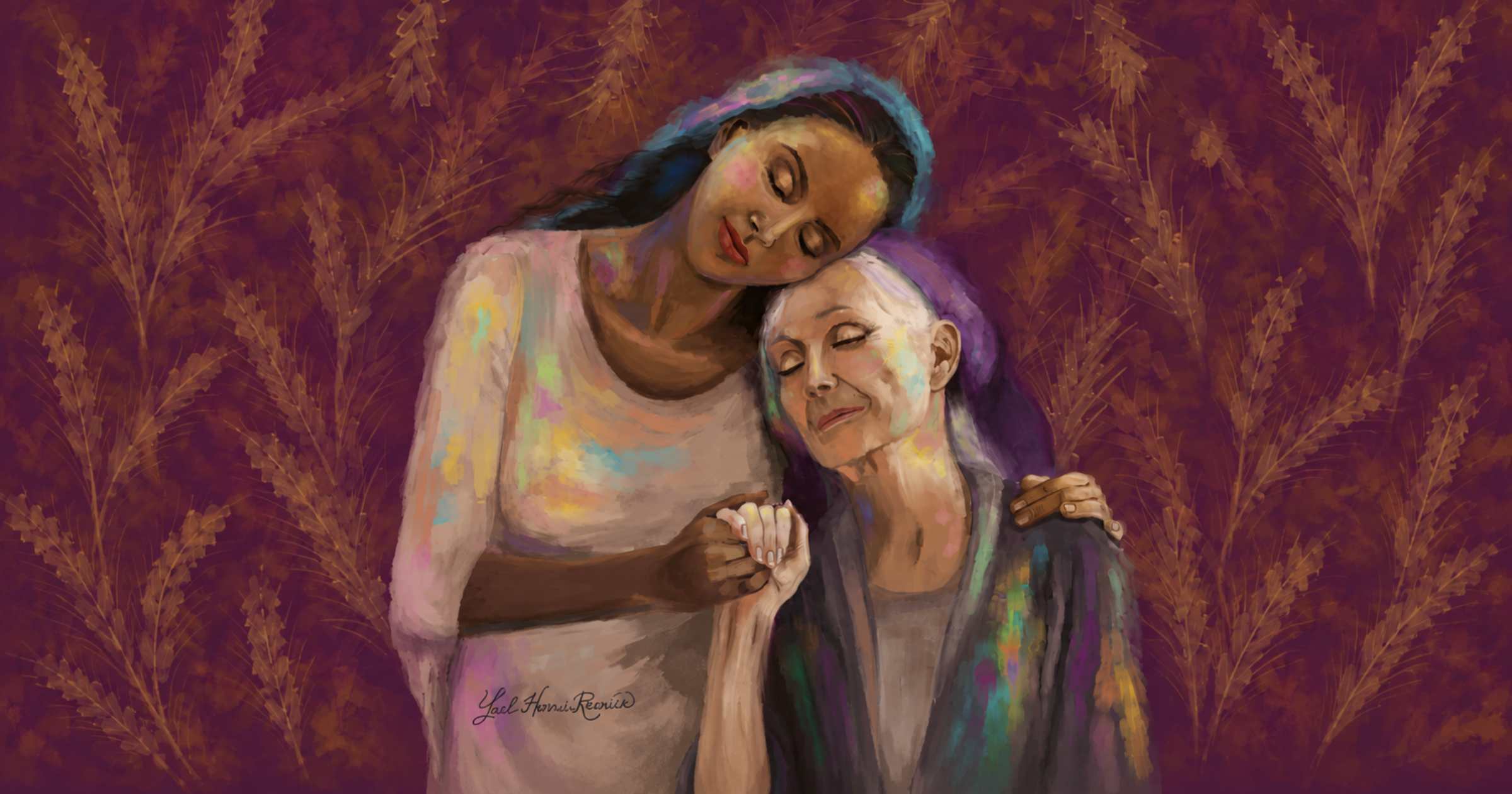
Growing up in a secular Jewish home in suburban Baltimore, I didn’t have much familiarity with Torah. I assumed it must be full of stories about holy people doing holy things, setting a good example for us messed-up modern people.
As a college student, I began to study ancient Jewish texts and discovered that I’d been completely wrong. Stories of Torah were, in fact, every bit as complicated as my own messy life. In particular, I delighted in the way biblical women engaged with complexities I struggled with daily living in a female body, existing in a society oriented around men’s experience and managing the inevitable tensions of human relationships as a daughter, sister, mother and friend.
Decades later, as a musician and a Torah teacher, I’m still studying and teaching about biblical women, exploring how their complicated lives intersect with ours and singing about them with my “Girls in Trouble” songwriting project.
In this spirit, I’d like to invoke Ruth, a brave young woman whose story serves as a guide and model for our own spiritual journeys.
We read about Ruth on Shavuot, which begins this year on the evening of May 21. This holiday celebrates the quintessential Jewish moment of revelation: Moses receiving the Torah, complete with a soundtrack of thunder and lightning, on Mount Sinai. This transforms the Israelites from a scraggly extended family of desert wanderers to a full-grown culture with myths, laws and an elaborate relationship with the Divine.
But this version of revelation, with its fanfare and pyrotechnics, isn’t the only one. Some of the most important transformations, like Ruth’s, are subtle and personal, emerging from deep within. I suspect this is why the rabbis decided we should read her story on Shavuot—as a reminder that quiet, intimate revelations are just as important as the thunder-and-lightning ones.
In Ruth’s story, recounted in the biblical book named for her, she is a Moabite, living in her native land, happily married to an Israelite foreigner. When Ruth’s husband dies suddenly, his grief-stricken mother, Naomi, who also is living in Moab, decides to return to her own land. Somewhat inexplicably and despite Naomi’s protests, Ruth declares that she is going to follow her mother-in-law: “Wherever you go, I will go, and where you stay, I will stay. Your people will be my people, and your God my God” (Ruth 1:16-17).
Ruth’s astonishing journey parallels the earlier story of Abraham, who also leaves his home and embarks on a radical voyage. But while Abraham is explicitly commanded by God to leave his family and go to a new land, Ruth receives no such mandate; she’s responding to an internal imperative. Her simple, poetic lines are at once a declaration of love for Naomi and a testament to this young woman’s remarkable faith in her own journey. Indeed, my “Girls in Trouble” song about Ruth, titled “Separate Histories,” focuses on her leap of faith as she leaves everything she knows and sets out on a quest for meaning, love and transformation.
Ruth is a model of courage for today’s scary, divided world—not just spiritual courage, but also physical and political. As a single woman, she is vulnerable to all sorts of dangers on the journey, as is her equally powerless mother-in-law, yet she makes the bold decision to pursue a new life. Her tribal affiliation as a Moabite carries a history of conflict and mistrust with the Israelites, yet she listens closely to her heart and hears, instead of discord and division, an instinct to draw close to the other.
In a world that attempts to separate us from one another, to disrupt our attention and keep us from listening to the still, small voice inside each of us, Ruth serves as a model of integrity. She inspires us to cross boundaries, to love each other and ourselves. She reminds us to listen closely to what is in our hearts and bravely walk the path of our own spiritual journeys, even when this path feels frightening or dangerous, even when we have no idea where it will lead.
This ancient story reminds us that even in the most uncertain moments of our lives, we’re not alone. We have Ruth to keep us company.
Alicia Jo Rabins is a writer, musician, filmmaker and feminist Torah teacher based in Portland, Ore. She is the creator of “Girls in Trouble,” an indie folk song cycle about biblical women, and the author of five books. This essay was adapted from her recent spiritual memoir, When We’re Born We Forget Everything. Visit her online at aliciajo.com.
 Facebook
 Instagram
 Twitter

Leave a Reply