



Arts


The Jewish Men and Women of the Revolution
On September 15, 1776, just over two months after America declared independence, the British invaded New York. Five days later, fire consumed a third of the city. When the embers burnt out, Congregation Shearith Israel’s Mill Street Synagogue, the first purpose-built synagogue building in North America, stood despite the wreckage.
However, many of the city’s 300 Jews were not there to see the destruction of their homes and businesses or the synagogue’s survival. Having largely backed the Patriot cause, most of New York’s Jewish men and women had fled to Philadelphia and towns in Connecticut ahead of the British advance.
Such displacement defined Jewish life during the war, repeating itself in Newport, Savannah and Charleston. Eventually, even the rebel stronghold of Philadelphia wasn’t safe. When the British entered the city in September 1777, Jewish refugees again took flight, this time westward to Lancaster.
Among them was teenager Rachel Gratz, sent by her father, Barnard Gratz, to relatives in Lancaster for her safety. The teen dutifully wrote letters to her merchant father, who was busy running much-needed supplies to the rebels. She noted she was “minding my schooling” and described a colonel’s funeral that she had attended. Some of her schoolwork resides today in the collection of New York City’s American Jewish Historical Society (AJHS).
Recent histories of the American Revolution have sought to incorporate the perspectives of women, people of color and other minorities. Names like those of financier Haym Salomon and Col. Mordecai Sheftall, the highest-ranking Jewish officer in the Continental Army, may be somewhat familiar. However, the broader story of Jewish participation in the Revolutionary War and its impact on the lives of Jewish men and women has been left out of mainstream histories.
In some respects, this omission makes sense: Jews of that time made up only one-tenth of one percent of the population of the colonies. Still, their contributions to the Revolution were significant and followed three main avenues: military service, financing and provisioning. Even as Jews helped shape the Revolution, the war in turn reshaped their communities in lasting ways.
Several Jewish museums, exhibitions and archives are honoring the 250th anniversary of the signing of America’s Declaration of Independence. Among the exhibitions are “The First Salute: An Untold Story of the American Revolution” at the Weitzman National Museum of American Jewish History in Philadelphia; “Circa 1776: Jews in Colonial America” at The Jewish Museum in New York City; and “All We Have Standing Between Us: Jews and American Democracy,” with items from the AJHS, at the Center for Jewish History, also in New York City. Together, they paint a fuller picture of Jewish life in the Revolutionary era.
While some colonial Jews supported the British, most supported the Patriots, with Jewish men across the 13 colonies joining Patriot militias. Among them were Joshua Isaacs, who took refuge in Pennsylvania, where he joined the Lancaster militia, and Jacob I. Cohen, who served in the Charleston Regiment of Militia, or Charles Town Militia. This regiment had so many Jewish soldiers that it was referred to as the “Jew Company.”
As soldiers in the Continental Army and colonial militias, Jewish men had a glimpse of the rights they hoped the new regime might extend. In contrast, Jews were often barred from military service in Europe. Even in the Dutch Caribbean, for example, they could serve only in separate militias. General George Washington, however, allowed Jews to fight alongside Christians.
The war’s toll extended far beyond the battlefield. Families endured separation, and women bore the burden of wartime instability, managing households on their own. Sheftall and one of his sons were captured during the defense of Savannah in 1778 and confined to a prison ship notorious for its brutality.
Letters from Sheftall’s wife, Frances Hart Sheftall, preserved in the archives of the Georgia Historical Society in Savannah and in the Mordecai Sheftall Papers at AJHS, offer a glimpse at the difficulties women faced and the roles they took on during the conflict.
Amid smallpox epidemics and British raids, Frances Sheftall struggled to support her family and provide kosher food for her four other children. Taking refuge in Charleston, she turned to “needle worke,” as she wrote in a letter, and laundry services. Despite her own hardships, she brimmed with concern for her husband and son. She took a public role in petitioning for their release, reaching out to Continental officers on their behalf. In a letter to her husband, she lamented that she was “verry misreable [sic] to hear that you and my dear child was in so much distress,” while reassuring her husband that their children sent their love and “long for to see you.”
In addition to fighting, Jews helped finance the Revolution, often by brokering loans. The most famous of these financiers was the Polish-born Salomon, who also served as a spy while living in British-occupied New York City and was arrested twice for espionage.
While engaged in his clandestine activities, Salomon married Rachel Franks, a member of a prominent colonial family. Their ketubah, dated July 1777 and now at New York City’s Jewish Museum, shows that they were married between his two arrests. Being married to a rebel wasn’t easy. When the British ordered his second arrest in 1778, Salomon fled New York, leaving Franks and their newborn child behind. Advancing his own money to the Patriot cause left his wife impoverished after Salomon died of tuberculosis at the age of 44. She wasn’t the only poor widow. Many colonial Jews relied on their wealthier coreligionists for help.
Salomon was not the only Jew using economic resources to aid the Revolutionary effort. Jewish merchants played a crucial role in supplying the Continental Army, relying on extensive trade networks that they strengthened through marriage.
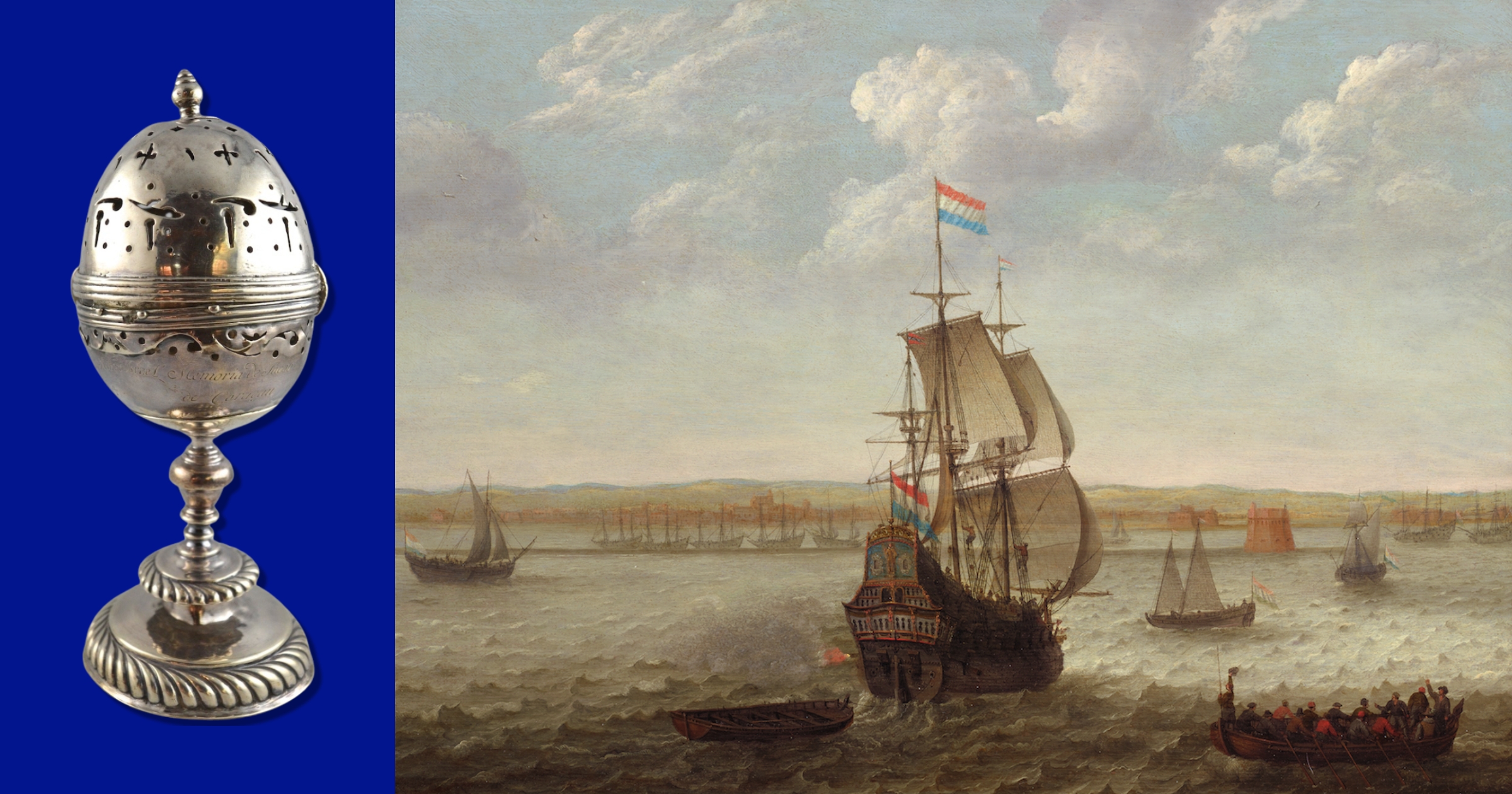
“The First Salute” at the Weitzman museum highlights how Caribbean Jewish communities were pivotal to the resupplying efforts, and in winning America’s independence. The exhibit also reveals that many colonial Jewish merchants sought out marriage partners in the Caribbean, home to the largest, wealthiest and best-educated Jewish communities in the Americas before 1825.
These communities also supported mainland congregations such as New York’s Shearith Israel. Jewish trade networks became conduits for transporting Torah scrolls, tefillin and Hebrew books. Kosher food was shipped, too, as is evident from kashrut certificates from the Caribbean housed at AJHS.
With the start of the Revolutionary War, these trade networks also supplied rebels with guns, ammunition, food, clothing and shoes. Jewish ties to the Caribbean were crucial to this provisioning, particularly with the tiny Dutch island of St. Eustatius. At the time, St. Eustatius’ Jewish population was roughly twice that of New York’s. Northern Jewish merchants sent agents like Moses Myers to the island. Jewish suppliers infuriated British Admiral Rodney, who consequently invaded the island in 1781. In addition to removing the Jews from St. Eustatius, Rodney seized their goods and destroyed the community’s synagogue. Many on the island lost everything, among them Myers, who had set up an import business based there after briefly serving in the New York Second Battalion.
On the other side, Jewish loyalists also used their networks to supply the British. Of the 30 Jews who remained in the city of New York when the British invaded, 16 signed an oath of loyalty to the crown. Fifteen-year-old Rebecca Hendricks of New York made sure to stitch a crown into her embroidery sampler that featured the Ten Commandments. Her father, Uriah, had signed the oath, and the royal motif served as an indication of her and her family’s allegiance to Britain.
Provisioning gave loyalist Jews social cachet with the British and helped keep the Mill Street Synagogue from being commandeered—that is, until renegade British soldiers ransacked the building and defaced the Torah scrolls. Although the soldiers were punished by their superiors, the experience underscores how Jews were subject to abuse during the war regardless of their politics.
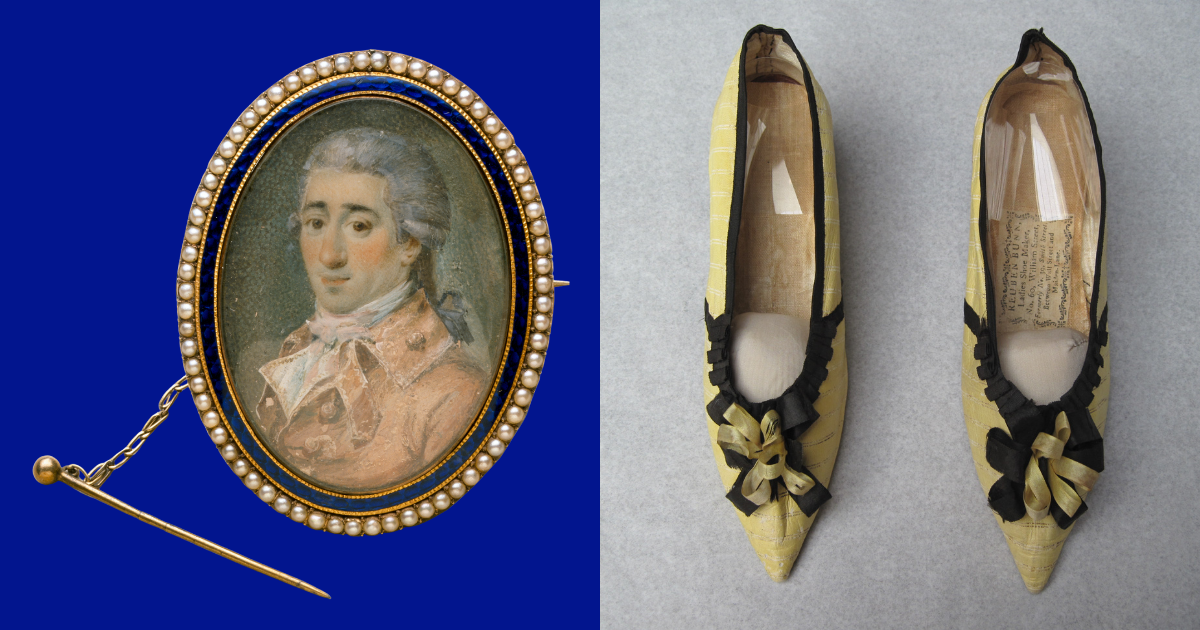
Wartime displacement forged new social ties. The war gathered Jews from different colonies as they took refuge from the British. Many who otherwise might never have met fell in love and married. This was the case for Belle Simon, who met New York refugee and soldier Solomon Myers-Cohen when he attended religious services at her father’s Lancaster home. Simon, like other brides from the era, saved the exquisite yellow silk slippers from her 1779 wedding, now in the collection of Congregation Mikveh Israel in Philadelphia. She and her descendants passed them down as mementos of her wedding and of the Revolution’s impact on the family’s destiny.
The war also changed communities’ prospects. Membership at Mikveh Israel surged due to wartime migration, leading the congregation to consecrate its first synagogue building in 1782. Mikveh Israel, which followed Sephardic rites, thrived.
Seventy years later, its hazzan, Rabbi Isaac Leeser, published the first Jewish American translation of the Hebrew Bible, known as the Leeser Bible.
In Manhattan, loyalist Jews who had safeguarded the Mill Street Synagogue ensured that the community had a religious home to return to after the war, while Jewish merchants supported the city’s expansion.
And in Newport, the brutal British occupation devastated its Jewish community, as did the death of its primary philanthropist, Aaron Lopez. Returning to the city following the British retreat, Lopez drowned when his carriage overturned while he was crossing a pond. Newport’s Jewish community, which had been centered around the historic Touro Synagogue, took nearly a century to recover.
The Continental Army’s liberal military policy led Jews to hope that the new nation might extend full civil rights to Jews. In the war’s aftermath, Jewish congregations across the land wrote to President George Washington, congratulating him while also seeking assurances of religious freedom. He warmly responded to all, but his most famous reply was to Newport’s Jews. In it, he pledged that the new government would give “to bigotry no sanction, to persecution no assistance,” a promise that became a touchstone for Jewish American civic belonging. Every August, around the anniversary of the Newport congregation’s receipt of that historic 1790 letter, TSF Newport, an educational nonprofit, hosts a ceremonial reading.
Later conflicts, waves of immigration and the changing roles of Jewish women in synagogues and society would further transform American Judaism. Yet these changes were built on foundations laid by Jews during the Revolution, when a small and scattered population helped forge a new nation while redefining its own place within it.
Laura Arnold Leibman is the Leonard Milberg Professor of Jewish American Studies and director of Judaic Studies at Princeton University. Her books on early American Jews have won four National Jewish Book Awards and a Jordan Schnitzer Book Award.
 Facebook
 Instagram
 Twitter

Norman miller says
Laura, perhaps Francis Salvador should be prominently mentioned. (Interesting that his family retained a New Testament name.). What he had in common with the Jews of the Caribbean was indigo. His family had 7,000 acres of indigo in South Carolina. He was scalped, a horrible death, by Cherokees allied with the British. He was the first Jewish Patriot to die in the Revolution. As such, his importance should be underscored.