



Books


New Haggadot Celebrate the Contributions of Jewish Women
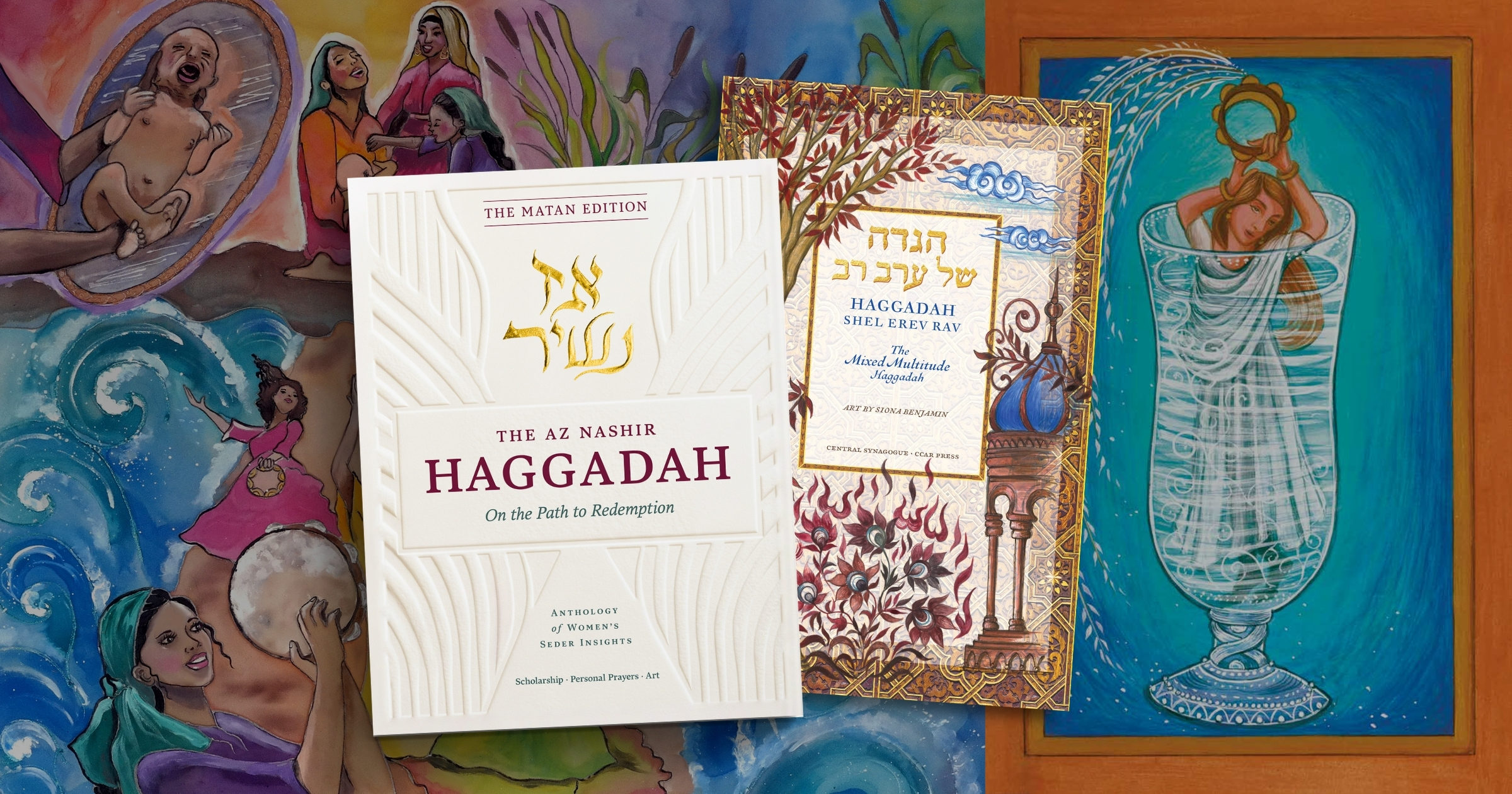
In recent years, an artistic trend has taken hold in some Jewish circles: the decorating of tambourines with biblical verses, floral motifs and imagery from the Exodus. Called Miriam’s tambourines, this craft stems from the biblical account of Miriam, sister of Moses, taking up a timbrel and leading the Israelite women in song and dance upon the liberation of their people after crossing the Red Sea. The depictions represent joyful faith and women’s resilience through musical celebration.
Two beautiful new haggadot with notable similarities as well as clear differences celebrate that same impulse: hope, faith, Jewish textual study and the contributions of Jewish women.
Haggadah Shel Erev Rav: The Mixed Multitude Haggadah (CCAR Press) and The Az Nashir Haggadah: On the Path to Redemption (The Layers Press) both feature illustrations by female artists that enrich the Passover seder narrative as well as essays and commentary by female scholars and leaders. Each includes questions threaded throughout the text, invitations to those gathered at the table to reflect and encouragement to children to engage in the ritual of retelling the Exodus story.
And both devote considerable space in their retellings—through poems, songs and prayers—to Miriam. While not the sole focus of either volume, the prophet’s role in the Exodus story and in leading the women of Israel in jubilation is honored as a symbol of the importance of women throughout Jewish history.
Haggadah Shel Erev Rav uses Miriam’s voice to narrate the Exodus as the collective achievement of women: “I remembered how we got here, how we arrived at our deliverance. Shiphrah and Puah’s defiance. Yocheved’s guile. Batyah’s compassion. Zipporah’s strength. My confidence. It took all of us—a mixed multitude standing together.”
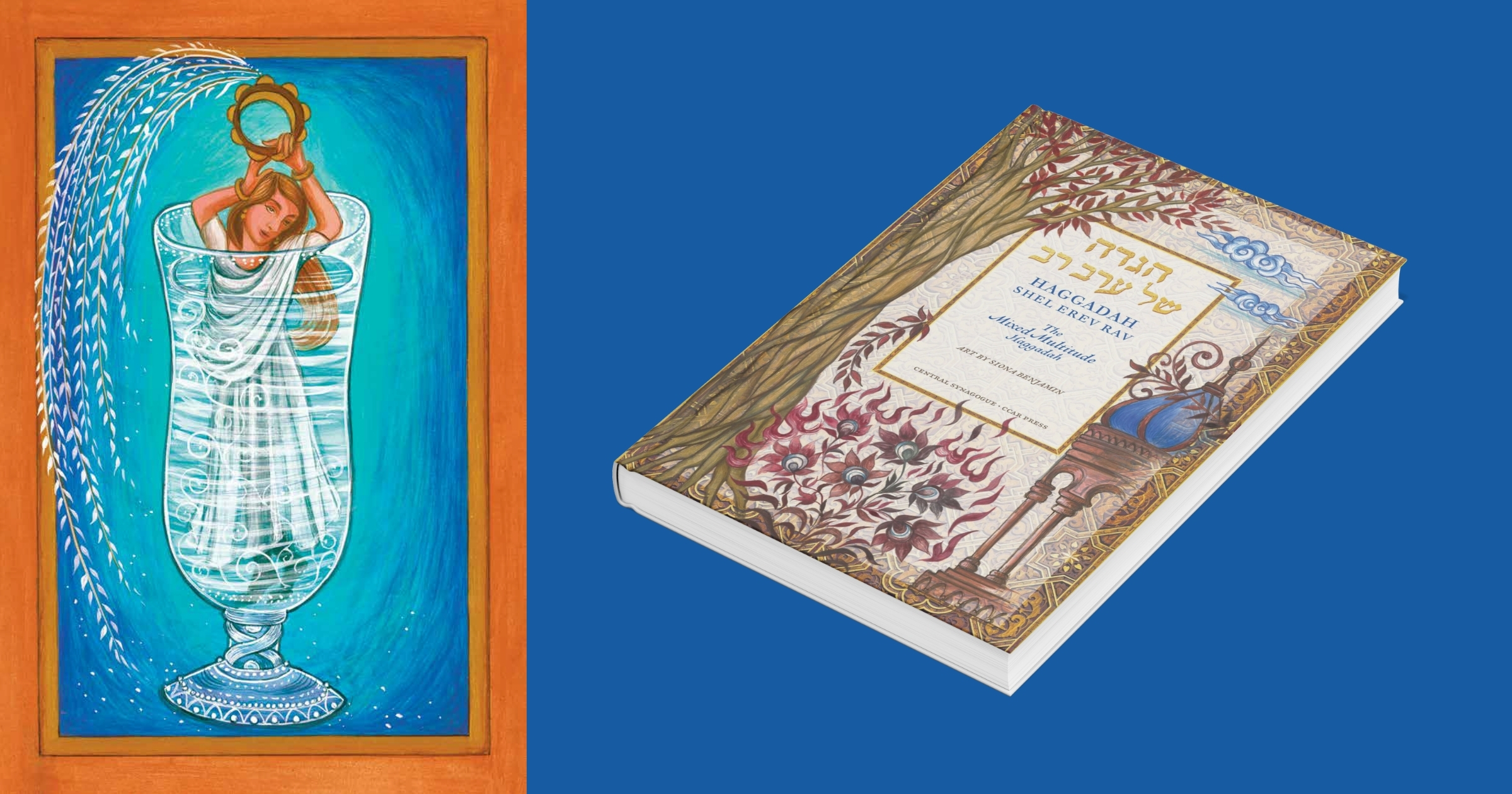
That titular “mixed multitude,” erev rav in Hebrew, is this haggadah’s central metaphor. Found in the Exodus story, the erev rav refers to the non-Israelites who accompanied the Israelites when they left Egypt. Over the centuries, biblical commentaries have interpreted them alternately as riffraff, converts and even mercenaries. Many accuse these “mixed multitudes” of leading the Israelites to sin in the desert.
In her introduction, Rabbi Angela Buchdahl, spiritual leader of Central Synagogue, a Reform congregation in Manhattan, reclaims the erev rav as a “diverse assembly of Israelites and fellow travelers, all swept up in a shared yearning for freedom.”
For Buchdahl, the erev rav represents an early expression of the multiplicity that is visible today in Jewish communities—Ashkenazi, Sephardi, Ethiopian, Mizrachi—as well as in converts and newcomers.
Such diversity also exists in differing modes of observance, from extended seders to abbreviated ones, from those who eat rice on Passover to those who do not. Jews, writes Buchdahl, the first Asian American cantor and rabbi in the United States, were never “a monolith but a mosaic.”
That sacred “multivocality,” as Buchdahl calls it, shapes the haggadah’s structure. Alongside a more traditional text, the haggadah offers four alternate versions of magid (the section of the haggadah that retells the story of the Exodus): “Magid for All Ages,” a family-friendly retelling; “With a Mighty Hand and Outstretched Arm,” centering on divine intervention; “Go Down, Moses,” emphasizing universal redemption; and “Miriam’s Song,” the Exodus told through Miriam’s eyes.
Illustrations by Siona Benjamin appear throughout, featuring floral designs and mandala-like depictions of the plagues. Benjamin’s artwork reflects her Indian Jewish heritage and evokes Persian and Indian miniatures and illuminated manuscripts.
Rooted in the United States, with essays that touch on American history, the haggadah itself was commissioned by CCAR, the Central Conference of American Rabbis, and Central Synagogue to commemorate Buchdahl’s two decades of service to Central.
The Az Nashir Haggadah, in contrast, was created in Israel and dedicated to all the “Jewish women of our generation,” but with a focus on those who have struggled—and persevered—since the Hamas attacks of October 7, 2023. Its contributors come from traditionally observant Israeli communities, and its artwork by female artists spans a range of styles and media, from photography to illustration and papercuts.
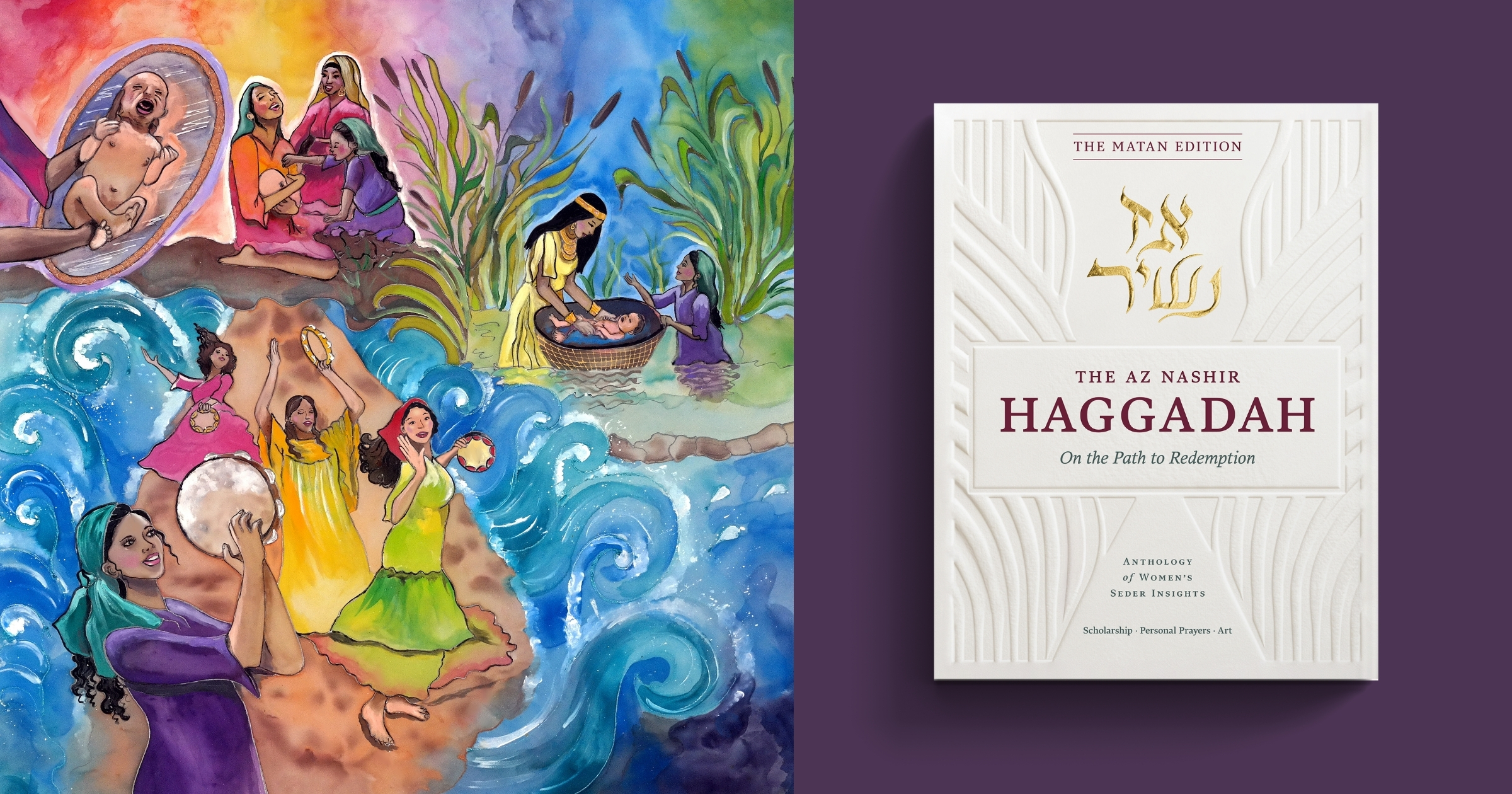
The volume is a collaboration between the SHVILLI Center, an Israeli organization dedicated to uplifting female scholars and artists, and Matan: The Sadie Rennert Women’s Institute for Torah Studies in Jerusalem. The third book in the Az Nashir series, Hebrew for “we will sing,” the haggadah continues a project launched after October 7 to preserve and amplify women’s voices in moments of rupture.
The haggadah brings together some 65 contemporary writers, thinkers, Torah scholars, Jewish leaders and artists. Among them are Ayelet Hoffmann Libson, senior lecturer in the Talmud department at Bar Ilan University, who writes about the plague of the firstborn and the overturning of social hierarchies; Elana Stein Hain, head of the beit midrash at the Shalom Hartman Institute, who makes the connection between hametz and freedom; and Rabbanit Debbie Zimmerman, educator and director of Matan Shayla: Online Responsa by Women, who explores the obligation to retell liberation stories, from the Exodus to the return of Israeli hostages.
To fully appreciate the depth of this extraordinary volume and the flowering of Jewish wisdom from women now surfacing in Israel, readers should explore it well before seder night.
“Not only during the Exodus from Egypt, but in every generation, women have played a vital role in maintaining faith, nurturing hope and shaping the spiritual destiny of the Jewish people,” writes Rabbanit Malke Bina, founder and president of Matan, in the introduction to The Az Nashir Haggadah. “They are the ‘secret weapon’ propelling Jewish redemption forward throughout the ages.”
In celebrating contemporary women, both the Erev Rav and Az Nashir haggadot make explicit what Jewish texts, and Miriam’s song, have long affirmed: women’s central role—in the Diaspora and in Israel, across denominations, institutions and artistic traditions—from generation to generation.
Leah Finkelshteyn is senior editor of Hadassah Magazine.
 Facebook
 Instagram
 Twitter

Leave a Reply