



Arts
Theater


Pamela Gray’s Summer of ’69
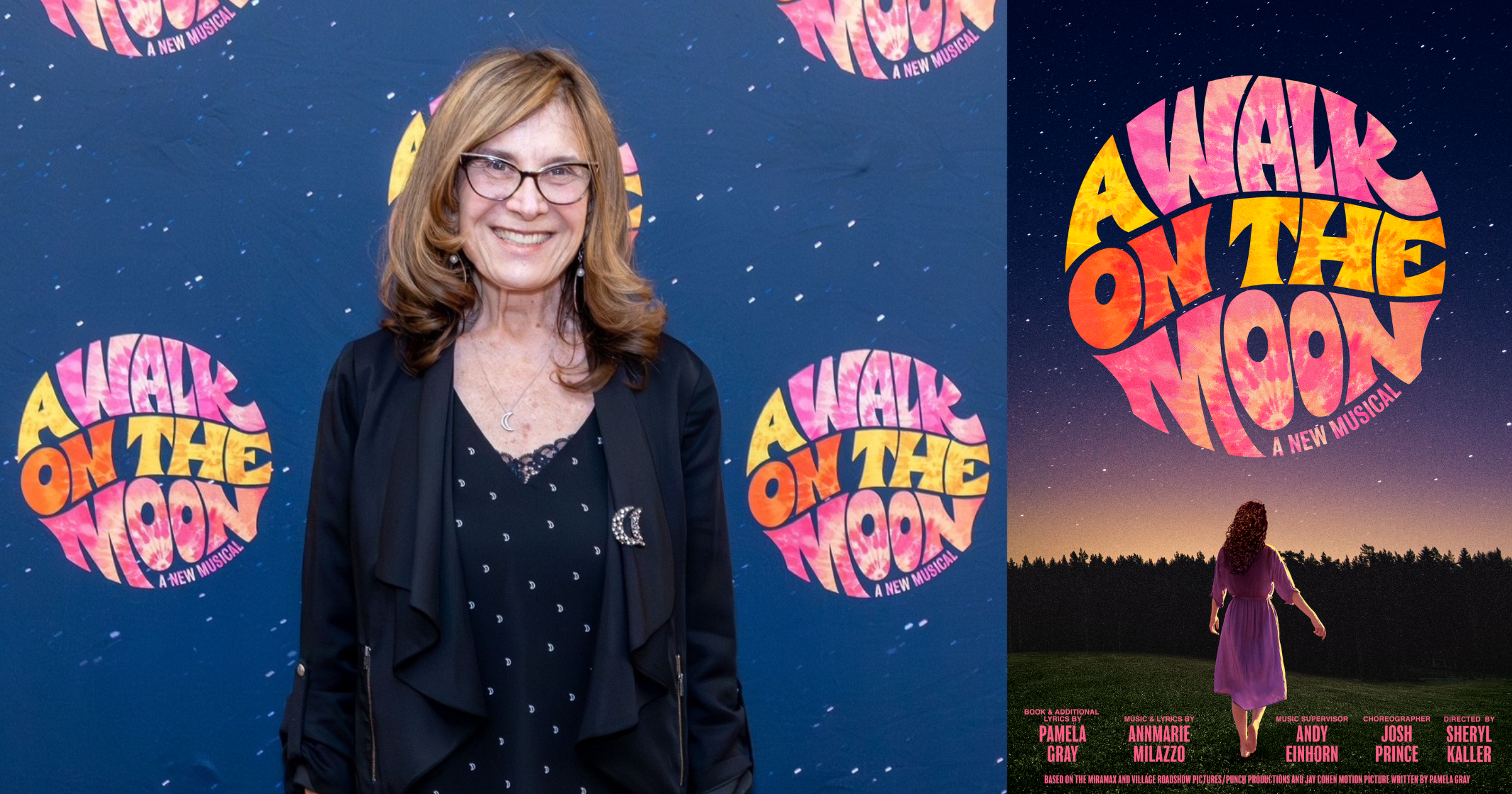
Inspired by her own childhood summers spent in a Catskills bungalow colony, Pamela Gray wrote the 1999 hit film, A Walk on the Moon. Through August, a musical adaptation for which Gray wrote the book and co-wrote some of the lyrics is playing Off Broadway. Set in the Catskills in the summer of 1969—“the summer of all summers,” Gray said—the musical unfolds against the backdrop of the Woodstock music festival nearby and the Apollo moon landing. In a fictional bungalow colony, where wives and children spend the summer with their working husbands coming up for the weekends, culture is changing very quickly. Gray has crafted a story of romance, longing and identity that feels both nostalgic and timely.
Gray, 70, who lives in Santa Barbara, Calif., spoke to Hadassah Magazine while in New York City for the production. This interview has been edited for brevity and clarity.
You’ve made many films based on real-life and fictional stories. Is there a through line connecting your projects?
I’m drawn to female-driven stories about ordinary women who make extraordinary changes. A Walk on the Moon is more subtle than Betty Anne Waters, played by Hilary Swank, a working-class woman who becomes a lawyer to get her brother out of jail, in Conviction, or Roberta Guaspari, played by Meryl Streep, starting a violin program in an East Harlem public school, in Music of the Heart.
For Pearl Kantrowitz, the main character in A Walk on the Moon, the changes are emotional leaps. She was married and had a baby at 17, and she’s starting to recognize that she missed out, skipped adolescence—especially as she watches her teenage daughter, Alison, come of age.
What made you think about setting a feature film in a Catskill bungalow colony?
I had seen Dirty Dancing, the 1987 film with Jennifer Grey, set at a Catskills resort like Grossinger’s. But bungalow colonies were different. We were working class. I wanted to put them on the map.
I wrote a screenplay in film school that I called The Blouse Man, named for the man who’d stop at the bungalow colonies with a trunk full of blouses for sale. There was also a fruit man and Ruby the knish man. That screenplay became the film A Walk on the Moon.
What was the process for turning A Walk on the Moon into a musical?
It was a new experience working with a composer-lyricist. Developing a musical is a collaborative effort—different artists coming to the story with their own lens. It’s amazing how long I’ve known these characters, and yet I got to know them anew.
I had terrific, talented collaborators all telling this story. We have a Jewish woman as director, Sheryl Kaller, and our creative team includes music supervisor Andy Einhorn, choreographer Josh Prince, with sets and projections by Tal Yarden.
Can you describe some of the music in the show?
It’s a combination—1950s-style music and then rock’n’roll comes in.
I introduced a scene with one of the bungalow colony women buying a copy of Betty Friedan’s The Feminine Mystique, thinking it was a book of beauty secrets. She and her mah jongg partners were not so interested in Betty’s ideas, although Pearl is intrigued. Composer-lyricist Annmarie Milazzo has them sing:
“How when I don’t have a car/ could I ever be a Brownie chauffeur/ Hey Betty, Betty/ Keep your book/’cause we ain’t ready.”
The Catskills is having a cultural comeback. Can you share some memories from your time there?
In the 1950s, my father was a tummler, or social director, by day, and he and his partner, Danny, performed comedy at night, mostly at The New Roxy Hotel in Loch Sheldrake. He was still doing comedy when he met my mother, and then he became a salesman.
My dad’s love of “the Country,” as people called the Catskills, led us to spending every summer in bungalow colonies in Sullivan County.
My parents developed deep friendships, and they sometimes had adjoining bungalows next door to friends. One summer, there was a hole in the kitchen wall to the adjoining bungalow. My dad would say, “Ben, pass the salt,” and Ben would request something back. This became their nightly routine.
The women got to be with their friends all summer, and I was too young to appreciate what a luxury this was. The wives had hours of free time to talk, laugh, swim, read, play cards or mah jongg.
What do you remember about the summer of 1969?
I was 13, sitting with the bubbes at the pool at Dr. Locker’s Bungalow Colony in Mountaindale, N.Y. Some women nearby were playing mah jongg. Beyond the chain link fence, I watched hippies holding signs and walking to Woodstock. I wanted to throw myself over the fence and go with them.
Have you been back to the Catskills lately?
Yes. I’ve taken some road trips with my mom and brother. Even though it’s not the same world that it was, it’s still the mountains, and the air up there still smells good, the same smell I remember from my childhood.
When I could finally afford my first house, I bought a house “in the country” in Northern California, because I always wanted to feel like I was living in the Catskills.
Sandee Brawarsky is an award-winning journalist, editor and author of several books, most recently of 212 Views of Central Park: Experiencing New York City’s Jewel From Every Angle.
 Facebook
 Instagram
 Twitter

Janine Gorell says
I went to high school with Pamela Grey. She actually lived down the block from me. I had no idea that she went and spent the summer at the Catskills the summer of Woodstock. I was in teen trails and we took a weekend in the Catskills to be returning home in the middle of the Woodstock traffic. I was exactly the same age as Pam very interesting perspective and a walk on the moon. I wish I’d be able to see the show, but I am not in New York. She can reach me through KAREN if she’d like to hoping all is well with her.
Ellie Solomon says
I saw the show and it is fabulous. I live in Colorado Springs and visited NYC in July, where my son works at Lincoln Center. I honeymooned in 1962 at The Nevele Resort for a week.
Thank you for your wonderful show.
Ellie Solomon
Ellie Solomon says
I just saw the play in NY, in July, while visiting our son, who works at Lincoln Center. We live in Colorado Springs. My husband, son and I loved it. Thank you for a wonderful play. We honeymooned at The Nevele Resort in 1962.