



Books
Being Jewish


The Jewish Story Missing From America’s Classrooms
In educational philosophy, there is a concept called the Null Curriculum: material that isn’t taught in schools. Educators have pointed out that the Null Curriculum is in fact part of the curriculum, because by not teaching it, teachers silently tell students that the people entrusted with their education take no responsibility for it. Students will still learn this material, just not from their teachers—and sometimes in inappropriate ways with less than accurate information. Consider the ways children often learn about sex when it isn’t taught in the classroom.
In my travels around the United States speaking about my work focusing on antisemitism and attitudes about Jews, I have encountered many people with a deep curiosity about Jews. These people have asked me their questions and have asked me where they can go to learn more. There is so much more ignorance than malice.
A few months after the October 7, 2023, massacre, I spoke at a Holocaust educators’ conference in central Pennsylvania attended almost entirely by non-Jewish teachers, most of whom teach in public schools that have few or no Jewish students. All of these teachers were very passionate about fighting bigotry—and very dedicated to teaching about dead Jews. I asked them what they thought the purpose of Holocaust education was, and they all said the right things about preventing antisemitism and opposing hatred, repeating various versions of “never again.” Then I asked them, “What do your students know about Jews, besides that Jews died in the Holocaust?”
An awkward pause. Eventually, one brave teacher raised his hand. “Pretty much everything my students know about Jews are things they learned in church,” he admitted. Church, I thought: a great source of information about Jews.
“The kids see a lot of Jews in pop culture,” another teacher offered. Television: another high-quality educational resource.
Someone else said, “Well, Israel’s in the news all the time.” The 24-hour news cycle: more wells of wisdom.
Another teacher added, “The students pick up things about Jews from social media.” Indeed, they do!
I asked the teachers: “Why aren’t your students learning about Jews from you?”
None of them had an answer.
The fact that Jews have been placed in the Null Curriculum, in schools and almost every other institution entrusted with educating the public, would be irrelevant if there weren’t a vast unacknowledged civilizational structure built on the idea that Jews are collectively evil. Unfortunately, the presence of this assumption in our broader culture makes this Null Curriculum matter tremendously, because it means that no one is providing any other information. And that means the Big Lie surrounding Jews will never die.
Antisemitism, I have come to understand, isn’t primarily a bigotry or bias. It is a lie told by people who want to gain or maintain power. That Big Lie is always the same: Jews are destroying whatever a given society values the most. That Big Lie fools people into thinking they are standing up for their ideals, while they are actually just pushing Jews out of public life.
Today, the Big Lie is winning.
It goes without saying that virtually no one is teaching about modern Zionism as a typical late-19th and early-20th century national movement, one that resembles dozens of other contemporaneous national movements around the world. But neither is anyone teaching at any kind of scale about the content of Jewish civilization or the long history of the Jewish people, not only its origins and presence for thousands of years in the Land of Israel, but the conscious choices made by this tiny group to maintain and develop its independent culture in the midst of overwhelming dominant empires that sought to either assimilate or crush it.
There is an inherent connection between the countercultural ideas of this group and the recurring nature of antisemitism. The groundbreaking ideas of Jewish civilization include monotheism, the refusal to bow to tyrants, a liberation narrative, laws that even rulers are expected to uphold and interpretation of those laws through discussion and debate. These ideas were radical in the ancient world—and still are today. They are rightly perceived as a threat by tyrants and dominant societies that cannot handle pluralism or dissent. The story of how Jews carried these ideas through millennia and the story of antisemitism for millennia are not two separable stories. They are one story.
It’s a story we need now because of everything it demonstrates about humans flourishing in a diverse and contentious world, not to mention the foundational role that this particular story happens to play in the development of world history as a whole. Yet despite the bottomless resources invested in combating hatred through education, this is exactly the story that has been erased.
There are, however, brave people trying to fill that gap.
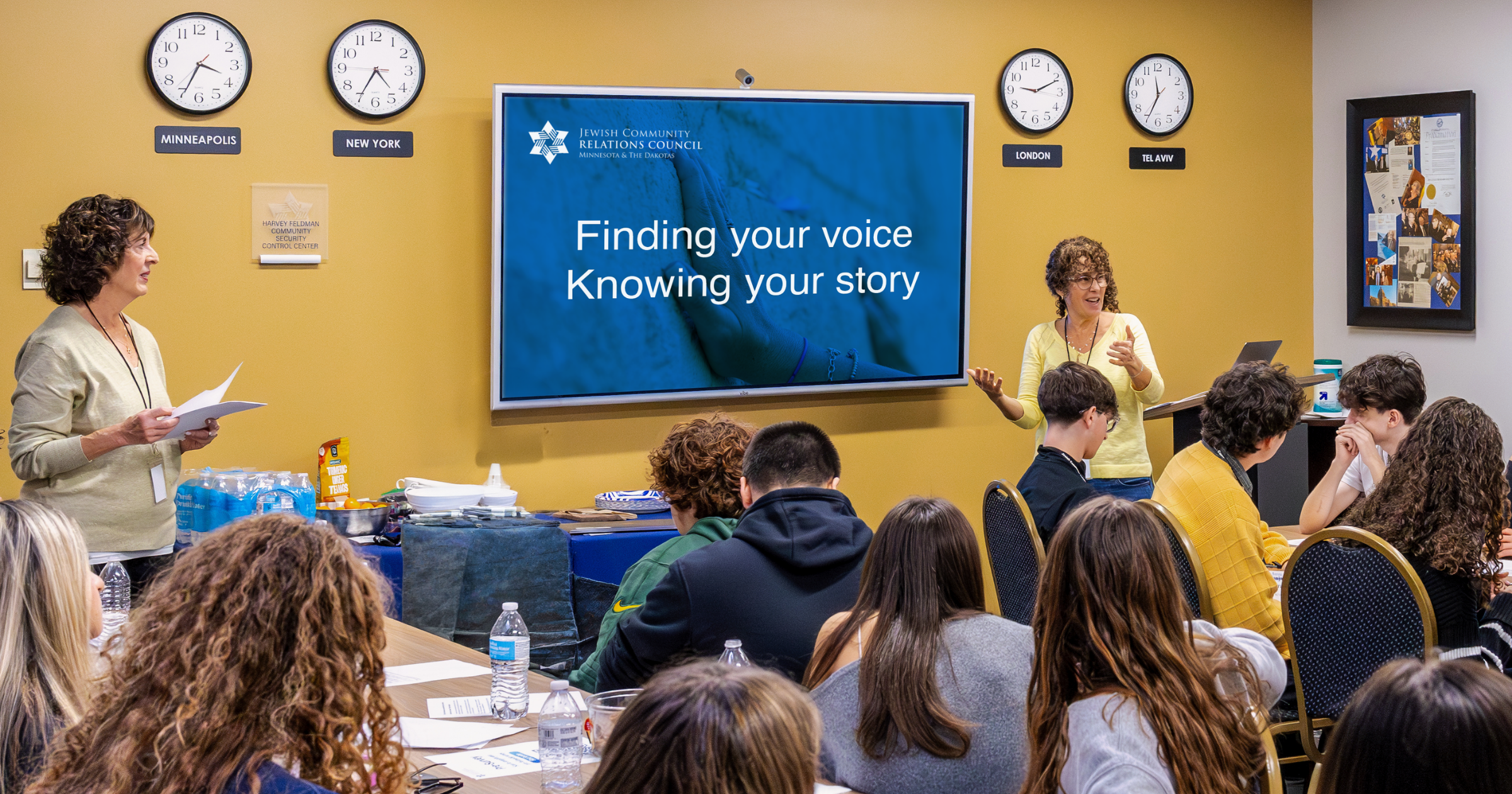
Sally Abrams and Holly Brod Farber spend most of their days in classrooms—300 different classes a year, on average—which is remarkable considering they aren’t teachers but are Jewish communal professionals working at the Jewish Community Relations Council of Minnesota and the Dakotas. The two women, both Hadassah members, spend their working lives giving students in non-Jewish public and private high schools a very basic introduction to Jewish civilization. It’s a maverick task, not just because there aren’t many Jews on the prairie, but also because almost no one else is doing it. And they’ve been doing it for over 20 years.
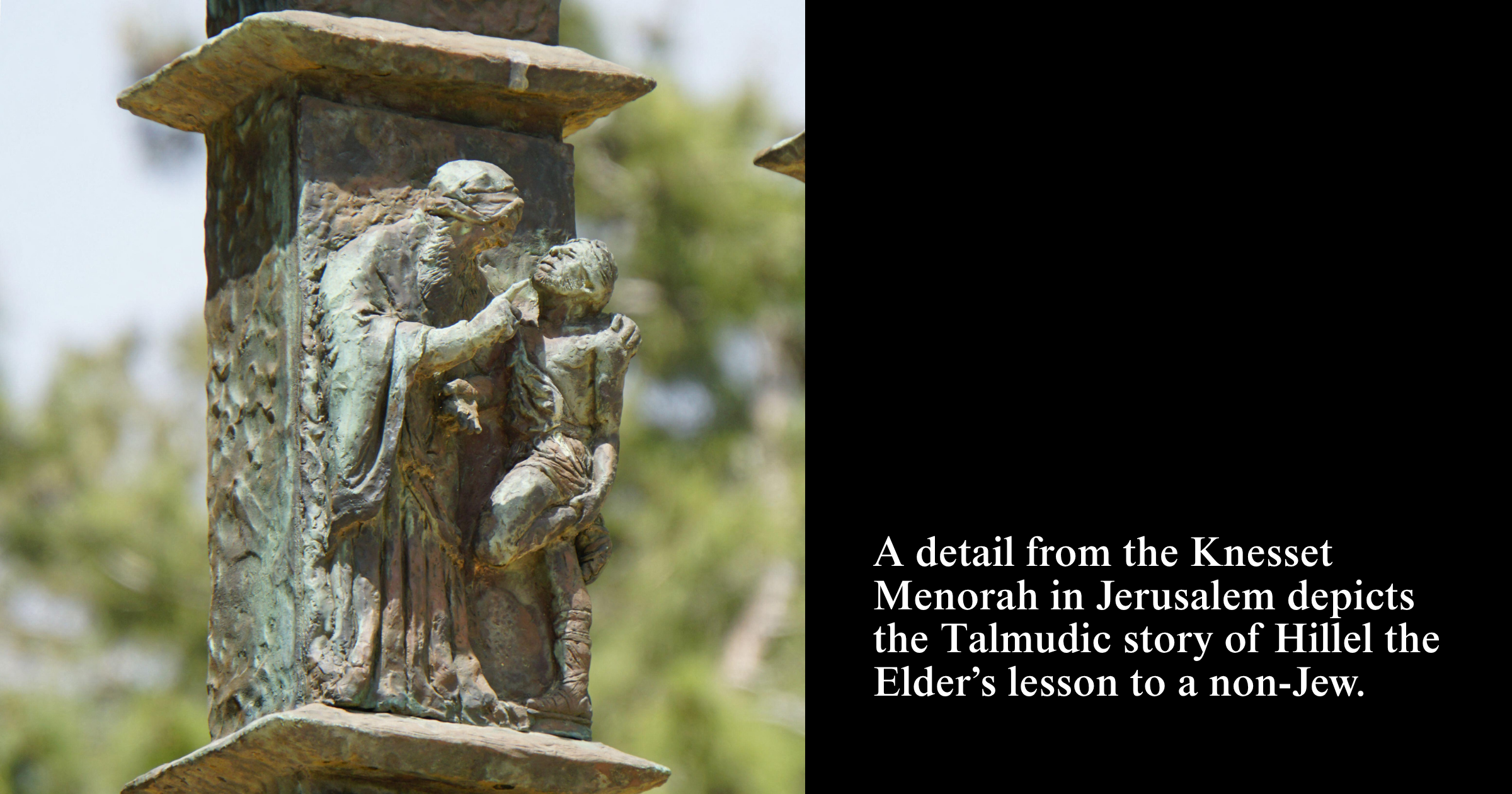
Their one-hour presentation is titled “Judaism on One Foot,” named after an ancient Talmudic story about a non-Jew who knocked on the doors of two rival rabbis, asking each one to teach him the entire Torah while he balanced on one foot. The first rabbi refused to respond, insulted by the idea of reducing a complex tradition to a one-liner. The second rabbi, Hillel the Elder, had an answer: “What is hateful to you, do not do to your neighbor. That is the entire Torah. The rest is commentary. Now go and learn.”
What do they say during those 60 minutes on one foot?
“It’s really simple,” Abrams explained. “It’s just a positive and engaging presentation about who Jews are. We begin and end with Jewish peoplehood, including Israel and Zionism. We talk about Torah, holidays, Hebrew, the local and global Jewish community, the diversity and variety of Jewish life. That’s honestly it.”
One problem is that schools often want them to focus on antisemitism, which they find counterproductive. “We have to be really careful,” Brod Farber pointed out, “because we don’t want to introduce stereotypes that students may not even have heard yet. There are so many ways to do it wrong.”
In one Catholic school in a Minneapolis suburb, I watched Brod Farber dive directly into a description of Jewish peoplehood, sharing photos of her own racially diverse friends and family in Israel and noting that many American Jews, including those in the Minneapolis area, had friends, family or other personal connections to Israeli society.
Brod Farber shared simple timelines, explaining how Jewish tradition preceded Christianity and Islam by more than a thousand years. She posed the question: What percentage of people on the planet are Jewish? Student guesses ranged from 10 percent to 20 percent. The answer is 0.2 percent.
“There are two reasons why this number is so small,” Brod Farber said. “First, Jews do not try to convince others to become Jewish. If people want to become Jewish, they can, but that’s their personal journey, not something
we seek out. The second reason is harder to talk about, which is that people have been killed for being Jewish, throughout history and now.”
She paused. “If you take nothing else home from today, I hope you remember that one of the reasons Jews feel vulnerable is because there are so few of us. And one of the reasons that most Jews throughout the world have a connection to Jews in Israel is because there are just not that many of us in the world.”
At another school where Abrams was presenting, a student asked, “Is Judaism a religion or an ethnicity?”
“Judaism is a specific religion for a particular people,” Abrams said. “I want you to try to free your mind from the categories that are familiar to you, like race, ethnicity or religion. Those are all categories that came into the thought process long after the Jews were already established. Our story is almost 4,000 years old, and we began as a people—a family of families. Jews are a global family. That’s who we are.”
The teenagers took notes as Abrams spoke about Israel, the Hebrew language, about how she chats on the phone every week with the young Israeli woman who stayed in her house in Minneapolis years ago—and how that young woman’s husband was just called up to his reserve unit to serve in Gaza, while she puts their three young children to sleep in their bomb shelter each night because it is too hard to transfer them when missiles are fired at her town with only 40 seconds of warning.
“Israel is not a cause,” Abrams said. “It’s a real place where our friends and family live.”
As I observed Abrams and Brod Farber in classrooms in November 2023, the hostile questions I was expecting never arrived. Instead, the most frequently asked questions, in every type of school, followed a pattern:
“Do you learn about Christianity in your synagogue?” “Do you believe that Jesus is at least a prophet?” “If you separate meat and dairy, does that mean you can’t have a cheeseburger?”
The Middle East was irrelevant, it turned out. The kids mainly cared about Jesus and food.
In a later discussion with Abrams, Brod Farber and other educators, they asked me: If I had one single chance to tell a group of teenagers with no prior knowledge about 4,000 years of an enduring global civilization that had shaped the history of the world, in 60 minutes or less, what would I say?
We spent some time together going through their presentation’s details, tweaking the language, changing the order, swapping out slides, trying out new bullet points—and hit a wall at every turn. That wall, it became stunningly clear, was the immovable fact that they had only a limited time. Yet they had resolved to do the most with what was available to them.
Why, I wondered, were we begging for some upstander teacher or principal to graciously bestow 60 minutes of class time upon us, out of the thousands of instructional hours during seven years of middle school and high school?
These were schools whose leaders claimed to be devoted to “fighting anti-semitism.” Many of them devoted weeks to reading books about the Holocaust. Many more devoted weeks to ancient Greece and Rome, civilizations with no living adherents today. Yet somehow these schools barely managed to find any time at all to spend on the civilization that is the source of the faiths of the majority of living people on the planet, the civilization whose stories of liberty and law inspired the American founders, the civilization that showed the world that freedom and civil discourse are possible—the civilization that is still proving it now.
What might happen if we were to make people curious about that story?
To find out, I founded The Tell Institute to tell that one story to a broad public, including Jews and non-Jews, in non-Jewish middle schools and high schools and in Jewish community settings, too, including b’nei mitzvah cohorts.
My goal wasn’t to create a flood of content, but to do the opposite: to provide an introduction to who Jews are—one that explicitly explained why people were so threatened by the Jews’ refusal to submit to dominant groups, and which alerted and inoculated people against the Big Lie. I wanted to test a hypothesis. My hypothesis was that making people curious about that one story of the Jewish people—not a story about victimhood and generic “hate,” and also not a “heroic” story about triumph, but a story about choices and agency and one very specific and consistent lie—might actually make a difference.
Dara Horn is the author of eight books, including People Love Dead Jews, and the founder of The Tell Institute. This article is adapted from her new book, The Final Solution to the Jewish Question: A Love Story for the Living (Avid Reader Press). Look out for a podcast episode of Hadassah Magazine Presents with the author in October. (Find all HMP episodes wherever you get your podcasts.)
 Facebook
 Instagram
 Twitter

Polly Goldberg says
Bravo! What can WE do, we individual Jews? I would love to tell this story, but how do I, a rural grandmother, find an audience?
Chaya Friedmann says
This is so inspiring.
I teach the Holocaust to 8th graders (Jewish school) and I’ve always been somewhat uneasy that the intense focus on victimhood, though an important history lesson, shortchanges the students, even in Jewish schools, by not focusing at least as much on who the Jewish people are. Thank you – will check out the program.
Jill g says
I’m retired and have curriculum and books for grades 6-10. Would anyone know a school or teacher who would like these materials?